Beyond the Tiger: What Tipu Sultan’s Life Can Teach Gen Z
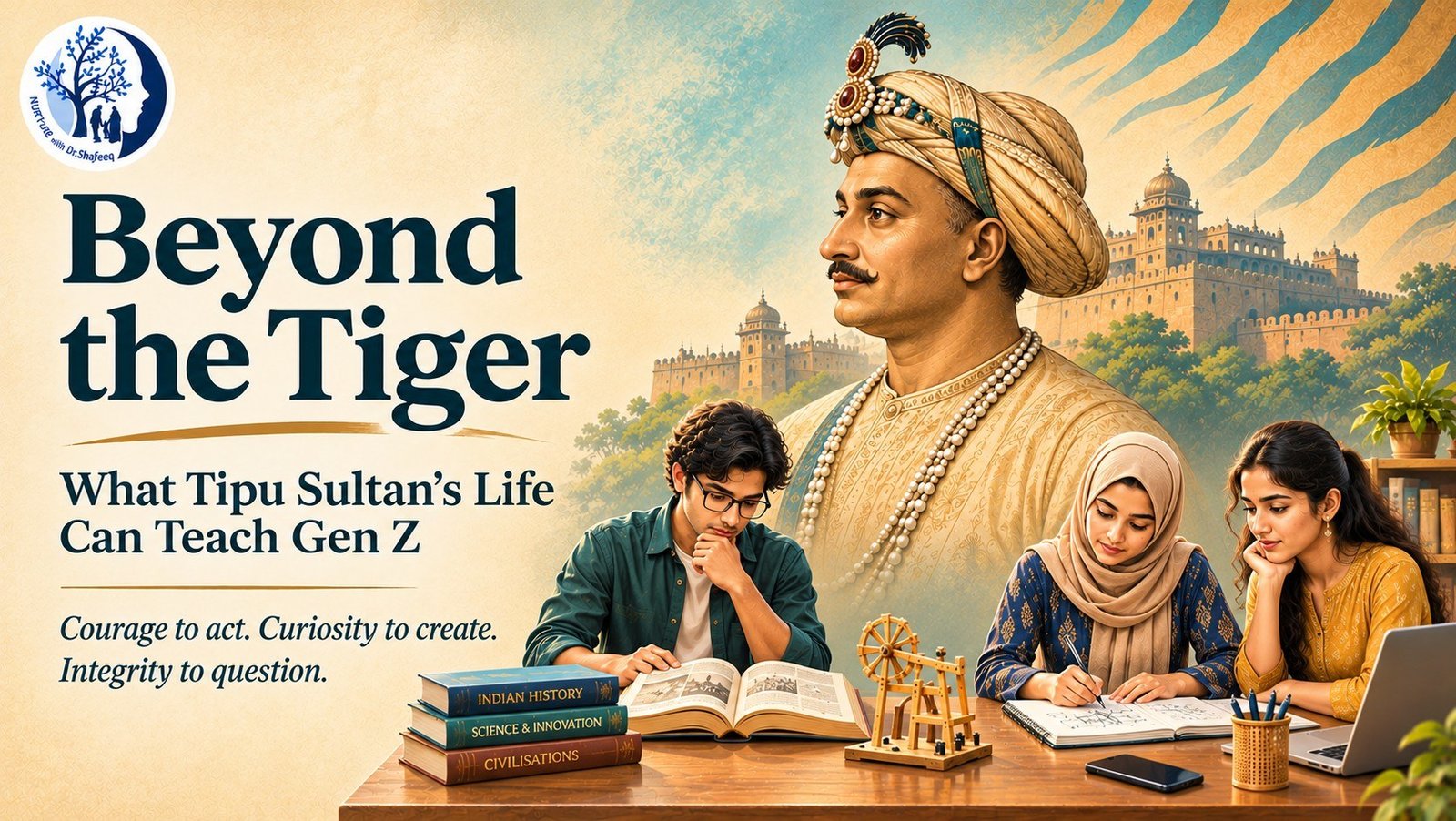
Beyond the Tiger: What Tipu Sultan’s Life Can Teach Gen Z
Courage to stand firm, curiosity to innovate, and maturity to question.
By Dr. Shafeeq Ahmed
It is easy to admire courage when it belongs to someone in a history book. It becomes harder when courage asks something of us: admitting a mistake, refusing a dishonest shortcut, or continuing to learn when progress feels painfully slow.
As commemorations of Tipu Sultan’s birth approach, there is an opportunity to look beyond familiar portraits and slogans. The occasion can become an invitation to study his life thoughtfully—not merely celebrate his name.
The eighteenth-century ruler of Mysore is remembered for resisting the British East India Company, supporting military innovation, and introducing administrative changes. His religious patronage included Hindu temples and the Sringeri monastery, alongside Muslim institutions. His record also includes coercion and harsh treatment during campaigns, with historians debating the extent, motivations, and interpretation of particular actions.
Understanding him requires examining these strands together, rather than allowing any one of them to stand for the whole.
We do not need to turn a historical figure into a flawless hero to recognize achievement. Nor do we need to dismiss achievement to examine wrongdoing.
The purpose of remembering the past is not to stop thinking. It is to think more deeply about how we should live.
Courage Beyond the Fierce Image
Tipu Sultan’s resistance to the East India Company ended with his death during the assault on Seringapatam on 4 May 1799. His military career belongs to a world very different from ours. For young people today, its relevance need not be a romantic attraction to conflict.
It can prompt reflection on the quieter courage to take responsibility.
You may need courage to tell your family that you require help. To refuse cheating when others call it practical. To challenge bullying without becoming cruel yourself. Or to begin again after a result that has shaken your confidence.
These are contemporary reflections, not teachings quoted from Tipu Sultan. They remind us that bravery does not always announce itself. Sometimes it is simply doing the right thing when an easier option is available.
Courage also needs judgment. Standing firm is not the same as refusing feedback. Changing your approach after careful reflection can be a sign of maturity, not weakness.
You do not have to appear fearless. You need enough honesty to recognize your next responsibility—and enough resolve to act on it.
Learn Widely, Create Usefully
Tipu Sultan’s military innovation was not a story of working in isolation. His forces combined Western military methods with Indian weaponry and tactics. Mysore’s development and deployment of iron-cased rockets under Haidar Ali and Tipu became a notable example of technological adaptation; captured examples subsequently influenced British rocket development. Tipu did not invent rockets—the achievement lay in improving and deploying an existing technology.
For Gen Z, this offers a useful distinction: innovation does not always mean producing something entirely unprecedented. It may begin with understanding what exists, identifying a limitation, and improving it.
A student who makes a learning resource easier to understand is creating value. So is a young programmer building an accessible tool, or a trainee finding a safer way to perform a routine task.
Instead of asking only which new tool to use, consider the problem first. What do you understand? What knowledge do you lack? What small solution could you test? Who could help you improve it?
The constructive lesson is not the glorification of weaponry. It is the importance of curiosity, technical learning, and practical experimentation—directed today towards peaceful human needs.
That requires openness. Your language, faith, or cultural identity need not prevent you from learning from someone different. Nor does learning from others require believing that everything local is inadequate.
Read beyond familiar circles. Ask experienced people how they work. Study another language. Learn the principles behind a technology rather than merely copying its output.
Being rooted in your identity need not limit your curiosity; it can give you the confidence to learn from others.
Look Beyond the Battlefield
A ruler’s work is not confined to war. Tipu also introduced changes to coinage, the calendar, and revenue administration. These initiatives widen the historical picture beyond the familiar image of the warrior. Their purposes and effects deserve examination, rather than an assumption that every change was beneficial simply because it was new.
For young people, the contemporary lesson is practical: an idea needs a workable structure.
A student initiative needs clear responsibilities. A business needs reliable records. A community project needs a budget, realistic commitments, and follow-through.
It is tempting to admire the person who makes a bold announcement. Less attention goes to the person who checks the figures, coordinates the team, notices a problem, and ensures that the work continues.
Yet useful progress depends on both initiative and organization.
Ambition attracts attention. Systems help turn it into sustained work.
Turn Ambition into Preparation
Admiration often settles on dramatic moments. Our own progress, however, usually depends on less visible effort: learning, organizing, practicing, and correcting.
That is worth remembering when your screen seems filled with other people’s achievements.
Wanting a scholarship is not the same as preparing a strong application. Wanting to become an entrepreneur is not the same as understanding a customer’s problem. Wanting to serve society is not the same as listening carefully to the people you hope to help.
Begin with something manageable. Complete one practice exercise. Seek feedback on one draft. Investigate one genuine need before announcing a large project.
You do not need to appear impressive today. You need a next step that makes tomorrow’s work more possible.
Preparation also includes knowing when to rest and when to seek support. A meaningful life is not a competition to remain constantly busy. Make room for your health, relationships, and responsibilities alongside your ambitions.
Let ambition become a commitment to useful work—not a permanent feeling that you are falling behind.
Recognize Complexity Without Losing Moral Clarity
One revealing episode in Tipu Sultan’s religious patronage concerns the Sringeri monastery after it was plundered in 1791. Correspondence between his court and the Shankaracharya records assistance for its recovery. This evidence matters because it challenges a portrayal of his rule defined exclusively by religious hostility.
Supporting a religious institution does not automatically absolve a ruler of wrongdoing. Equally, evidence of wrongdoing does not justify ignoring documented patronage or reducing an entire reign to a single motive.
Historical context can help explain conduct without automatically justifying it.
Most importantly, one ruler’s conduct should never become a verdict on a religion or on people living today.
For Gen Z, the lesson extends well beyond this particular debate: learn to hold more than one relevant fact in view without surrendering your concern for justice.
Question the Story—Including the One You Like
Historical sources also have histories.
Some influential accounts of Tipu were produced by people connected with the British campaigns against him. Historians have questioned how political interests shaped particular descriptions. That does not make every criticism false; it makes careful comparison and corroboration necessary.
The same discipline must apply to admiring accounts.
A story does not become reliable simply because it makes us proud.
A flattering quotation may be misattributed. A dramatic post may omit context. A confident claim may rest on a source that says something much more limited.
Before sharing a historical claim, ask:
Who produced this account, and when?
What evidence supports it?
Does it distinguish documented events from interpretation?
Do other credible sources corroborate it?
What important evidence might be missing?
Neither admiration nor dislike should decide the answer in advance.
The willingness to question a story you enjoy is not disloyalty. It is intellectual maturity.
Let Admiration Remain Accountable
Strength can command attention. It should not be allowed to silence judgment.
Courage without restraint can harm. Intelligence without compassion can exploit. Leadership should be examined not only through victories, but through consequences for people.
That standard should apply consistently—to rulers we admire and those we criticize.
For a young person, this means asking more than, “Was this leader powerful?”
Ask, “How was that power used? Who benefited? Who suffered? What can I responsibly learn?”
You can appreciate resistance to colonial expansion without romanticizing every exercise of royal power. You can recognize technological achievement without glorifying war. You can examine injustice without assigning collective blame.
Fairness does not require an equal number of compliments and criticisms. It requires giving claims the weight their evidence deserves.
Make Remembrance Meaningful
A meaningful anniversary activity could be a reading discussion, a visit to a historical site, or a small research project comparing reliable accounts.
A student group might examine how technologies develop through adaptation and exchange. Another might explore how a ruler’s image changes across textbooks, museums, family memories, and political speeches.
Interest in innovation could also become a peaceful project addressing a local need: an accessible study guide, a water-saving idea, a digital resource in a regional language, or a practical improvement suggested by the people who would use it.
The aim is not to borrow a ruler’s grandeur. It is to become more responsible with our own abilities.
History becomes useful when it helps us ask better questions:
What deserves my courage?
What do I need to understand more carefully?
How can my skills serve someone beyond myself?
Beyond Admiration, Towards Responsibility
We do not need to fight yesterday’s battles to live courageously today. We need to meet today’s responsibilities—with honesty, preparation, curiosity, and respect for others.
The past should deepen our understanding of one another, not become a reason to distrust people who share our present.
Let remembrance lead beyond admiration: towards something learned carefully, something created usefully, and someone treated more justly.
What is one responsibility you could approach with greater courage, curiosity, or fairness this week?
NurtureWithDrShafeeq
Nurturing relationships, learning, and a fresh perspective.

Dr. Shafeeq Ahmed S.M
Pediatrician, child psychologist, parenting coach, and career & life counsellor with over 20 years of experience. Read full bio →