Poverty Beyond the Purse
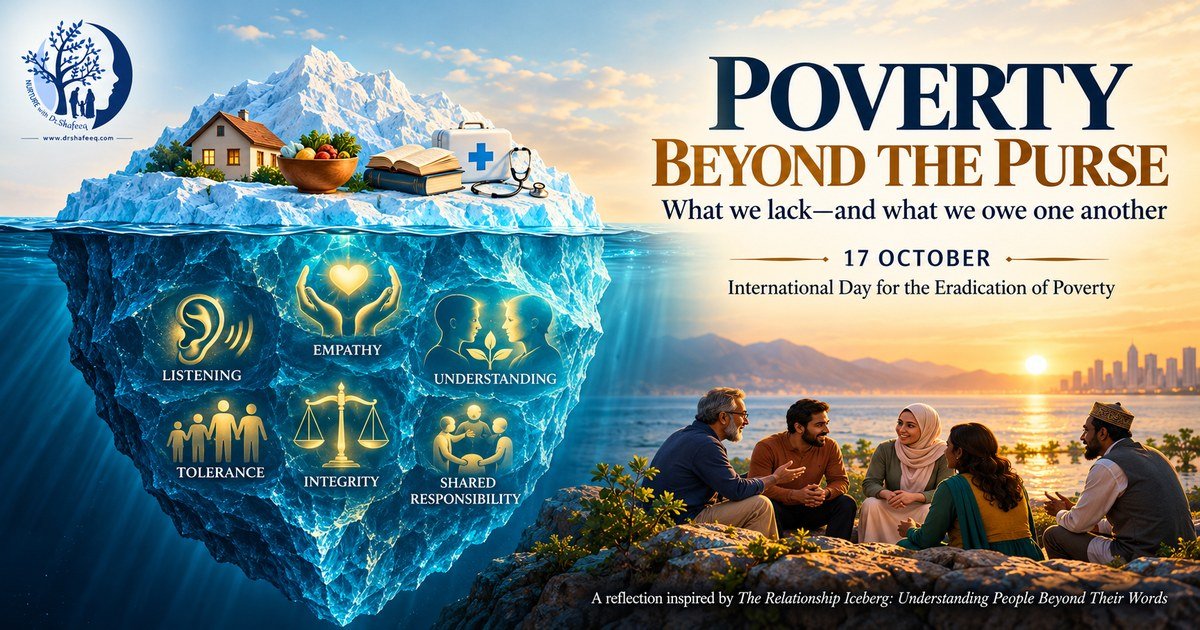
Poverty Beyond the Purse
What we lack, and what we owe one another
17 October | International Day for the Eradication of Poverty
Dr. Shafeeq Ahmed
There is a particular silence that poverty carries. It is the silence of a child who stops asking for a new notebook because she already knows the answer and of a mother who postpones her own treatment again and again because something else is always more urgent.
Every year on 17 October, the world observes the International Day for the Eradication of Poverty, a call to confront deprivation and uphold human dignity. It also invites a more personal question: not only how wealth is shared among us, but also how we see and treat one another.
First, the poverty we can touch
Material poverty must remain at the heart of this conversation. Hunger, unsafe housing, untreated illness, and children shut out of classrooms are not problems that kind words can solve. The global Multidimensional Poverty Index rightly measures overlapping disadvantages in health, education, and living standards, because a family short of money is often also short of clean water, a nearby clinic, and a school that will keep its children.
Yet this day asks us to look deeper. What becomes of a society that has resources but lacks understanding, empathy, tolerance, or integrity? Here, poverty is a metaphor for our collective shortcomings, never a judgement on people living with hardship. A lack of money does not mean a lack of character, and wealth offers no guarantee of moral wisdom.
The poverty of understanding
We grow poorer every time we judge people before we understand them: when we dismiss hardship as laziness, mistake disagreement for hostility, or assume our own life explains everyone else's.
In my book, ‘The Relationship Iceberg: Understanding People Beyond Their Words,' I return to a simple image. Like the tip of an iceberg, a person's words reveal only part of their story. Beneath lie experiences, fears, hopes, and pressures we cannot see. The man who seems rude at the counter may not have slept for two nights. So before reaching a verdict, we might ask, what have I not yet understood? Truly listening to people in hardship means treating them as partners in finding solutions, not as objects of sympathy.
The poverty of empathy and tolerance
Empathy becomes impoverished when our concern stops at the edge of our own circle. Whose struggles go unnoticed in our own cities? Does distance, language, or identity make another person's suffering easier to scroll past? Human worth should never depend on familiarity.
Tolerance means room to disagree without humiliation and to challenge ideas without dehumanizing people. It does not mean accepting abuse, discrimination, or violence; it means holding firm principles while honoring equal dignity. The same holds between nations: disagreement need not become contempt for entire populations.
The poverty of integrity and responsibility
We should be wary of any idea of success that celebrates wealth without asking how it was earned, whom it benefits, and who bears its cost. Prosperity needs a moral compass of honesty, fairness, and accountability. Institutions must deliver fair, accessible services, businesses must remember the people their decisions touch, and each of us must examine the standards we practice, not only those we demand of others.
Turning compassion into practice
Empathy is no substitute for food, education, healthcare, decent work, or social protection. Its value lies in helping us pursue them with respect rather than prejudice so that help arrives without humiliation. A meaningful response joins practical action with a change of heart: support fair opportunities, listen before deciding what others need, challenge dehumanising language, and make honesty part of everyday conduct. Pay wages fairly and on time. Speak to every worker with respect. Ask a struggling colleague how they are, and wait for the real answer.
A richer question for a poorer world
On this 17 October, let us ask not only how much we possess but also what we are failing to provide and whom we are failing to understand. We cannot end deprivation through understanding alone, but we must never let indifference decide whose deprivation matters. A truly rich society is one in which every person has the means to live and is heard, respected, and treated with dignity.
That kind of wealth begins not in our purses, but in our hearts.
www.drshafeeq.com
Dr. Shafeeq Ahmed S.M
Pediatrician, child psychologist, parenting coach, and career & life counsellor with over 20 years of experience. Read full bio →