The Language Without Words
The Language Without Words
What my father's silent circle of friends knew about being human and what our educated world seems to have forgotten
Dr. Shafeeq Ahmed
My father never spoke a word in his life. He was born deaf, and the world of sound was never his. He had no formal schooling, no certificates to frame, and no degree to mention at family gatherings. What he had were two remarkably skilled hands and a quiet, stubborn dignity. He was a fine tailor, and later he worked as a mechanic on the lock systems of heavy metal lockers, those cold steel cabinets that kept other people's valuables safe. I sometimes think he was a keeper of trust long before I understood what trust meant.
As a child, I saw his world only from the edges. Today, decades later, and standing in a very different India, I find myself returning to it again and again, because I have come to believe it held a lesson our generation badly needs to relearn.
A Living Room Full of Silence, and Not a Trace of Division
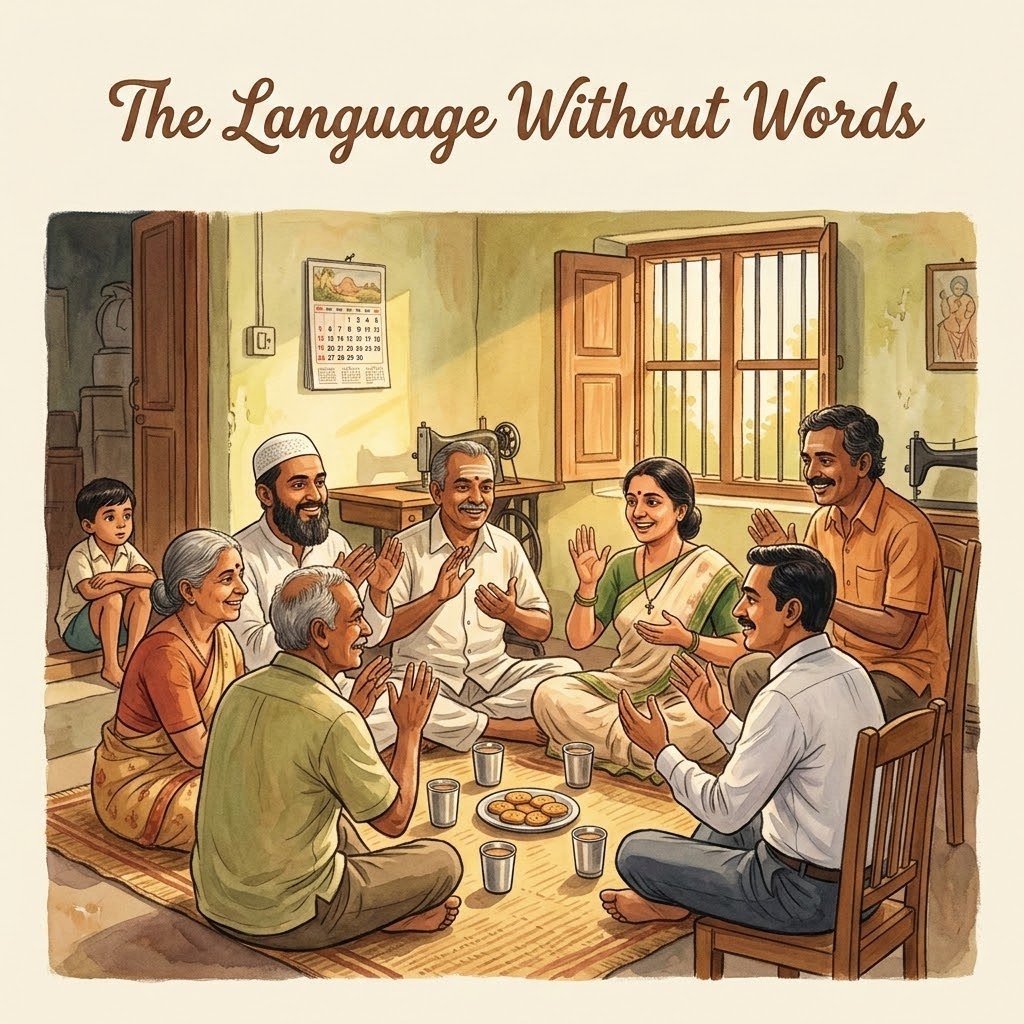
There was a state association for the deaf, and in our town, there was a small local group that belonged to it. Every so often, its members would gather in one of their homes, taking turns as host. Tea would be poured, plates of biscuits passed around, and then the room would come alive. Not with voices, but with hands. Fingers flying, faces animated, eyebrows rising and falling, laughter that was felt more than heard.
To a small boy, it was simply what grown-ups did. Only now do I see what was really happening in those rooms.
The men who sat together came from different faiths. Hindus, Muslims, Christians, etc. Different castes, different incomes, different shades of skin. Some had steady jobs in large companies; some, like my father, lived from one piece of work to the next. And yet, in all those years, I never once sensed that anyone in that circle measured another by religion, community, color, or status. Their shared silence had made them family. Their first identity was not what they worshipped or where they came from. It was that they understood each other's struggle in a world that did not always make room for them.
The Man from the Paper Mill
There was a period when my father was without work. For a family that lived on what his hands could earn, those were anxious days, though as a child I understood little of it.
The office holder of that association was an upper-caste Hindu gentleman who worked at the paper mill in Dandeli. He had no obligation to us. There was no shared temple or mosque, no family tie, and no favor to return. Yet he took it upon himself to help my father find a job at Mysore Kirloskar. He made the effort, used whatever influence he had, and opened a door that changed the course of our household.
He did not ask what my father's name signified. He did not weigh what community he belonged to. He saw a fellow member who was struggling, a man who was skilled and willing, and he acted. That was all. That was everything.
I did not thank him properly then. I was too young to grasp what he had done. I write these words partly as a long-overdue thank you.
Looking Back in a Changing Climate
Today, when I look around, my heart is heavy. We live in an age of extraordinary education. Our children carry more computing power in their pockets than entire institutions had a generation ago. We hold degrees, speak several languages, and can reach anyone in the world in a second.
And yet we seem to understand each other less.
We are quicker to label than to listen. A name, a dress, a festival, and a food habit is enough for some to decide who is worthy of their kindness and who is not. Social media, which promised to connect us, has too often become a marketplace of outrage. Neighbors who once shared tea now share suspicion.
In some honest moments I have felt that I am among the less fortunate, the less privileged, the less educated compared to those silent men and women of my father's circle. Even animals seem to understand one another's distress better than many of us do. A herd will slow down for an injured member. A flock will circle back. We, the so-called intelligent species, often walk past.
So I keep asking myself the question that perhaps you are asking too. Where have we gone wrong?
Is It an Education System Without Values?
We have built an education that trains the mind brilliantly and leaves the heart largely untouched. Children are ranked, graded, and pushed into a race where the person beside them is a competitor, not a companion. We teach them to solve equations, but rarely to sit with someone different from themselves and truly understand their life.
My father's friends never studied ethics in a classroom. They learned it the hard way, through exclusion and struggle, and it made them gentle with one another. When education produces achievers who lack empathy, it is not that education has failed to teach. It is that we stopped asking it to teach the most important things.
Moral science periods, service projects, interfaith friendships, and real conversations about kindness—these cannot be treated as optional extras squeezed in after the syllabus is done. They are the syllabus of a humane society.
Is It Parenting That Has Lost Its Way?
As a pediatrician and a child psychologist, I must say this gently but honestly. Children do not learn values from what we say. They learn them from what we do and from what we quietly allow.
When a child hears a parent speak with contempt about another community at the dinner table, no textbook can undo that lesson. When a child sees us help only our own, they learn that compassion has borders. When we are too busy, too tired, too absorbed in our own screens to model patience and generosity, the screens step in to raise them instead, and the screens are rarely kind teachers.
My father could not speak a single word to me about tolerance. He did not need to. I watched him share tea with people of every faith, and I watched a man of another faith come to our rescue. That silent example has stayed with me for a lifetime. Our children are watching us in the same way. The question is what they are seeing.
Is It a Lack of Political Will?
It would be dishonest to ignore the larger climate. When division becomes useful, some will always be tempted to use it. When people are sorted into groups for convenience, the bonds between those groups begin to weaken. Leaders and institutions at every level carry a responsibility to protect the shared spaces where people of different backgrounds can meet, work, and trust each other.
But I have also learned that we cannot wait for policy alone to repair what we have allowed to fray in our own homes and streets. The man from the Dandeli paper mill did not wait for a government scheme to tell him to help my father. Harmony was not handed down to that little association from above. It was built from below, cup of tea by cup of tea.
Perhaps It Is All of These and Something More
If I am truthful, I believe the answer is not one single failure. Our education, our parenting, and our public life have all drifted toward the same quiet belief, that success is personal and that other people's struggles are not our business.
My father's friends had less of everything the world measures and more of the one thing it cannot. They had what I can only call a shared heart. Perhaps it was their own experience of being overlooked that made them so attentive to each other. They knew what it felt like to be unheard, and so they made sure that no one in their circle ever was.
We, with all our voices, have perhaps forgotten how to truly listen.
What We Can Still Do
I do not write this out of despair. I write it because I have seen, with my own eyes, that a better way of living together is entirely possible. It existed in ordinary homes, among ordinary people, without fanfare.
We can begin by opening our own homes the way those men and women did. Invite a neighbor of a different faith for tea. Let our children see that friendship. Let them hear us speak of other communities with respect, not suspicion. Let schools give as much weight to kindness as to marks. Let each of us, when we have some small power to open a door for someone, do it without first asking what name they carry.
And let us teach our children the language my father spoke so fluently, the language without words. It is the language of noticing when someone is struggling. Of sitting beside them. Of helping simply because they are human.
My father has given me many things, but this may be his greatest gift. He showed me that the deepest understanding between people does not need a common tongue, a common faith or a common status. It needs only a willing heart.
May we find ours again.
If this story stirred something in you, share it with someone who needs to hear it, and tell me in the comments about a person who showed you kindness that crossed every boundary. Let us keep these stories alive for our children.
www.drshafeeq.com
Dr. Shafeeq Ahmed S.M
Pediatrician, child psychologist, parenting coach, and career & life counsellor with over 20 years of experience. Read full bio →