When Science Advances, Must Humanity Fall Behind?
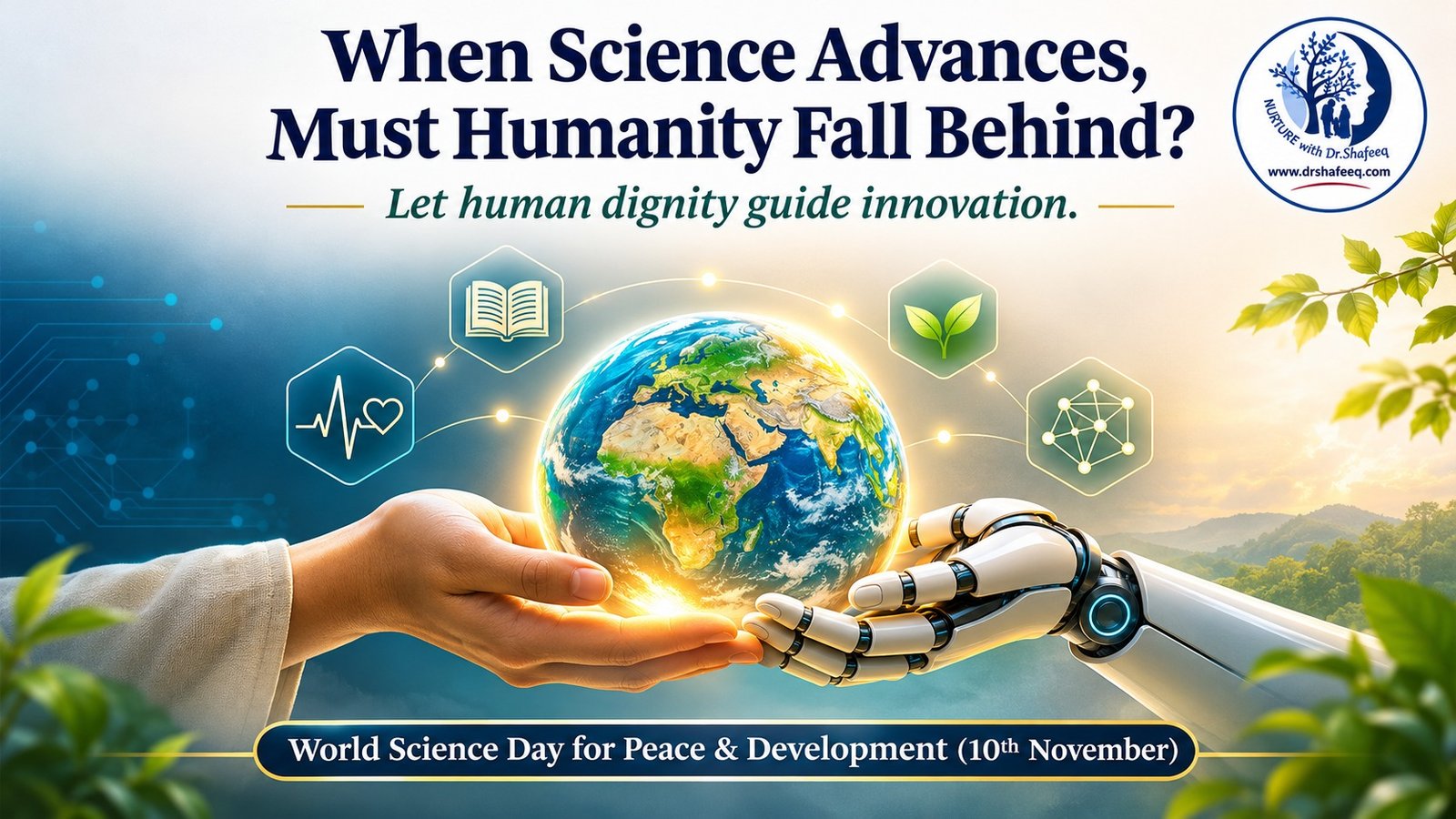
When Science Advances, Must Humanity Fall Behind?
A World Science Day reflection on progress, power, and the conscience that must guide innovation
By Dr. Shafeeq Ahmed
A machine can become more intelligent without the world becoming more humane.
That is the uncomfortable thought we must confront on World Science Day.
Science and technology offer extraordinary possibilities: better diagnosis, more accessible learning, stronger disaster preparedness, and new ways to address environmental challenges. Yet the same expanding capabilities raise concerns about discrimination, surveillance, manipulation, and the use of increasingly autonomous weapons. The promise and the danger exist together.
Watching global events, it is understandable to ask: Have we become better at developing powerful tools than at deciding how they should be used?
This is not an argument against science. It is an argument against confusing technical achievement with moral progress.
The question is not whether humanity needs science.
The question is whether we are willing to take responsibility for the power it places in our hands.
The Words We Must Not Forget: “For Peace and Development”
Observed on 10 November, the occasion’s full name is World Science Day for Peace and Development. UNESCO established its purpose around the relationship between science and society, public participation, and the contribution of knowledge to peaceful and sustainable communities. The 2026 theme, “Common ground through science diplomacy,” reinforces that connection.
Those words—peace and development—are not decorative additions.
They give scientific progress a direction.
A discovery may be remarkable. A machine may be efficient. A system may outperform its predecessor. But none of these facts, by itself, tells us whether the outcome is just.
We must also ask:
Who benefits? Who bears the risks? Who decides? And who can challenge a decision when something goes wrong?
A celebration of science becomes incomplete when admiration for its capabilities replaces examination of its consequences.
Science Explains What Is Possible. Ethics Asks What Is Acceptable.
Scientific inquiry helps us understand how the world works. Technology turns knowledge into practical capability. Ethics asks what we ought to do with that capability—and what limits we must respect.
These are connected responsibilities, but they are not interchangeable.
Knowing how to build something does not establish a moral right to deploy it.
A technically accurate system can still serve an unjust purpose. An efficient process can still exclude people. A profitable innovation can still impose unacceptable costs on those who never consented to its use.
Nor is it sufficient to say that technology is neutral and only its users matter.
Choices about what to research, whose data to collect, which risks to tolerate, and whose needs to prioritize shape a technology before it reaches the public. UNESCO’s AI ethics framework accordingly addresses the entire life cycle of a system—from development and design to deployment and use.
Responsibility begins long before someone presses a button.
When Human Suffering Becomes a Technical Problem
The ethical questions become especially urgent in warfare.
Debates over autonomous weapons concern systems that, once activated, can select and attack targets without further human intervention. UNESCO’s work on robotics ethics has stressed the need to retain human control over weapons and the use of force.
At stake is more than whether a machine can identify an object correctly.
A human life cannot be reduced to a classification task.
An assessment of a weapon’s performance must not distract us from questions of civilian protection, accountability, and the legitimacy of its use. Nor should distance from a battlefield become distance from responsibility.
The phrase “precision technology” should never end the ethical discussion. Precision describes an aspect of technical performance; it does not, by itself, settle whether an action is lawful or morally defensible.
The standard must remain consistent: civilian dignity does not change with nationality, religion, ethnicity, or political allegiance.
If our concern for suffering depends on whose suffering it is, the failure is not scientific. It is ours.
Artificial Intelligence Needs Human Accountability
Artificial intelligence makes the tension between benefit and harm particularly visible.
UNESCO identifies opportunities in healthcare diagnosis and treatment, personalized learning, and cultural preservation. It also warns that AI can reproduce and amplify bias, threaten human rights, and contribute to environmental harm.
This is why the debate should not be reduced to enthusiasm versus fear.
The more useful distinction is between accountable and unaccountable deployment.
Imagine an automated system influencing whether someone receives a job interview, a financial service, or an important public benefit. The ethical questions are immediate:
Can the affected person understand the decision? Can they correct inaccurate information? Can they appeal? Is there a clearly identifiable institution responsible for the outcome?
“The algorithm decided” must never become a modern way of saying, “No one is responsible.”
UNESCO’s recommendation places human dignity, fairness, transparency, and human oversight at the center of AI governance. These are not obstacles to useful innovation; they are conditions for making innovation worthy of public trust.
Progress for Whom?
An innovation can be impressive and still leave the people who need it most beyond its reach.
A diagnostic tool has limited public value if the communities facing the greatest healthcare barriers cannot access it. An educational platform cannot fulfil its promise if learners lack connectivity, appropriate devices, accessible design, or the skills to use it.
UNESCO’s ethical framework explicitly calls for equitable access to AI’s benefits, with attention to disadvantaged and marginalized populations, different languages, persons with disabilities, and countries with fewer resources.
This suggests a broader measure of success.
We should ask not only, “How advanced is this technology?” but also, “Whose life has it meaningfully improved?”
Access is not an afterthought to progress. It is part of the test.
The benefits of science should not become privileges available only to those who already possess wealth, institutional influence, or technological advantage.
Public Trust Cannot Be Demanded
Scientific institutions rightly want the public to distinguish evidence from misinformation.
But trust cannot rest on authority alone.
It must be supported by transparency about uncertainty, honest communication about limitations, and meaningful responses when harm occurs. UNESCO has emphasized both public engagement in scientific debates and the need to rebuild the relationship between science and society through participation, inclusion, and responsiveness to public concerns.
Questioning a technology’s use is not necessarily a rejection of science.
A patient asking how their data will be used is exercising a legitimate concern. A worker questioning an automated assessment is not inherently resisting progress. A community asking about environmental consequences deserves an answer, not a label.
At the same time, scrutiny must remain disciplined. Claims should be examined through evidence, not accepted merely because they confirm our suspicions.
We need neither blind faith in technology nor blanket distrust of expertise.
We need informed confidence, earned through accountable practice.
Education Must Prepare People to Exercise Power Responsibly
If education celebrates technical ability while treating ethical judgment as optional, it leaves an important part of professional preparation unfinished.
An engineer should be able to ask not only whether a system works, but whom it might harm.
A healthcare innovator should consider not only clinical performance, but patient dignity, consent, affordability, and access.
A business leader should examine not only productivity gains, but how benefits and burdens are distributed.
A policymaker should distinguish a system that is convenient for an institution from one that is fair to the public.
Ethics should therefore not appear merely as a chapter at the end of a technical course. It should be part of how problems are defined, designs are assessed, and decisions are defended.
We need people who can build sophisticated systems—and people willing to say, with sound reasons, “This should not be deployed in its present form.”
Sometimes the most responsible exercise of capability is restraint.
From Ethical Statements to Enforceable Responsibility
Good intentions matter. They are not enough.
UNESCO has warned that industry self-regulation alone is insufficient to prevent ethical harms and has called for accountability and mechanisms of redress.
A credible approach to responsible technology should include:
Assessment before deployment: examine foreseeable harms, affected populations, and whether a less harmful alternative exists.
Independent scrutiny: allow appropriate testing rather than relying entirely on a developer’s assurances.
Meaningful human oversight: give responsible people the information and authority to intervene—not merely the task of approving a machine’s recommendation.
Accessible remedies: enable people to challenge harmful decisions and obtain correction.
Public participation: involve affected communities, not only investors, developers, and officials.
Consistent standards: apply concern for rights and safety regardless of the identity of the developer, government, or affected population.
These principles will not remove every difficult trade-off. They will make it harder to hide those trade-offs from the people who must live with them.
Science Can Still Create Common Ground
The answer to the misuse of science is not less knowledge.
It is knowledge governed more responsibly and shared more fairly.
Science can help societies address challenges that cross borders: disease, environmental degradation, resource pressures, and disasters. UNESCO’s account of science for peace emphasizes its capacity to support practical responses to such shared problems.
That is the promise behind this year’s emphasis on science diplomacy.
Cooperation need not require agreement on every political issue. It can begin with recognizing that certain human needs are not exclusive possessions: safe water, reliable health knowledge, a habitable environment, and protection from preventable harm.
Science diplomacy should not mean overlooking injustice in the name of cooperation. It should mean creating opportunities for cooperation while preserving truth, dignity, and accountability.
The world needs spaces in which evidence can be examined across divisions—and in which another person’s safety is not treated as a threat to our own.
The Real Measure of Progress
On World Science Day, we should celebrate discovery, curiosity, and the patient work of those who expand human understanding.
But we should also ask whether our moral and institutional responsibilities are keeping pace with our inventions.
Are we reducing suffering—or merely becoming more efficient at managing its appearance?
Are we widening opportunity—or concentrating power?
Are we helping people make informed choices—or making them easier to monitor and influence?
Scientific advancement and human progress can move together. They do not do so automatically.
Their relationship depends on the purposes we choose, the safeguards we enforce, and the people whose dignity we refuse to overlook.
The question is not simply how far science can take us.
It is what kind of humanity we intend to take with us.
#NurtureWithDrShafeeq

Dr. Shafeeq Ahmed S.M
Pediatrician, child psychologist, parenting coach, and career & life counsellor with over 20 years of experience. Read full bio →