An Anxious Child Is Not a Crisis
An Anxious Child Is Not a Crisis
Dr.Shafeeq Ahmed
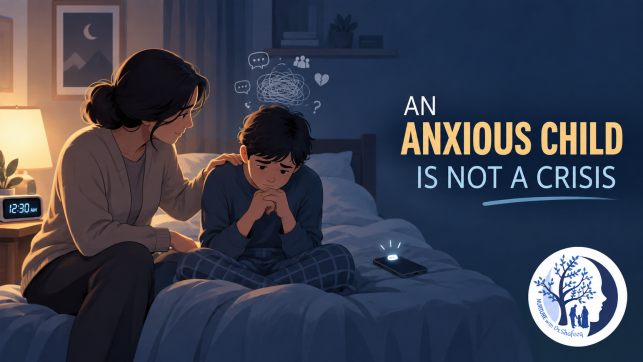
It's past midnight, and your child is supposed to be asleep. The room is dark, the door is closed, and by every visible sign, the day is over. But under the blanket, a small rectangle of light is still on. A group chat is still moving, someone said something, someone else screenshotted it, opinions are forming about who's in the wrong. Your child isn't scrolling for fun anymore. They're monitoring. Their body is tired but their mind is on alert, the way yours might be if you'd sent an email you were now worried about, except this happens most nights, about something new each time, and they're thirteen.
The instinct, when you find them like this, is to confiscate the phone and call it a screentime problem. It's tempting, because the phone is the visible part. But the phone is mostly a delivery mechanism here. What's actually keeping your child awake is something older and more human than any app: a nervous system that hasn't yet learned how to put a worry down.
It's worth saying plainly, before anything else: a child who worries, who gets nervous before a test, who feels stung by a friend's comment, who has trouble sleeping the night before something big, is not broken, and you have not failed them. Worry, stress and sadness aren't malfunctions. They're part of having a nervous system that's paying attention to a world that sometimes matters. The same racing heart before a test that feels unpleasant is the body mobilizing energy and focus. The same wakeful alertness that keeps a child scrolling a group chat at midnight is, underneath the unhelpful trigger, a very old system built to notice threats to belonging and status, because for most of human history, being cast out of the group was genuinely dangerous. Children's brains haven't caught up to the fact that a heated exchange in a chat isn't that kind of threat. That mismatch, more than any personal fragility, explains why something that looks small from the outside can feel enormous from the inside.
It also helps to hold two different meanings of "anxiety" apart, because mixing them up causes a lot of unnecessary parental fear. One is a normal, universal emotion, the tightness before a performance, the churn before a hard conversation. Every child has this repeatedly, and it isn't a problem to fix so much as a capacity to build. The other is a clinical condition, where that same machinery gets stuck in the "on" position so persistently that it interferes with a child's ability to function. Most anxious nights are the first kind, not the second, and reaching for diagnostic language every time a child looks stressed can backfire, teaching a child to fear their own feelings while making it harder for a parent to notice when something has genuinely crossed into needing real support.
Here is the part that actually changes what a parent does about it: children are not born knowing how to regulate a strong feeling. It isn't a personality trait some children have and others lack, and it isn't something they simply grow out of if left alone. It's a skill, built the way any skill is built, mostly in the company of a calmer nervous system than their own. Long before a child can calm themselves down, they borrow calm from an adult, the way a toddler's system settles because a parent's voice is steady and their face is unhurried. This doesn't stop mattering once children get older, it just gets less obvious. A teenager spiraling about something in a group chat is still, underneath the eyerolling and the closed door, taking cues from whether the adults around them treat the moment as a catastrophe or as something survivable. Every time you stay calm next to your child's storm, you are teaching their nervous system what calm looks like and that it's reachable from here. Every time you match their panic with your own, you're teaching the opposite, even if your words are reassuring.
Most stress in a child's life is ordinary, uncomfortable, worth taking seriously in the moment, but not a sign that something has gone wrong. The signal worth actually watching for isn't the presence of worry, it's whether stress has started to shrink your child's life: avoidance that keeps growing, physical symptoms with no medical explanation that persist for weeks, a noticeable drop in functioning at school or with friends. None of these alone is an emergency, but together, persisting for weeks, they're a reasonable reason to bring in a school counselor, a pediatrician, or a child psychologist, the same way you'd see a doctor for a persistent physical symptom rather than waiting it out. And one line deserves plain language rather than a soft approximation: if a child expresses any thought of self-harm or not wanting to be alive, that is never something to handle alone, it warrants an immediate, calm conversation and prompt professional help. Asking a child directly and gently whether they've had these thoughts does not plant the idea. It opens a door that badly needs to be open.
This is the exact ground Chapter 13 of Two Worlds, One Childhood is built on: the idea that emotional regulation isn't taught in a single talk about feelings; it's built unglamorously, in hundreds of ordinary moments across years, mostly through your own steadiness sitting next to their storm, again and again, until eventually they can find that steadiness on their own. An anxious child is not a broken child. And a parent whose child struggles with stress has not failed at parenting; they're simply standing at the exact spot where this particular skill actually gets built.

Dr. Shafeeq Ahmed S.M
Pediatrician, child psychologist, parenting coach, and career & life counsellor with over 20 years of experience. Read full bio →