Only Child or Many Children?
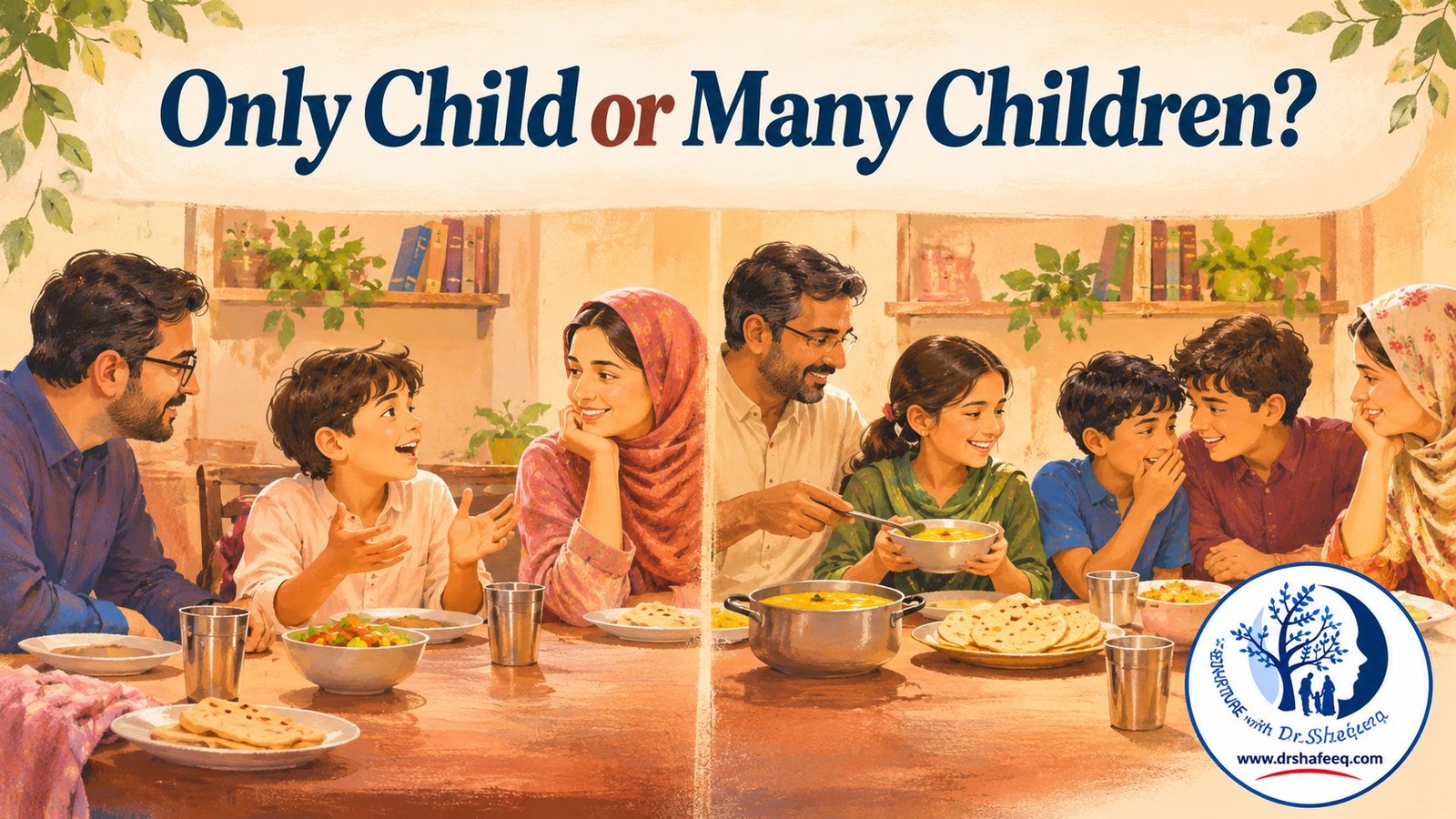
Only Child or Many Children?
What the Research Says About the Right Family Size
By Dr. Shafeeq Ahmed
At almost every family wedding in India, someone eventually asks a young couple with one child, "So, when is the second one coming?" In the opposite corner of the room, an uncle who grew up with seven siblings recalls how they shared one bicycle, one radio and one plate of jalebis, "and we turned out fine." Both are speaking from experience. But is there an answer that goes beyond opinion?
As a pediatrician, I have met thriving only children and struggling ones and thriving children from large families and struggling ones. The question "which is better?" deserves more than nostalgia or modern anxiety. It deserves evidence, honesty and some humility.
The Case for a Bigger Family
Some writers argue that families with four or more children offer something small families cannot. Their points are worth hearing.
Letting go of control. With one or two children, many parents believe they can manage every outcome: the right school, the right tuition, the right hobby. Somewhere after the third child, that illusion fades. Parents simply cannot hover over everyone, so children learn to find their own shoes, solve their own small problems and recover from their own small failures.
Built-in help. In a larger family, the eldest sister helps with homework, the middle brother walks the youngest to school, and responsibility is shared naturally. Anyone who grew up in a busy Indian household knows this rhythm well.
Rough edges smoothed by daily friction. Siblings argue over the TV remote, the window seat and the last piece of mango. Those daily squabbles teach negotiation, patience, apology and compromise. Sharing clothes without a war is a small life skill with big consequences.
Unchosen roommates. Brothers and sisters are the first people we have to live with without choosing them. That, the argument goes, is excellent preparation for hostels, workplaces and marriage.
Siblings over violin lessons. Perhaps the boldest claim is that a sibling is a greater gift to a child than another enrichment class or gadget.
What the Research Actually Says
Several of these ideas have real scientific support, though more modest than enthusiasts suggest.
Siblings help children read minds. A classic study in Child Development found that three- and four-year-olds from larger families were better at understanding that another person can hold a mistaken belief, a key step in what psychologists call "theory of mind". Later work showed that older siblings, adult relatives and other older children also contribute. For Indian families, that is reassuring: grandparents, cousins and neighbors count too.
Siblings and marriage. Using US survey data from 1972 to 2012, Ohio State researchers found that each additional sibling was linked to about a 3% lower likelihood of divorce among adults who married. A later study found a similar pattern, an 11% decline per sibling in China and 2% in Europe. This is an association, not proof that siblings cause stable marriages, but the "unchosen roommate" idea has some backing
Siblings offer early social practice, but only children form friendships too. Among more than 20,000 American kindergarteners, teachers rated only children as having somewhat weaker social skills and self-control. By adolescence, though, only children were named as friends just as often as children with siblings. School, playgrounds and friendships appear to close the gap.
The Case for the Only Child
The other side of the evidence is just as important.
The "lonely, spoilt only child" is largely a myth. A landmark review of 115 studies found only children did as well as or better than others in achievement and intelligence and had especially positive relationships with their parents. Across developmental outcomes, they were indistinguishable from firstborns and children from small families.
Resources do get divided. Parents have limited time, energy and money, and each additional child receives a smaller share. This idea, called "resource dilution", remains a leading explanation for why children with fewer siblings tend to score higher on cognitive tests. However, a large Norwegian study found that once birth order is considered, family size itself has little effect on education. Being born later matters more than how many siblings you have.
More siblings are not always more happiness. In both the US and China, the number of siblings was linked to poorer adolescent mental health. Crowded homes stretched parents and competition for attention can take their toll.
Overprotection is a real risk. A meta-analysis of 53 studies linked "helicopter parenting" with more anxiety and depression and weaker self-regulation in young adults. A small Indian study suggested that parents of single children are more prone to this behavior, but its authors cautioned that larger studies are needed. Policy matters too. Research on China's one-child policy found that people born just after it began were less trusting, less competitive and more risk-averse. That was a government-imposed policy, not a family's free choice, so it should be read carefully.pubmed.ncbi.nlm.nih+2
What This Means for Indian Families
India's average is now about two children per woman, and only 1.6 in cities. The single-child household is quickly becoming normal in urban India, so the real question is how to raise any child well, whatever the family size.
Some families have one child by circumstance, not choice. Infertility, health, loss or finances shape these decisions, and such parents deserve gentleness, not wedding-hall interrogations. A woman's health also matters. The World Health Organization recommends waiting at least 24 months after a birth before the next pregnancy, to protect both mother and baby. A large family built at the cost of a mother's well-being is not a better family.
Wisdom for Every Family
If you have one child:
Create "sibling-like" experiences through cousins, neighbors, sports teams and joint-family weekends.
Let your child lose, wait, share and solve problems without rushing in to rescue them.
Resist the temptation to pour all your ambitions into one young life.
If you have many children:
Guard one-on-one time with each child, even if it is only ten minutes.
Don't overburden older children, especially daughters, with caring for younger ones.
Watch for the quieter child who may be lost in the crowd.
For all families:
Space births sensibly and plan within your means.
Remember that warmth, presence and good values matter more than numbers.
The Verdict
So, which is better? Honestly, neither. Siblings offer a rich, daily school of empathy, negotiation and companionship. Only children often enjoy deep parental bonds and focused support, and most catch up socially by adolescence. Research consistently suggests that how children are raised matters far more than how many are raised together.
A child does not need a particular number of siblings. A child needs to be loved without being smothered, guided without being controlled, and given enough space to stumble, share and grow. Whether your dining table seats three or eight, that is the real measure of a family.
NurtureWithDrShafeeq
Dr. Shafeeq Ahmed S.M
Pediatrician, child psychologist, parenting coach, and career & life counsellor with over 20 years of experience. Read full bio →