Before You Share: Truth, Compassion and Responsibility in Times of War
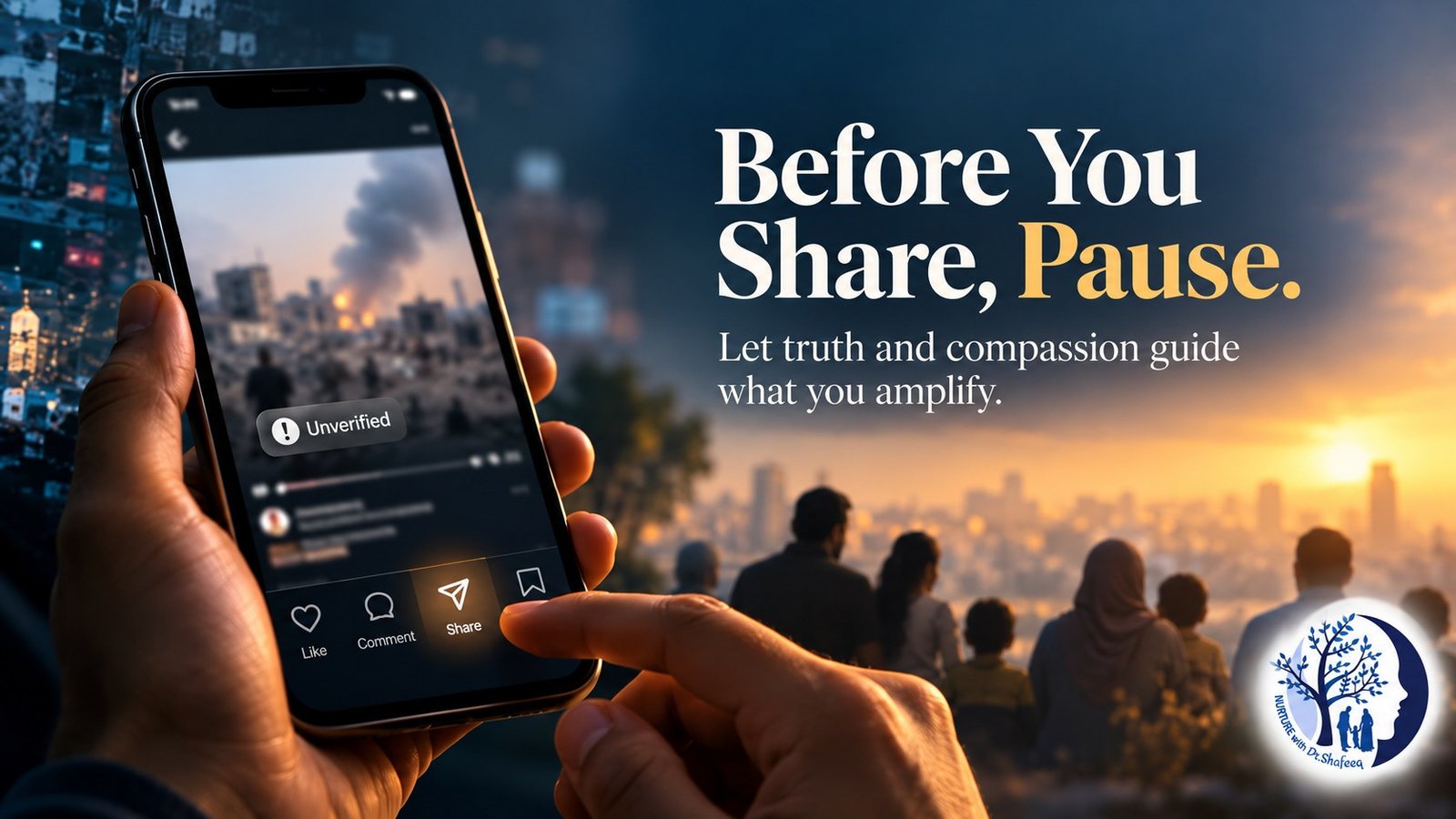
Before You Share: Truth, Compassion and Responsibility in Times of War
Dr. Shafeeq Ahmed
A video arrives in a family group. It appears to show an attack. The caption names an enemy, demands outrage and ends with: "Share before it is deleted."
For a moment, forwarding it feels like an act of solidarity. But what if the footage belongs to another conflict? What if the voice has been altered, the caption invented or the scene digitally generated?
In wartime, the distance between a tap on a screen and harm to another person can be frighteningly short. Our first responsibility is not to share faster. It is to share with care.
When False Information Becomes Human Harm
Technology allows people to document suffering, seek assistance and bear witness across borders. Yet the same digital networks allow misleading information to travel at extraordinary speed and scale. Advances in artificial intelligence create new opportunities for manipulation.
Not every person sharing a falsehood intends to deceive. Some create disinformation deliberately; others pass along misinformation because they believe it is true. That distinction matters when judging intentions, but good intentions do not prevent harmful consequences.
A false report about an evacuation route can put families in danger. A fabricated allegation can expose a community to hostility. Rumors about aid workers can undermine trust and obstruct assistance. The International Committee of the Red Cross warns that harmful information can threaten civilians' safety, dignity and access to essential services.
Behind every "viral story" may be people who must live with its consequences long after the audience has scrolled away.
Compassion Must Not Become Selective
We should ask ourselves an uncomfortable question: would we demand stronger evidence if this story accused people we support?
An ethical commitment to truth must apply across nationalities, religions and political loyalties. We can condemn violence and demand accountability without treating every allegation against an opponent as established fact. We can stand beside victims without turning another population into a collective enemy.
Equally, verification should not become an excuse to dismiss suffering. "This particular video is unverified" does not mean "these people's pain is imaginary." Responsible communication distinguishes between what is known, what is alleged and what remains uncertain.
Human dignity should guide not only whether we share, but how. Before reposting images of injured children, grieving families or the dead, we should consider whether we are informing others or turning someone's most vulnerable moment into a public spectacle. Even authentic content deserves an ethical decision, not an automatic forward.
A Shared Ethic, Illuminated by Islamic Teachings
Islam offers a clear reminder about the relationship between information and responsibility. The Qur'an instructs believers to verify news brought by an unreliable person, lest they harm people unknowingly and later regret their actions (49:6). The emphasis is not merely on avoiding error, but on preventing injustice.
Another verse teaches: "Do not pursue that of which you have no knowledge," connecting hearing, sight and the heart with accountability (17:36). Applied to digital life, this invites humility about what we see, believe and repeat.
These teachings reflect a wider human ethic shared across religious and secular traditions: be truthful, avoid unjust harm and recognize the limits of your knowledge.
For Muslim readers, verification can be understood as a moral responsibility, not simply a technical skill. For everyone, the underlying question is accessible: could my words wrong another person?
A Pause Before Every Forward
We can put that ethic into practice through a few deliberate habits:
Check the source and context. Who originally published the claim? Does the footage establish the date, location and event described, or does only the caption make those connections?
Seek independent corroboration. Look for credible reporting or relevant humanitarian updates. Many accounts repeating one post are not necessarily separate confirmations.
Name uncertainty honestly. Do not present an allegation as a fact. If you cannot establish a claim's reliability, refrain from amplifying it, especially when it concerns someone's identity, safety or evacuation routes.
Protect dignity. Avoid exposing personal details, circulating humiliating images or blaming an entire community for the actions of individuals.
Correct mistakes visibly. If you shared something false, acknowledge the error in the same group or channel. A quiet deletion may leave the original impression untouched.
Let us also correct one another without ridicule. "I checked this, and the footage appears unrelated" is more constructive than "How could you believe that?" The aim should be to stop the falsehood, not to humiliate the person.
Let Truth Be Part of Our Solidarity
Responsibility does not rest with individuals alone. Media organizations, public figures, community leaders and technology companies should make accuracy, transparent corrections and protection from harmful content central to their work.
Still, each of us controls one important point in the chain: what we pass on.
We do not have to choose between compassion and caution. We can care deeply, speak firmly and still say, "I do not know whether this is true."
In times of war, refusing to spread an unverified claim is not indifference. It is a refusal to let another person's suffering become material for manipulation. Truthfulness is one way we protect each other, even from far away.
Dr. Shafeeq Ahmed S.M
Pediatrician, child psychologist, parenting coach, and career & life counsellor with over 20 years of experience. Read full bio →