Beyond Blame: A Compassionate Approach to Cousin Marriage and Genetic Health
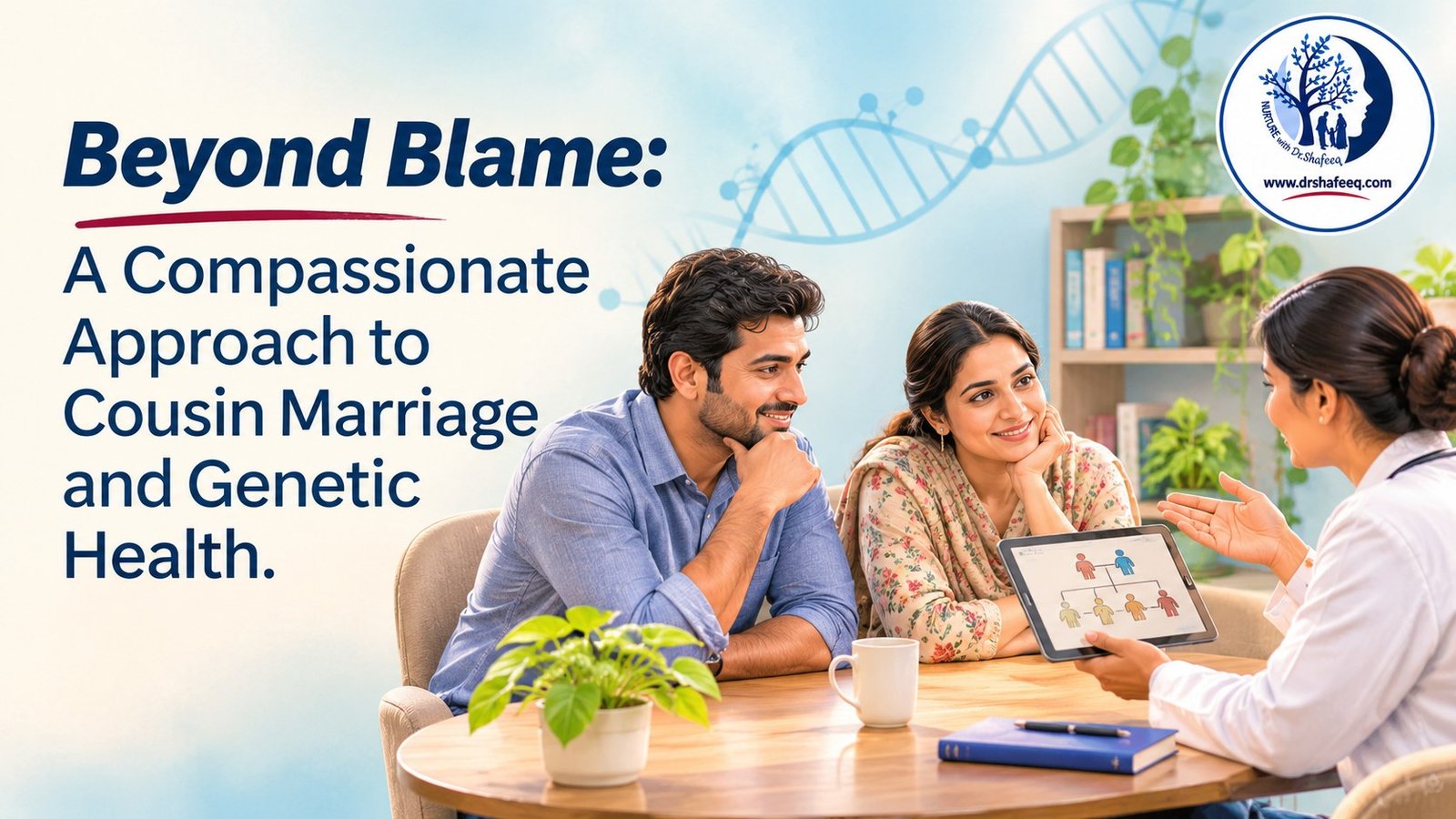
Beyond Blame: A Compassionate Approach to Cousin Marriage and Genetic Health
India’s conversation about marriage between biological relatives should bring science closer to families—not push communities further apart. Responsible journalism, accessible healthcare and respect for human dignity offer a more constructive path than fear or accusation.
By Dr. Shafeeq Ahmed
Behind every public debate about marriage and inherited illness are people whose lives cannot be reduced to a headline: a young person seeking answers about a disability, parents wondering whether they could have known more, and a couple trying to make a responsible decision without hurting those they love.
Their questions deserve honest answers. They also deserve kindness.
Recent Supreme Court proceedings have renewed attention to consanguineous marriage—marriage between people who share biological ancestry—and its potential health implications. According to legal reporting, the Court sought the Union government’s response on possible legislation or wider public education while recognizing marriage as a matter of personal choice. This was not a judicial ban on cousin marriage. That distinction should shape the public conversation from the outset.
India now has an opportunity to discuss a sensitive issue with maturity: acknowledging medical risk without encouraging prejudice, respecting faith without dismissing science, and protecting future children without diminishing the dignity of those already living with inherited conditions.
Begin with science, not suspicion
The medical concern is genuine. Biological relatives are more likely to carry the same recessive gene variant inherited from a common ancestor. When both parents pass on a disease-causing variant in the same gene, a child may develop an inherited disorder. The relevant factor is shared ancestry—not the family’s religion, caste or social standing.
But risk must be explained proportionately.
Clinical guidance commonly describes a background risk of congenital anomalies of approximately 2–3%, with an additional 2–3 percentage points for children of first cousins. These are broad estimates, not predictions for a particular pregnancy. Family history, the degree of relatedness and the presence of a known inherited condition can substantially change an individual couple’s assessment.
A headline saying that risk “doubles” may be mathematically defensible while remaining emotionally misleading if it omits the starting figure. Conversely, saying that most children are unaffected can minimize a meaningful increase in risk.
Responsible communication must explain both.
It must also distinguish an average population risk from the much higher, condition-specific risk that can arise when both partners are confirmed carriers of the same autosomal recessive disorder. For such couples, the usual chance of an affected child is 25% in each pregnancy. That figure does not apply to every cousin couple—and unrelated couples can also share recessive disease risks.
The sensible conclusion is neither panic nor complacency. It is that individual families need individual advice.
Journalism should illuminate, not inflame
Health reporting carries an unusual responsibility: readers may make intimate decisions on the strength of a few paragraphs.
A responsible report should distinguish what a petitioner alleges, what medical evidence establishes, what judges observe during a hearing and what the Court formally directs. A request for the government to examine legislation or awareness measures should not be presented as though a prohibition has already been imposed. The reported proceedings themselves emphasized informed choice and the limits of judicial intervention.
The same care is needed when linking a health issue to a larger political project. A discussion about genetic counselling does not automatically settle the separate debate over a uniform civil code. Readers should be told where the medical question ends and broader legal arguments begin.
Journalists should also resist making an individual’s diagnosis proof of a general claim. A person’s experience can reveal gaps in care and awareness; it cannot replace clinical investigation or population-level evidence.
Most importantly, reporting should not turn a patient into a spectacle. People living with inherited conditions are entitled to tell their stories on their own terms. Their achievements should not be used to minimize their difficulties, and their difficulties should not be used to portray their lives as less valuable.
Good journalism does more than warn. It tells readers what help is available, what a test can establish and where uncertainty remains.
Respect faith while encouraging informed decisions
For many families, marriage is simultaneously a personal, religious and social commitment. Public-health communication will be more constructive if it understands that reality rather than treating faith as an obstacle to overcome.
In mainstream Islamic jurisprudence, cousin marriage is permissible. But permission is not an obligation, and it does not remove the need to consider a particular family’s medical circumstances. Scholarly guidance reviewed for this discussion recognizes the relevance of potential harm and recommends consulting a reliable physician and genetic counsellor before seeking case-specific religious advice.
This distinction creates room for cooperation.
A clinician can explain an inherited risk. A qualified religious scholar can help a family consider the ethical questions raised by the actual findings. Neither needs to displace the other, and neither should override the informed consent of the people concerned.
The same respectful approach should extend to every community: understand the significance of a custom, explain the evidence clearly and avoid treating questions as disloyalty.
Faith-sensitive communication need not dilute science. It can help people engage with science without feeling that their identity is under attack.
Make informed choice a real possibility
It is easy to tell families to “get tested”. It is harder—and more important—to ensure that they can obtain appropriate advice, afford the recommended investigation and understand the result.
Clinical literature supports integrating preconception counselling into primary healthcare, particularly in settings where consanguineous marriage is common. Such counselling should explain family-specific risks, available investigations and the limitations of current knowledge.
A practical national response should rest on six commitments.
1. Explain risk clearly and without blame
Public information should use absolute figures alongside relative comparisons. It should explain that a population estimate is not an individual diagnosis and that inherited conditions also occur in unrelated families.
Materials should be available in accessible language and formats. The purpose must be understanding—not frightening a community into compliance.
2. Provide confidential preconception counselling
Counselling should be accessible before pregnancy, ideally early enough for people to consider their options without pressure.
Particular attention is appropriate where partners are biologically related or where the family history includes early vision or hearing loss, developmental difficulties, inherited blood disorders or unexplained childhood deaths. These histories warrant professional assessment; they do not establish a diagnosis by themselves.
A consultation should be a safe conversation, not an interrogation conducted on behalf of relatives.
3. Offer appropriate testing—and explain its limits
Carrier testing should follow clinical advice rather than commercial promises.
No negative result can guarantee that a future child will be free of every genetic condition. Screening covers particular genes and variants, and some risks remain undetectable or unknown. Families need to understand what was tested, what was not and what the result means for them.
A genetic report should never become a certificate of personal worth or family respectability.
4. Where possible, clarify an affected relative’s diagnosis
When an inherited condition is suspected, evaluating an affected family member can help identify the relevant disorder and guide testing for relatives. This can be more useful than beginning with an indiscriminate panel of tests in a healthy couple.
Such investigation must still respect that person’s consent and privacy. Being part of a family does not erase individual rights.
5. Build trusted partnerships without surrendering confidentiality
Clinicians, patient organizations, community groups and religious scholars can help make information understandable and approachable.
But partnership should not become surveillance. Couples should not have to disclose private results to community committees, neighbors or extended family members to obtain support.
The purpose of engagement is to make informed decisions easier—not to transfer those decisions to others.
6. Support people already living with disabilities
Prevention must never become an excuse to withdraw care.
Children and adults with inherited conditions need treatment, accessible education, rehabilitation where appropriate and opportunities to participate fully in society. These are obligations of an inclusive nation, not rewards dependent on how their parents married.
The clinical case for better counselling should strengthen a culture of care, not create a hierarchy of deserving families.
A civilized society offers support, not humiliation
Families may favor marriage within a known circle because of familiarity, trust, financial arrangements or expectations of support. These motivations are documented in research and deserve to be understood, even when the associated medical risks require candid discussion.
Understanding, however, does not mean romanticizing.
A familiar family is not a guarantee of compatibility. Preserving relationships is not a sufficient reason to conceal an inherited illness. Tradition should not prevent a young adult from asking questions, requesting counselling or declining a proposed marriage.
Civil society can help by creating settings in which these conversations become ordinary rather than shameful: health sessions in community centers, accessible educational material, confidential referral services and discussions led jointly by clinicians and trusted local organizations.
The standard of success should not be how many families are publicly corrected. It should be how many can seek reliable advice without fear.
Progress should be measured by care
Legislation may be debated, but a demand for legal change should not postpone measures that are useful now: better information, trained healthcare professionals, affordable counselling and sustained disability support.
Nor should the language of autonomy conceal inequality. Choice is incomplete when a couple cannot afford an assessment, cannot understand a report or cannot speak freely in front of relatives.
A progressive nation must therefore ask more demanding questions. Can a family obtain trustworthy advice outside a major city? Can a woman ask privately about inherited risk? Can a couple receive counselling without being labelled? Can a child with a disability enter a classroom with dignity and adequate support?
These are practical measures of progress.
India does not have to choose between science and sensitivity, or between respect for faith and responsibility towards children. It must insist that each informs the other.
The way forward is to reduce avoidable suffering through evidence, accessible services and informed choice—while preserving the dignity of every existing family. A mature society does not make difficult questions disappear. It makes them possible to discuss without fear, humiliation or hate.
#NurtureWithDrShafeeq
Dr. Shafeeq Ahmed S.M
Pediatrician, child psychologist, parenting coach, and career & life counsellor with over 20 years of experience. Read full bio →