Beyond the Degree: What Will We Do with What We Know?
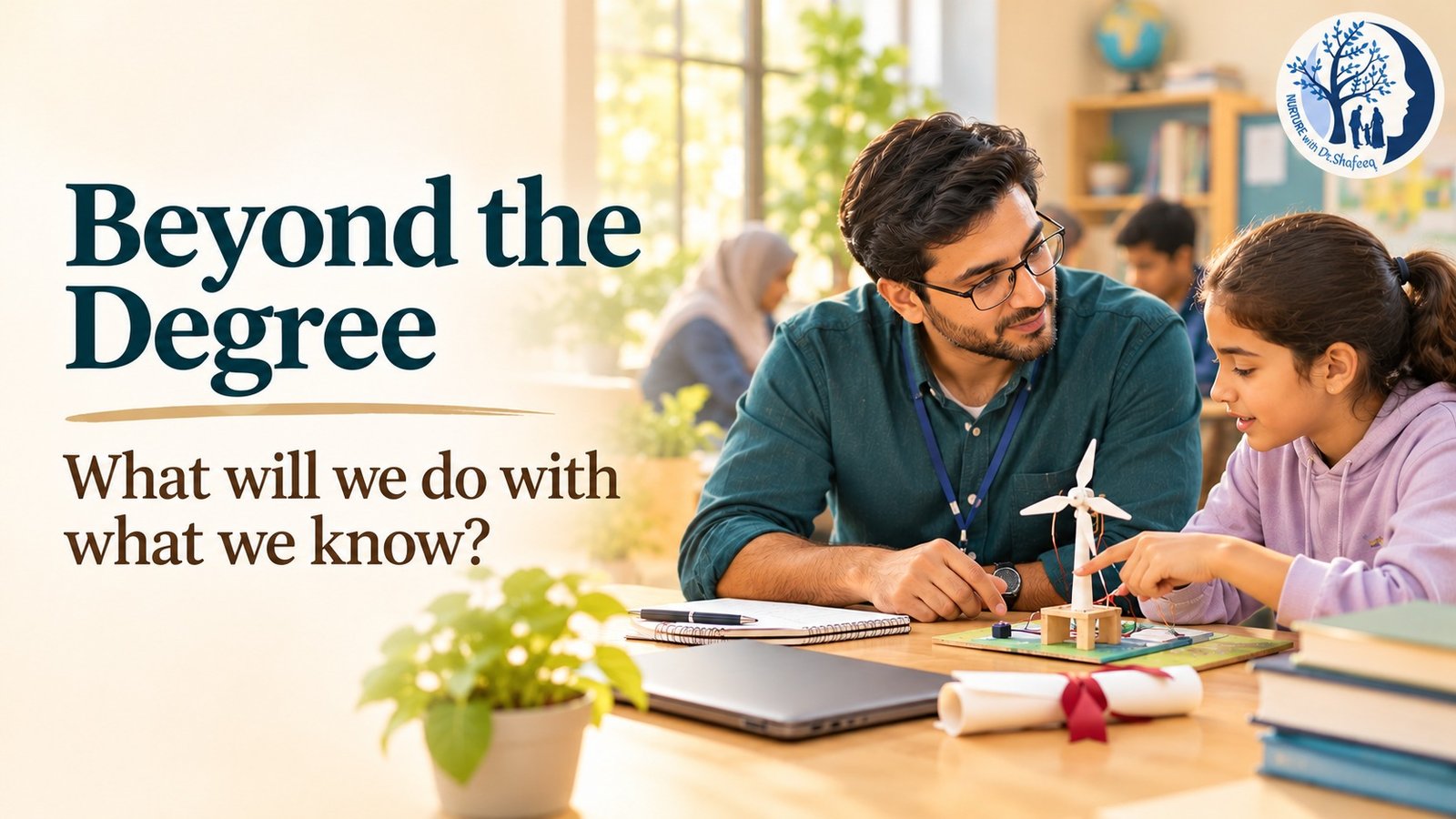
Beyond the Degree: What Will We Do with What We Know?
Knowledge becomes more meaningful when it helps us serve, not merely succeed.
Dr. Shafeeq Ahmed
At a graduation ceremony, we see the achievement: the gown, the certificate, the proud family photograph.
What we cannot see is the life that will follow.
Will this graduate become the doctor who listens when a patient struggles to explain? The business leader who refuses to profit from someone else’s vulnerability? The engineer who raises a safety concern when remaining silent would be easier?
I celebrate educational achievement. For many families, a degree represents years of sacrifice and the hope of a more secure future.
But I also find myself asking: after we have helped our children become qualified, have we helped them think deeply about what their qualifications are for?
Learning to ask the next question
Muhammad Athar Shamsi’s article in Urdu, Knowledge and Bearing Witness Before Humanity, invites us to move beyond acquiring knowledge towards examining its purposes.
It is a challenging invitation, but I do not read it as a reason to fear modern education.
We need skilled scientists, thoughtful economists, capable teachers and competent professionals. We need people who understand their disciplines well enough to contribute to them.
Yet competence should open a further conversation.
If we can build a powerful technology, who will benefit from it? If a business becomes more profitable, what happens to the people doing its least visible work? If a school improves its results, have its children also become more curious, responsible and considerate?
These questions do not diminish achievement. They ask achievement to become worthy of the people it affects.
A person is more than what we can measure
Imagine a clinician who studies a patient’s test results carefully but never looks up long enough to hear their concern.
The results matter. Accurate diagnosis matters. Evidence matters.
But the person sitting across the desk also has fears, responsibilities, relationships and a life beyond the appointment.
To me, this illustrates the distinction we need to preserve. A specialized field can reveal something essential without revealing everything.
A balance sheet can tell us about financial performance without settling whether every decision behind it was fair. An examination can measure aspects of learning without capturing a child’s whole potential.
The difficulty begins when we forget the limits of our measures—and start treating people as though the measurable part is the whole.
For a Muslim, faith offers a reminder that human beings carry dignity and moral responsibility. For colleagues of other faiths or none, there is ample room for a shared commitment: people should never disappear behind the systems designed to serve them.
Bearing witness begins with ourselves
The Qur’an describes a justly balanced community called to bear witness before humanity. The verse carries a significant religious responsibility; Shamsi develops its implications for intellectual and professional life.
I find that application most meaningful when it begins with self-examination.
It should not become an invitation to stand above others and announce that we possess all the answers. It should make us more careful about our evidence, more honest about uncertainty and more willing to correct ourselves.
In research, that may mean reporting an inconvenient finding accurately.
In business, it may mean refusing to hide an unfair condition in the small print.
In education, it may mean listening when a student asks a question, we find uncomfortable.
In public service, it may mean applying the same standard to a stranger that we would want applied to our own family.
Our witness becomes credible when the principles we explain are also the principles people experience.
Faith should deepen inquiry, not replace it
I would not want a young Muslim to leave this conversation thinking that scientific investigation is a threat to faith.
Nor would I want them to think that adding a religious quotation to an assignment completes its ethical work.
The more demanding task is to understand a subject properly, examine the evidence honestly and ask what responsibilities follow.
An engineer still needs to calculate correctly. A researcher still needs sound methods. A clinician still needs reliable evidence.
Alongside that expertise, we can ask whether the work protects dignity, distributes burdens fairly and takes foreseeable harm seriously.
We should also remain open to learning from others. Our neighbors do not need to share our religious foundations before we can work together for safer technology, fairer institutions or more humane services.
UNESCO’s recommendation on artificial intelligence, for example, places human dignity, fairness, transparency and human oversight at the center of responsible AI. It shows how people can cooperate around important ethical commitments while bringing different traditions and perspectives to the conversation.
Bring the question into everyday life
This reflection need not remain inside universities or scholarly conferences.
At home, we can ask our children not only what marks they received, but what they understood and whom their learning might help.
In classrooms, we can make room for questions about consequences alongside questions about correct answers.
At work, we can pause before approving a decision and consider who carries its risks—especially those who were not invited into the meeting.
And within our own communities, we can support spaces where religious scholars, scientists, educators and professionals listen to one another seriously.
None of this requires abandoning ambition. It asks us to give ambition a conscience.
Leave something better behind
The young person choosing a career deserves more than a choice between financial security and meaningful service. We should help them pursue honest provision while discovering how their abilities can benefit others.
Not everyone will produce a major theory or lead an institution.
But each of us can become more truthful in what we claim, more thoughtful in what we create and more attentive to those affected by our decisions.
For the Muslim learner and professional, that effort can form part of seeking Allah’s pleasure: acquiring knowledge with humility and using it with care.
A qualification tells the world that we have learned something.
The life we build afterwards reveals what we understood that learning to mean.
#NurturewithDrShafeeq
Dr. Shafeeq Ahmed S.M
Pediatrician, child psychologist, parenting coach, and career & life counsellor with over 20 years of experience. Read full bio →