Education: Is Being Capable Enough?
Education: Is Being Capable Enough?
Why learning must develop both competence and responsible judgment
Dr. Shafeeq Ahmed
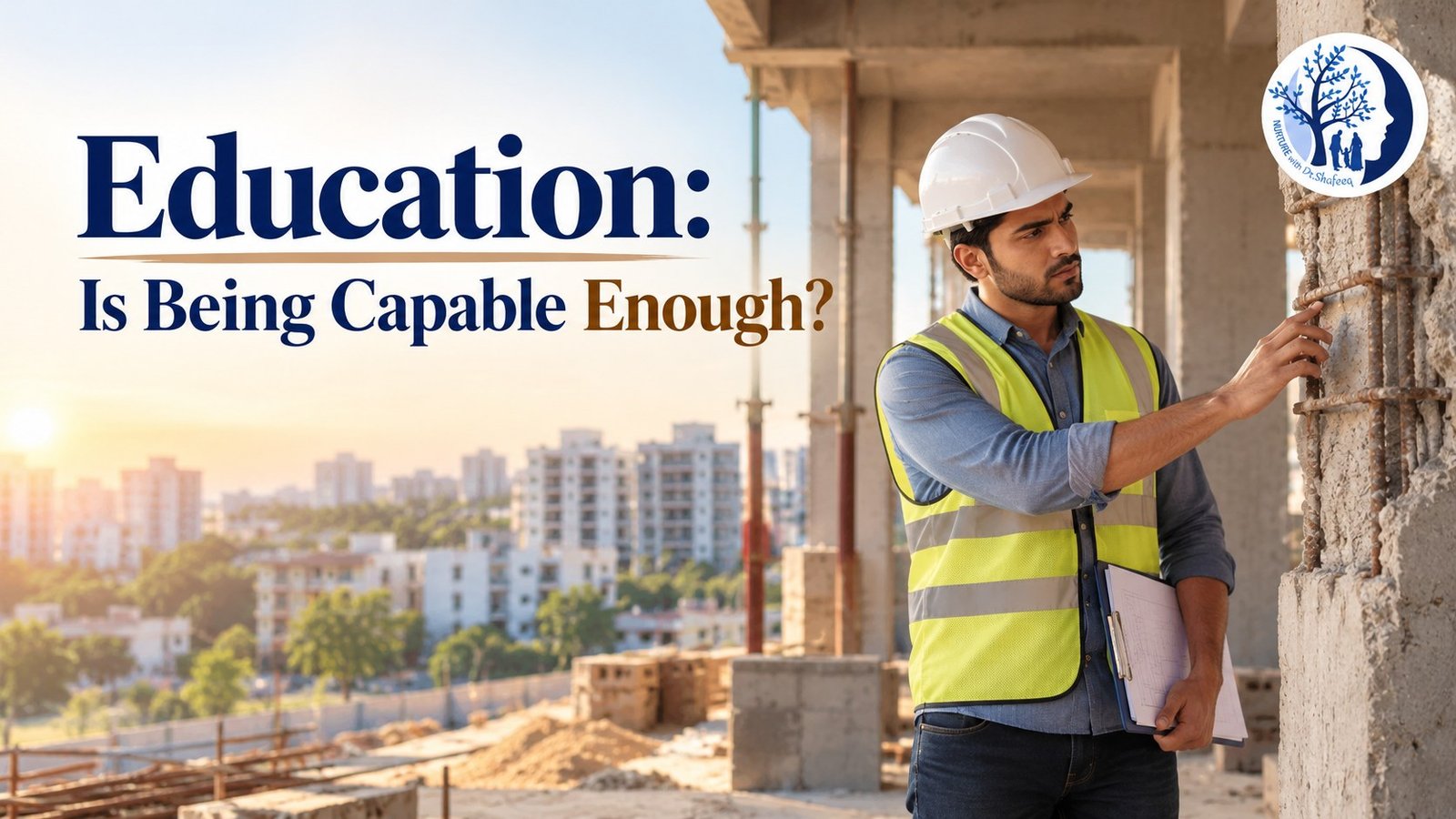
A young engineer graduates with excellent marks and secures a promising job. Assigned to a residential construction project, he is responsible for checking the quality of building materials. He discovers that the contractor is using materials below the required standard.
He recognizes the problem and understands the danger. But he fears that speaking up could damage his career. So, he remains silent.
The building is completed. The company earns its profit. Families move in, unaware that their safety may have been compromised.
The question is not whether this engineer is qualified. He has the technical knowledge. The deeper question is whether his education has prepared him to use that knowledge responsibly—even when doing so carries a personal cost.
Competence Is Essential—but Incomplete
Examinations, degrees, and professional standards matter. They help demonstrate what students know and which tasks they can perform. We need engineers who understand structural safety, doctors who can diagnose illness, and accountants who can interpret financial records.
The problem begins when competence becomes our entire definition of educational success.
Knowing how to do something does not automatically tell us whether it should be done, whom it might harm, or what obligations come with it. A person may understand a problem perfectly and still choose convenience over honesty.
Education must therefore connect knowledge with responsibility. It should prepare students not only to perform tasks, but also to examine the purposes and consequences of their actions.
Knowledge Needs Direction
Knowledge expands our ability to act. It does not, by itself, determine how we will act.
Medical expertise can serve patients or exploit their vulnerability. Financial knowledge can support fair decisions or conceal harmful practices. Technical skill can protect communities or place them at risk.
The answer is not to distrust expertise. It is to bring ethical judgment into the way expertise is developed and used.
Alongside “Can I do this?”, students should learn to ask:
Should I do this?
Who will benefit, and who might be harmed?
What evidence supports my decision?
Am I overlooking someone with less power?
Can I accept responsibility for the consequences?
These questions make learning more demanding, not less. They require students to connect accurate knowledge with thoughtful judgment.
A Faith-Informed Perspective, Open to Everyone
The original essay draws on Surah Al-Jumu‘ah, verse 2, which brings together the communication of revelation, purification, and the teaching of scripture and wisdom.
The essay interprets this as a vision of education that extends beyond information and skills. Learning also involves personal growth, moral reflection, and the wise application of knowledge.
For Muslim readers, this vision is rooted in spiritual accountability. Readers of other faiths, or of no religious faith, can engage with its central question without sharing the same foundation: What kind of person should education help us become?
An inclusive conversation can acknowledge this Islamic perspective while welcoming different understandings of honesty, fairness, care, and the common good. Shared reflection does not require identical beliefs.
From Correct Answers to Sound Judgment
Consider a student learning economics. Calculating profit, productivity, and resource allocation is important. But a fuller education would also ask who benefits from an economic decision, who bears its costs, and whether those costs are distributed fairly.
Similarly, the engineer in our opening example needs more than the ability to identify unsafe materials. He must evaluate the evidence, understand his obligations, and decide how to respond under pressure.
This is where knowledge meets wisdom: in decisions that require attention to facts, context, competing concerns, and human consequences.
Wisdom also involves humility—the willingness to recognize uncertainty, consider another perspective, and change one’s mind when the evidence demands it.
What Should Change in Education?
A separate ethics lesson may be useful, but it cannot carry the whole task. Responsible judgment should be woven into everyday learning.
Teachers can assess how students reach conclusions, not only whether their answers are correct. Classroom discussions can explore realistic dilemmas involving safety, fairness, loyalty, and financial pressure. Practical projects can ask students to explain who might be affected by their choices.
Students also need opportunities to acknowledge mistakes and improve. Responsibility is not the appearance of perfection; it includes the willingness to correct an error.
Institutions have obligations, too. Teaching integrity means little if students or employees are punished for raising legitimate concerns. Fair procedures, accountable leadership, and credible reporting channels must support the conduct education seeks to encourage.
The engineer should be prepared to speak up. His workplace should be prepared to listen.
Preparing for the Test Beyond Graduation
We do not have to choose between professional competence and ethical development. A fuller education brings them together.
It helps people become capable enough to recognize a problem, thoughtful enough to understand its consequences, and responsible enough to act.
The engineer’s most important test may come after his final examination: when he discovers unsafe materials, understands what silence could mean, and must decide what to do.
Education should prepare him for that moment, too.
#NurturewithDrShafeeq
(Inspired by the Urdu essay “تعلیم: قابلیت یا صالحیت؟” by Muhammad Athar Shamsi)
Dr. Shafeeq Ahmed S.M
Pediatrician, child psychologist, parenting coach, and career & life counsellor with over 20 years of experience. Read full bio →