Where There Is a Will, There Is a Way
Where There Is a Will, There Is a Way
What a ₹140 filter can teach students about invention, determination, and responsibility
By Dr. Shafeeq Ahmed
Sometimes, an inspiring idea begins not in a sophisticated laboratory, but with an ordinary object—and a thoughtful question.
For two Delhi students, that object was a fan.
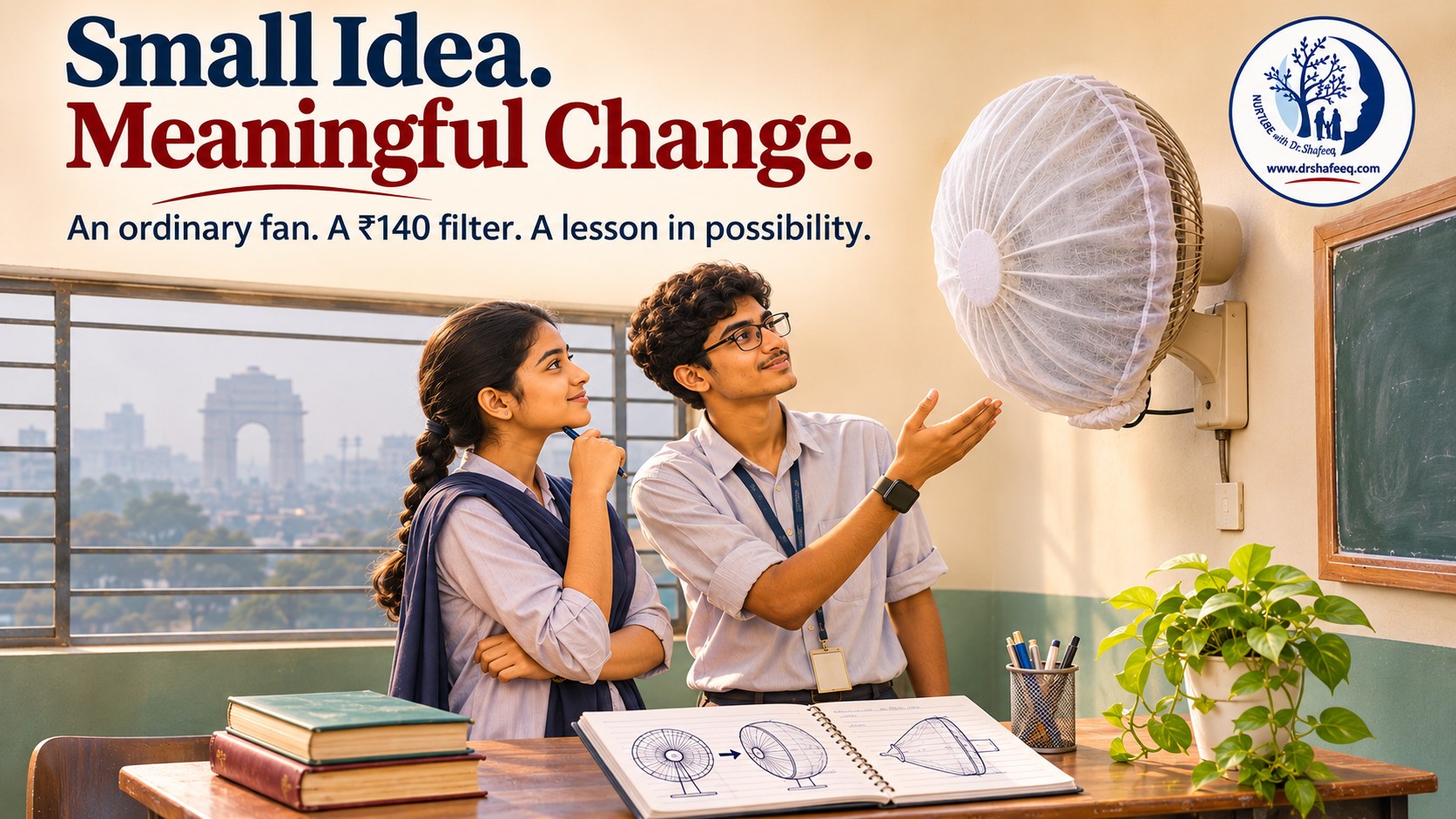
Krish Aggarwal and Samarth Meattle co-founded Project Vayu to make classroom air filtration more accessible. Their approach uses a low-cost filter fitted to an existing table or wall fan, rather than requiring schools to purchase a separate air purifier. The project reports a manufacturing cost of approximately ₹140 per filter and supplies the filters free to schools.
Their story invites every student to ask: What problem around me deserves a second look?
Necessity is the mother of invention
For Krish, air pollution was personal. In his KidsRights profile, he describes childhood breathing difficulties and frequent nosebleeds. An air purifier helped, but it also highlighted an uncomfortable reality: not every family could afford one.
That experience raises a question: if cleaner air matters to everyone, how can it become accessible to more people?
“Necessity is the mother of invention” is more than a saying to memorize for an examination. It is an invitation to recognize unmet needs and respond with curiosity.
A problem may be familiar without being acceptable. What we have learned to tolerate may be precisely what someone needs to question.
Look again at what already exists
Project Vayu’s filter uses electrically charged fibers to capture airborne particles, including fine particulate matter known as PM2.5. Fitted over a fan grille, the material expands into a balloon-like shape as air passes through it.
The lesson is not that every difficult problem has a cheap or easy answer. It is that innovation can begin by finding a new use for something already available.
Students sometimes imagine that meaningful invention must involve an expensive machine, a complex app, or a discovery nobody has ever considered. This story suggests another starting point: connect what you are learning to what people actually need.
Before asking, “What do I lack?” consider asking, “What can I learn to do with what I have?”
Willpower needs knowledge—and other people
“Where there is a will, there is a way” should encourage effort, not suggest that determination magically removes every obstacle.
A useful idea needs knowledge, testing, guidance, resources, and teamwork. Project Vayu describes collaboration with filtration company Hollingsworth & Vose—a reminder that this was not simply one student succeeding without support.
For students, the lesson is practical: observe carefully, ask for guidance, begin with a manageable and safe experiment, and record what happens honestly. When something does not work, investigate why.
Seeking help does not diminish achievement. Learning from failure does not disqualify an inventor. Both are part of making an idea useful.
Inspiration must remain honest
Does this invention solve Delhi’s poor air quality?
Not by itself. It aims to reduce particle pollution inside classrooms, not clean the city’s outdoor air or demonstrably lower Delhi’s overall AQI. Project Vayu reports substantial reductions in indoor PM2.5 under particular test conditions, but performance can vary with room size, airflow, and open doors. Those results should not become a promise for every classroom.
That limitation does not make the effort unimportant. Reducing exposure in a classroom is a worthwhile objective. But filtration cannot replace controlling pollution at its source, and air cleaners do not remove every pollutant.
For every young innovator, this distinction matters: be enthusiastic about your idea, but precise about what it can do.
Honesty is what makes ambition trustworthy.
Do not wait for everyone else to care
When an environmental problem feels overwhelming, it is tempting to ask, “What difference can I make when so many others seem unconcerned?”
Yet other people’s indifference need not become our excuse.
A limited contribution is not a meaningless contribution. These students chose to address one part of a larger problem. Their example invites us to turn concern into purposeful action.
At the same time, protecting ourselves from pollution must not become an acceptance of pollution. Personal initiative and institutional responsibility should strengthen—not replace—each other.
Let students bring environmental questions into classrooms, practical ideas into science projects, and thoughtful demands for change into their communities. Let us measure progress not only by what we achieve for ourselves, but also by what we make better for others.
The ambition is not merely to create protected rooms in an unhealthy world. It is to help build a healthier, more livable world in which clean air is not a privilege.
Begin with your corner of the world
Krish’s inclusion in the Diana Award’s 2026 Roll of Honour recognizes an initiative credited with benefiting more than 10,000 students. Behind that recognition is something more enduring than an award: an effort to make a useful solution accessible to others.
Dear students, you do not have to begin by changing the world.
Begin by noticing your corner of it.
Ask what is being wasted, who is being overlooked, and which everyday difficulty deserves a better answer. Not every question will produce an invention. Not every experiment will succeed. Neither outcome makes the effort worthless.
Let necessity awaken your curiosity. Let compassion give it direction. Let knowledge, cooperation, and persistence turn it into action.
We may not be able to change everything today. But we can refuse to let that stop us from changing something.
#NurtureWithDrShafeeq

Dr. Shafeeq Ahmed S.M
Pediatrician, child psychologist, parenting coach, and career & life counsellor with over 20 years of experience. Read full bio →