A Daughter Is Not a Second Choice
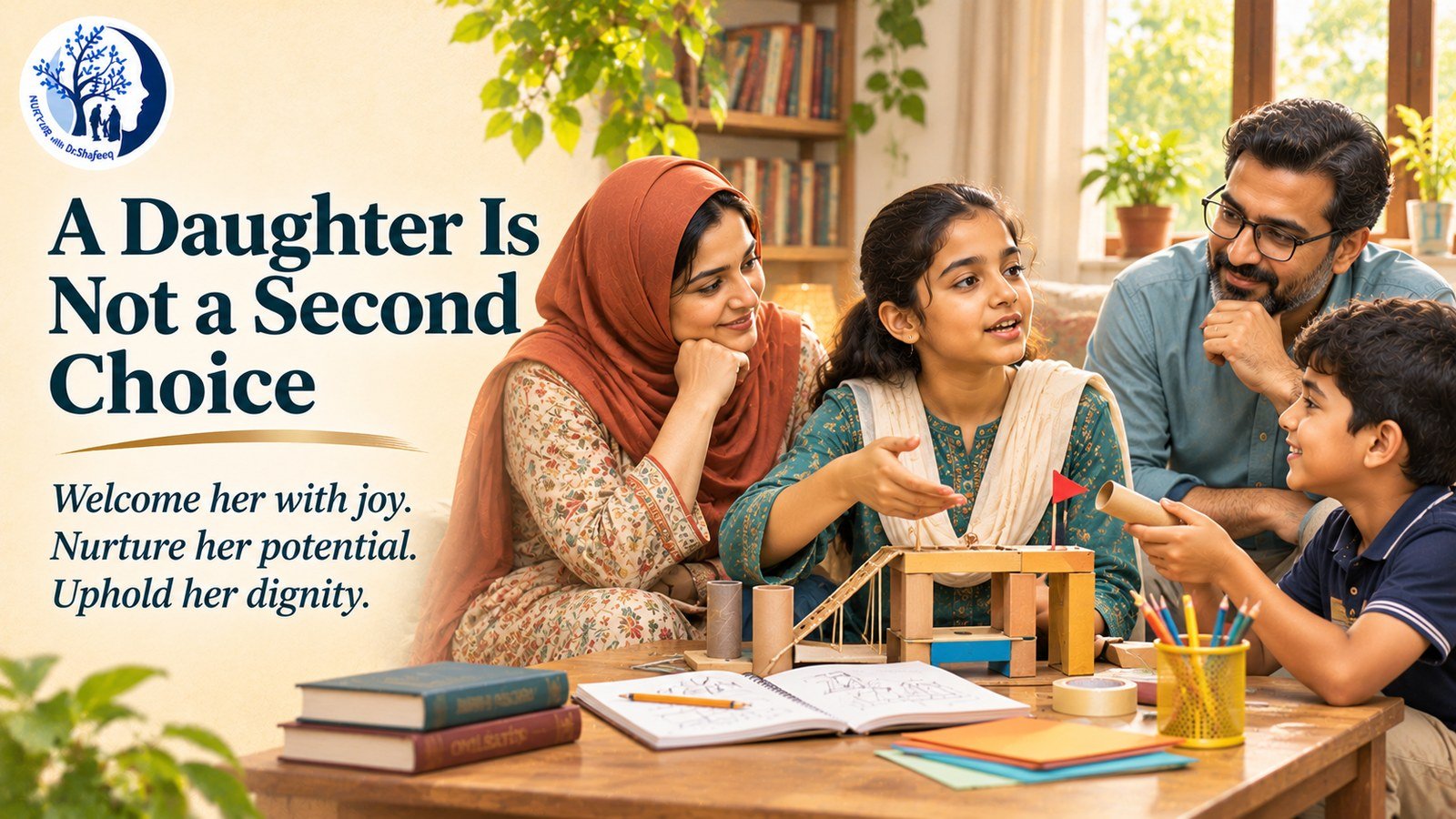
A Daughter Is Not a Second Choice
Raising girls for a meaningful life—and building a society worthy of them
By Dr. Shafeeq Ahmed
“Is it a boy or a girl?”
It is a natural question when a baby arrives. What matters is what follows: the warmth of the welcome, the expectations quietly formed, and the opportunities that will eventually be offered.
A daughter should never grow up feeling that her birth required consolation.
Nor should she have to become an exceptional student, a successful professional or a devoted mother to justify the happiness her arrival deserves. Her dignity comes first. Her achievements and contributions come later.
The Qur’an challenges the shame attached to the birth of a daughter and condemns the thinking behind it. It also places men and women alongside one another in moral responsibility and spiritual reward. These principles invite more than agreement. They invite an examination of how daughters are actually welcomed, educated, heard and treated.
Honour Must Become Everyday Fairness
The prophetic encouragement associated with caring for daughters gives their upbringing particular moral significance. A narration in Sahih Muslim connects the proper upbringing of two girls with closeness to the Prophet ﷺ in the Hereafter.
The practical question is what that care should look like.
Certainly, it includes food, clothing and safety. But a meaningful commitment to a daughter’s wellbeing should also include education, affection, healthcare, respectful guidance and opportunities to develop her judgment.
It means noticing the quiet inequalities that can survive inside otherwise loving homes. Is a son’s education treated as an investment while a daughter’s is considered optional? Is assertiveness encouraged in one child but discouraged in another? Are daughters expected to serve while sons are excused from learning basic responsibility?
Fairness need not mean treating every child identically. Children differ in needs, abilities and circumstances. But those differences should not become a convenient explanation for valuing one child less.
The Qur’an’s recognition of women’s entitlement to inheritance is particularly important here: a woman’s share is a right, not a favor granted by relatives.
Honour becomes credible when it reaches decisions about money, opportunity and voice.
Prepare Her for a Profession—and for Life
Families rightly want daughters to become educated and capable. A girl should have the opportunity to discover whether her abilities lie in medicine, teaching, engineering, enterprise, research, the arts or another field.
Yet a professional qualification, valuable as it is, cannot be the whole of preparation for adulthood.
Alongside academic learning, children need emotional maturity, ethical judgment, practical competence and the ability to build respectful relationships. They need to understand boundaries, manage disagreement, recognize manipulation, handle money responsibly and seek help without shame.
For Muslim families, this preparation can be grounded in faith: a sense of accountability to Allah, sincerity in intention, compassion towards creation and the pursuit of lawful, beneficial work.
But this is not a curriculum for daughters alone.
A girl should not be taught patience while a boy is excused from self-control. She should not be prepared to maintain a household while he remains unprepared to contribute to one. Both need the character and skills that make shared life possible.
Preparing a daughter for a meaningful life must be accompanied by preparing sons to become responsible partners, fathers and citizens.
Value Motherhood Without Reducing Womanhood
Motherhood deserves deep respect. Caring for a child involves bodily demands, emotional attention, practical labor and sustained responsibility. Families should make room for that work, rather than praising mothers while leaving them unsupported.
Yet respect for motherhood should not become the measure of every woman’s worth.
Some women will not marry. Some will not have children. Others will experience infertility, bereavement or circumstances they did not choose. Their dignity and capacity to contribute remain intact.
Calling girls “architects of society” can be a beautiful expression—provided it does not make them solely responsible for society’s moral condition. Women help shape communities through parenting, teaching, professional work, friendship, public service and many other relationships. Men share that responsibility.
The Qur’anic description of spouses as garments for one another offers a relational image of mutual closeness and protection. It invites reflection on partnership rather than a picture in which one person gives endlessly and the other merely receives.
A more humane question, therefore, is not simply whether a daughter has been prepared to care for others. It is whether she will also be respected, supported and cared for.
Challenge Materialism, Not Working Mothers
There is a legitimate concern beneath discussions about modern family life: earning more can gradually become more important than being present, and children’s needs can disappear beneath adult schedules.
But it would be unfair to treat women’s employment, or two-income households, as the cause of family breakdown. Families work for different reasons—including necessity—and employment status alone cannot tell us whether a home is attentive, secure or loving.
Likewise, describing difficulties as the result of departing from “natural instinct” risks overlooking practical questions: who has time to care, who carries the workload, and what support is available?
UNICEF’s family-friendly policy guidance emphasizes parental leave, support for breastfeeding, affordable quality childcare and adequate income as resources that help families combine employment and care.
The constructive response is therefore not to shame working mothers or dismiss the contribution of women who care for families full-time. It is to make caregiving a serious, shared commitment.
Families can examine workloads honestly. Fathers can take responsibility rather than regard their participation as occasional assistance. Employers can avoid treating limitless availability as proof of dedication.
Children should not have to compete with material ambition for affection. Neither should a mother have to sacrifice her wellbeing to compensate for everyone else’s absence.
A civilized society is not built by asking girls to carry more while giving them less. It is built by welcoming them without disappointment, educating them without narrow limits, protecting them without silencing them, and supporting their contributions without exploitation.
The higher purpose of upbringing is not merely to produce a successful professional or a self-sacrificing caregiver. It is to nurture a person of faith, understanding, compassion and responsibility—someone able to contribute meaningfully while recognizing her own dignity.
What would change in our homes if every daughter received not only the message “You are precious,” but also the daily experience “Your rights, your voice and your future matter”?
NurtureWithDrShafeeq
Nurturing relationships, learning and a fresh perspective.
Dr. Shafeeq Ahmed S.M
Pediatrician, child psychologist, parenting coach, and career & life counsellor with over 20 years of experience. Read full bio →