Your Child Needs More Than a Viral Answer
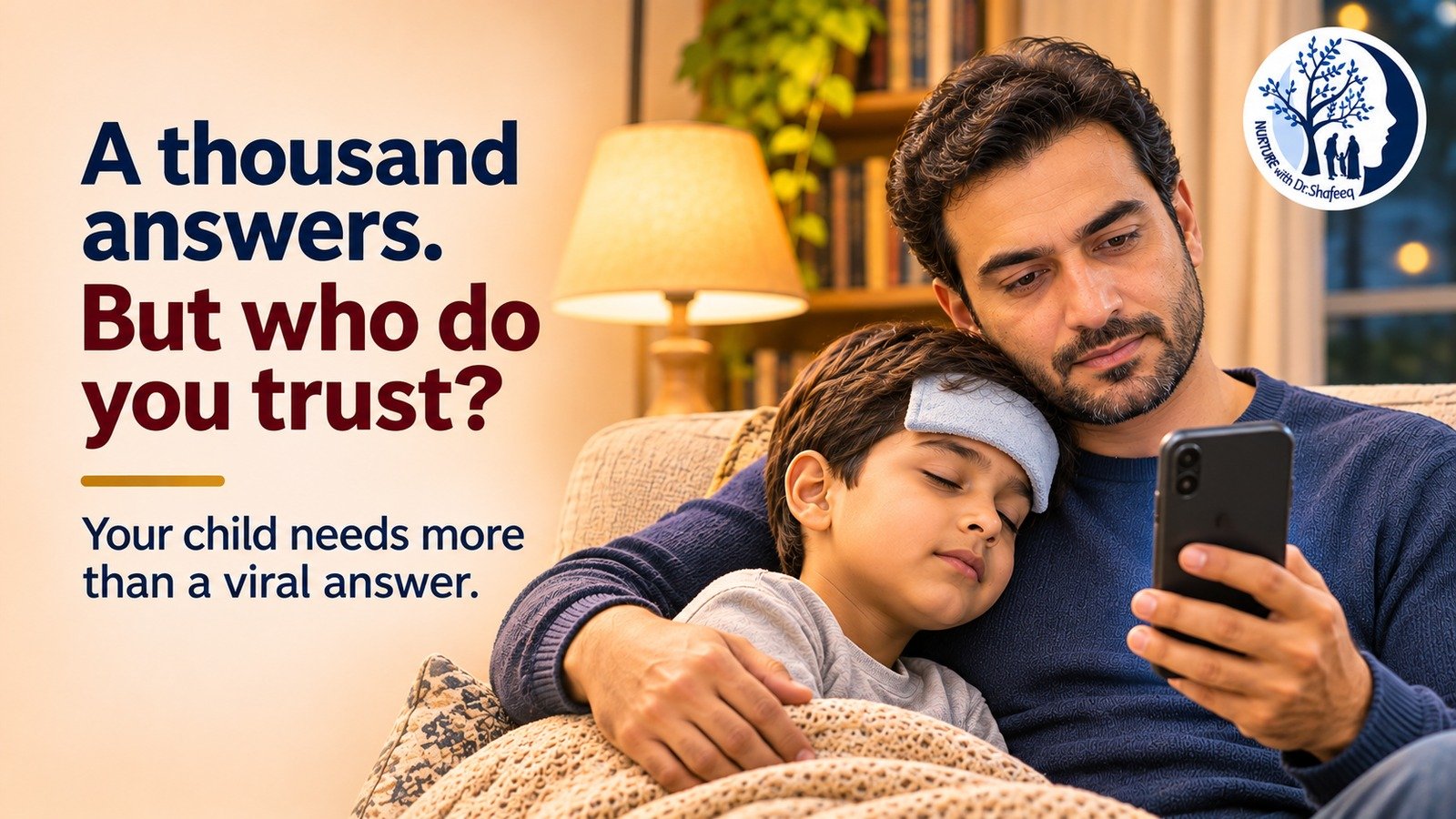
Your Child Needs More Than a Viral Answer
Dr. Shafeeq Ahmed
Picture a parent awake at midnight. A child has a rash. One post offers reassurance. Another predicts something frightening. A third recommends a product. The phone is full of answers, yet the parent feels less certain than before.
I do not see a foolish parent in that picture. I see someone trying to protect a child. That is where I believe this conversation should begin—not with blame, but with understanding.
What the research is telling us
In a Portuguese survey of 85 parents, 48 searched online. Among those searching, the detailed results report that 46 prioritized healthcare professionals when advice conflicted, while 15 felt uncomfortable asking professionals.
To me, that combination matters more than a headline about parents trusting social media. Searching is not necessarily rejecting medical advice. It may be an attempt to understand it, extend it, or find the courage to ask another question.
A systematic review describes widespread parental online searching, a desire for professional guidance, and gaps in discussing online findings during consultations. A separate scoping review identifies lived experience, social support and community among the reasons parents seek children’s health information through social media.
My conclusion is not that the internet has replaced the doctor. It is that the conversation should no longer stop at the consulting-room door. A parent should leave with both a care plan and somewhere trustworthy to turn when new questions arise.
Look beneath the scrolling
A parent may need medical knowledge and human reassurance. Another family can offer companionship without being qualified to recommend treatment. We should protect the value of the first without confusing it with the second.
This is the connection I would make with my book, ‘The Relationship Iceberg: Understanding People Beyond Their Words.’ The scrolling is visible. The worry beneath it may not be. Before correcting the information, I would want us to understand the concern: fear of missing something, uncertainty about a decision, or embarrassment about asking again.
Understanding the emotion does not make an inaccurate claim true. It makes a respectful conversation possible.
Two worlds, one responsibility
I see a natural companion theme in ‘Two Worlds, One Childhood: Raising Kids Who Can Thrive Online and Offline’. We cannot teach children to question what they see online while accepting every confident adult voice that appears on our own screens.
The example I want us to set is neither blind trust nor blanket suspicion. It is thoughtful checking. We can say, “This sounds convincing, but I want to know where the evidence comes from.” That is not weakness. It is responsible judgment.
A 2024 systematic review highlights misinformation and gaps in research directly examining how parenting content affect parental decisions.
Taken together, these studies support a practical direction, not a verdict that online advice is always harmful or always helpful. They describe information needs, trust and support more clearly than they establish effects on children’s health. My conclusion is to strengthen the bridge between families, credible digital resources and healthcare—not to pretend that either a screen ban or a warning label will solve the problem.
What I would like us to do differently
For parents, I suggest a simple pause before acting; check the author’s relevant qualifications, look for supporting evidence, and notice whether the advice is selling a product or promising a universal cure. A personal success story can start a question; it should not settle a medical decision.
Bring the post to the appointment. Explain what attracted or worried you. Do not change a child’s prescribed treatment on the strength of a video, and do not let online reassurance delay urgent medical assessment.
For professionals, my invitation is equally practical: make it easy to admit uncertainty. Invite parents to share what they have read, explain why a recommendation does or does not fit their child, and offer a small set of reliable resources. A useful response should leave a parent better equipped, not merely corrected.
For families, let us replace “Stop believing everything online” with “Let us check this together.” We can disagree with a claim without humiliating the person who brought it home.
I want children to grow up seeing adults who ask, listen, verify and change their minds when the evidence requires it. The goal is not to win an argument with the internet. It is to help a worried parent make a sound decision for a real child.
A viral answer can catch our attention. It should not take charge of our child’s care.
#NurtureWithDrShafeeq
Research references
[1] From Likes to Advice: The Influence of Social Media on Parental Health Decisions. https://www.pediatriconcall.com/pediatric-journal/view/fulltext-articles/1677/J/0/0/927/0 (Figures follow detailed results; the abstract contains a conflicting count.)
[2] Online Health Information Seeking by Parents for Their Children (2020). https://pubmed.ncbi.nlm.nih.gov/32840484/
[3] Parents’ Use of Social Media as a Health Information Source for Their Children. https://pubmed.ncbi.nlm.nih.gov/34906742/
[4] Parenting Information on Social Media: Systematic Literature Review (2024). https://pmc.ncbi.nlm.nih.gov/articles/PMC11541157/

Dr. Shafeeq Ahmed S.M
Pediatrician, child psychologist, parenting coach, and career & life counsellor with over 20 years of experience. Read full bio →