Before We Make Children AI-Ready, Let’s Give Them Time to Be Children
Before We Make Children AI-Ready, Let’s Give Them Time to Be Children
By Dr. Shafeeq Ahmed
A toddler reaches for a parent’s face. The parent, exhausted after a long day, reaches for a phone. A cartoon begins. The tears stop. For a few minutes, everyone can breathe.
There is no villain in this scene. There is a tired adult, a restless child and a device that offers immediate relief.
The question is not whether that parent has failed. It is what happens when an occasional convenience becomes our everyday answer to boredom, distress, meals, learning and companionship.
In his Indian Express article, educationist Krishna Kumar raises an uncomfortable concern: in our enthusiasm for digital progress, are we protecting childhood—or simply equipping it with more screens? His warning about introducing artificial intelligence into early education deserves thoughtful attention, not an automatic dismissal as resistance to change.
A quiet child is not necessarily a learning child
We have become remarkably good at measuring what devices can deliver: lessons completed, videos watched, questions answered. But childhood contains experiences that resist a dashboard.
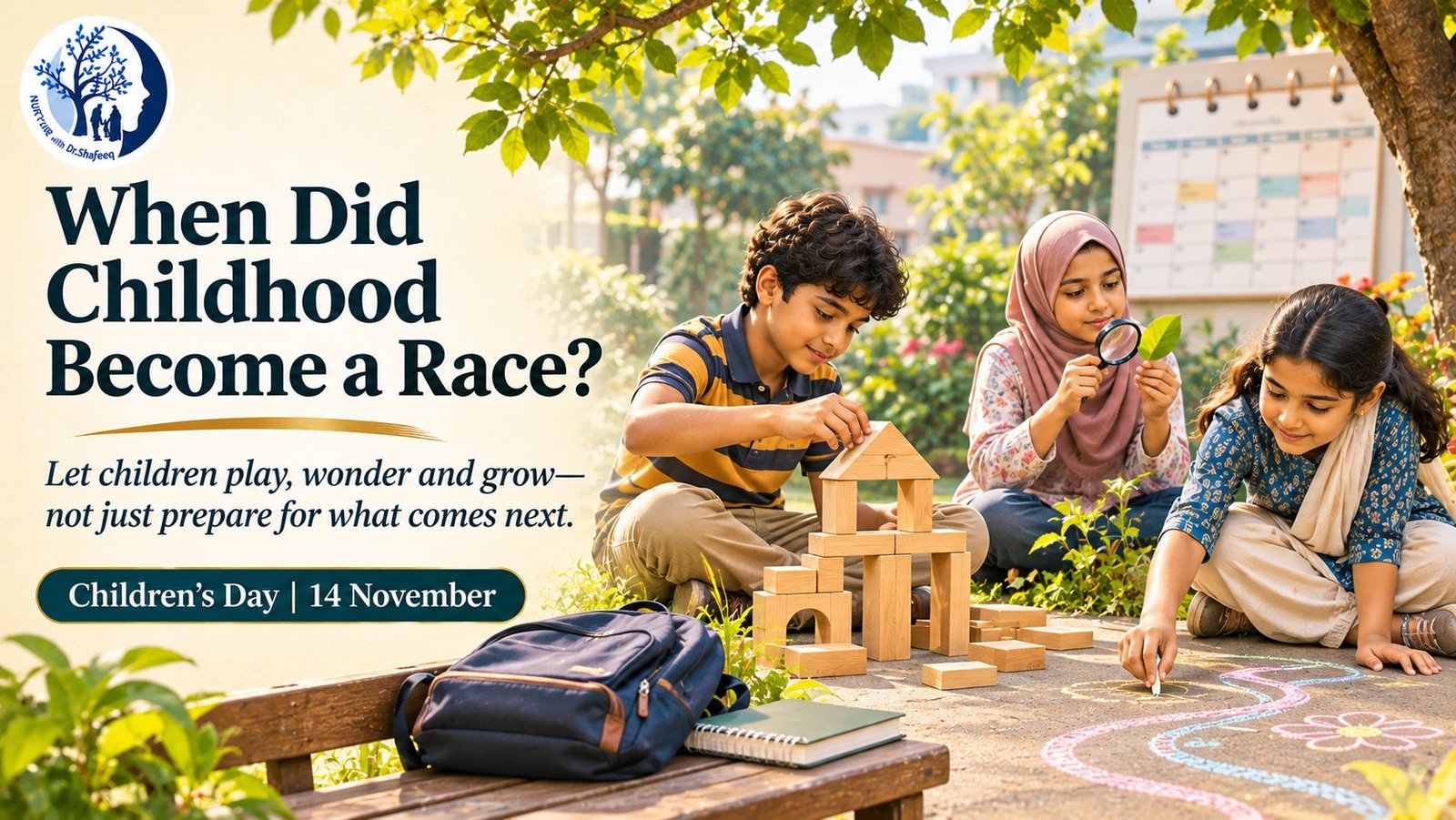
A child listening to a grandmother’s story can interrupt, ask why, notice her expression and request a different ending. A child building a crooked tower discovers balance, frustration and the possibility of trying again. Two children arguing over a ball must begin the difficult work of sharing a world.
These are not empty spaces waiting for an app.
WHO’s guidance for young children places active play, sufficient sleep and interaction with caregivers at the center of a healthy day. It specifically values reading, storytelling, singing and puzzles—not merely keeping children occupied.
The useful question, therefore, is not only “How much screen time?” but “What is the screen replacing?”
“Educational” is a claim, not a guarantee
A bright animation can explain a concept. An accessible digital book can open a door. Technology can help a child participate when a disability, distance or lack of resources creates barriers.
But a device in a classroom is not, by itself, evidence of better education.
UNESCO’s Global Education Monitoring Report cautions that robust, independent evidence of educational technology’s added value remains limited. Its central recommendation is not to reject technology, but to make it serve learners and complement—not replace—human interaction.
Before buying the next platform, schools should ask: What learning problem does it solve? For which children? What evidence supports it? What training will teachers receive? What will we stop doing to make room for it?
“Other schools are doing it” is not an educational rationale.
AI literacy need not begin with a chatbot
Parents understandably worry that their children will fall behind. Schools feel pressure to demonstrate that they are preparing students for the future.
Yet we should resist confusing early exposure with meaningful preparation.
A sensible foundation for later AI literacy would include asking good questions, recognizing uncertainty, checking claims, explaining one’s reasoning and respecting other people’s work. Children can practice these habits through books, conversation, observation and classroom discussion before they independently use generative tools.
For older students, carefully supervised AI activities may become useful opportunities to examine mistakes, bias and the difference between a convincing answer and a trustworthy one. But access should follow a clear learning purpose—not the assumption that younger always means better.
UNESCO calls for age-appropriate, context-sensitive technology decisions grounded in evidence and teachers’ professional judgement.
Protecting childhood cannot be a parenting task alone
It is easy to tell parents to “set limits”. It is harder to acknowledge crowded homes, unsafe outdoor spaces, long working hours and schoolwork that itself requires a device.
Families need support, not another reason to feel inadequate.
Schools, too, need more than equipment budgets. They need trained teachers, libraries, play spaces and time to evaluate whether digital tools improve learning. Governments and providers must take responsibility for privacy and safety: a child’s participation in education should not quietly become an opportunity for surveillance or commercial profiling. UNESCO identifies these as serious concerns requiring safeguards.
For younger children, WHO recommends no sedentary screen time for infants and one-year-olds, and no more than one hour daily for ages two to four, with less preferred. These recommendations sit within a broader picture of movement, sleep and attentive care—not a stopwatch-only approach to parenting.
Give children something worth putting the screen down for
A practical response begins with small, sustainable choices:
Protect some shared moments—meals, stories or an evening walk—from devices, including adults’ phones.
When screens are used, join the child where possible: ask, discuss and connect the content to real life.
Offer alternatives that invite participation: drawing materials, books, household tasks, outdoor play and unhurried conversation.
Ask schools to explain the purpose, evidence and privacy arrangements behind compulsory apps and AI tools.
Let children encounter manageable boredom without treating every quiet moment as a problem to solve.
We do not need to romanticize a technology-free past. Nor should we accept a future in which every childhood experience must be accelerated, personalized or automated.
The purpose of education is not to produce children who can operate the newest machine earliest. It is to help them become thoughtful, capable and caring people.
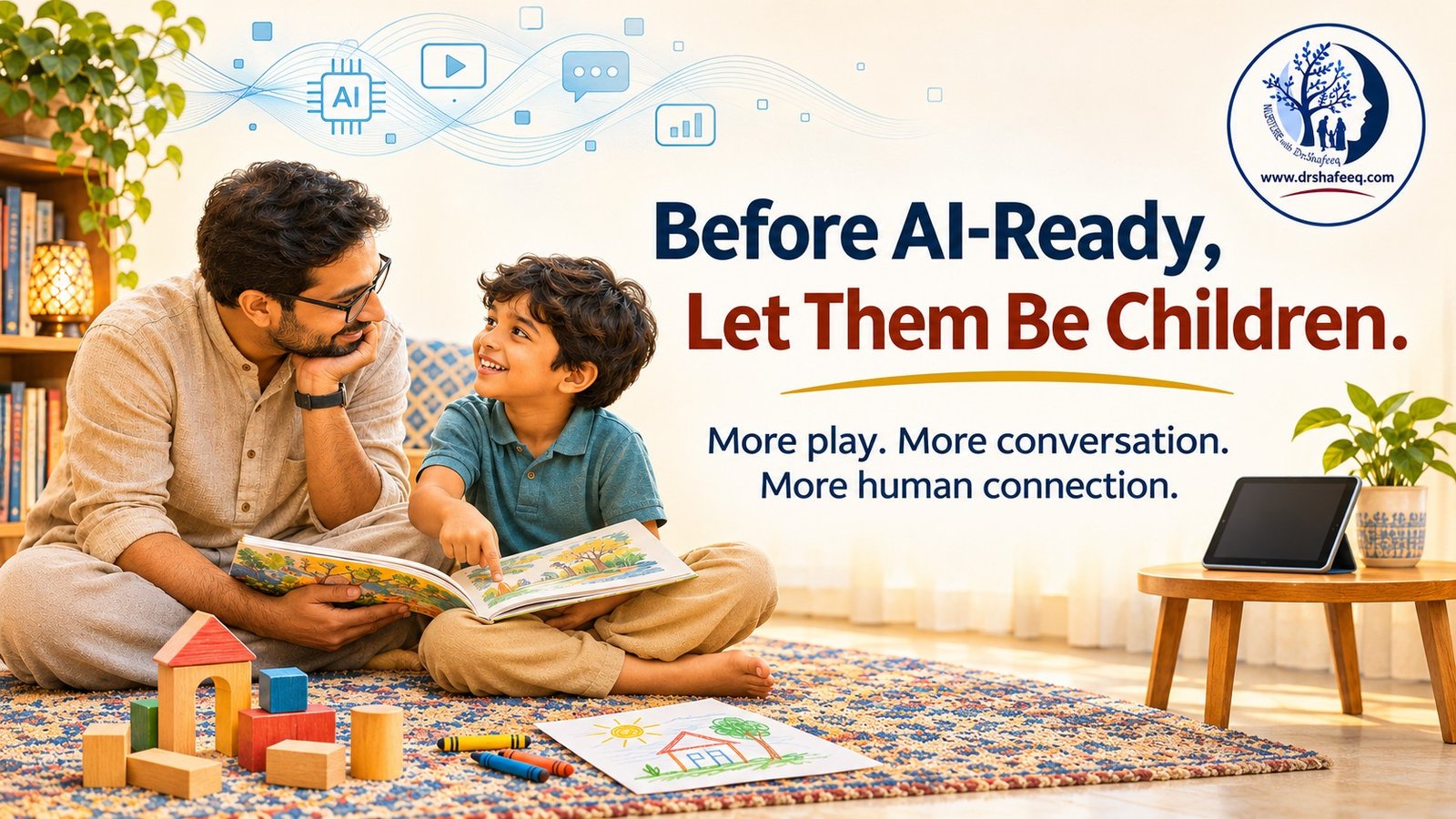
Before asking whether our children are ready for artificial intelligence, perhaps we should ask whether we are giving them enough human attention.
#NurtureWithDrShafeeq

Dr. Shafeeq Ahmed S.M
Pediatrician, child psychologist, parenting coach, and career & life counsellor with over 20 years of experience. Read full bio →