This Children’s Day, Give Them Room to Explore
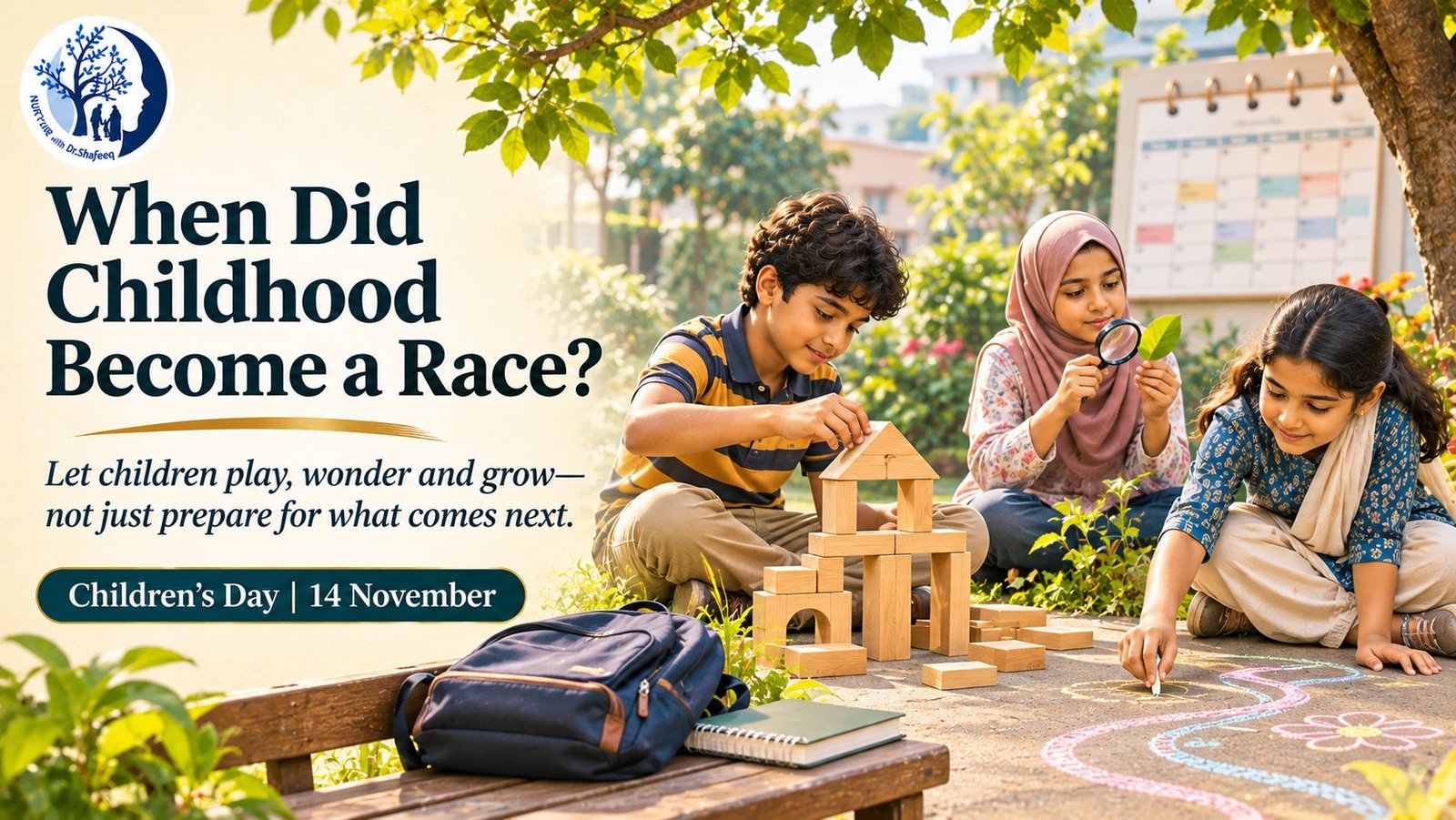
This Children’s Day, Give Them Room to Explore
Iqbal’s invitation to nurture curiosity, courage, and the confidence to discover new possibilities
By Dr. Shafeeq Ahmed
Every Children’s Day, we celebrate children with warm wishes, performances, gifts, and applause. In India, 14 November marks Children’s Day on the birth anniversary of Jawaharlal Nehru.
But beyond the celebrations, there is a question worth asking:
Are we giving our children only instructions for living—or opportunities to discover life for themselves?
“Be careful.”
“Do not try that.”
“What if you fail?”
As parents, we often speak these words out of love. We want our children to be safe and spared unnecessary pain. Yet we must ask: are we protecting them from danger, or also shielding them from experiences through which they might discover their abilities?
In his poem “روحِ ارضی آدم کا استقبال کرتی ہے”—“The Spirit of the Earth Welcomes Adam”—Allama Iqbal offers a different welcome to the world:
کھول آنکھ، زمیں دیکھ، فلک دیکھ، فضا دیکھ
مشرق سے ابھرتے ہوئے سورج کو ذرا دیکھ
Open your eyes: behold the earth, the heavens, the space around you; look at the sun rising in the east.
—A sense translation.
This is not an invitation to hide from life. It is an invitation to encounter it.
This Children’s Day, let us consider how to raise children who approach the world with curiosity, meet uncertainty with preparation, and recognize possibilities beyond the paths already familiar to us.
A world to explore, not merely fear
Iqbal’s poem moves through mountains, deserts, oceans, winds, clouds, and stars. It presents a world of challenge and possibility, linking human potential with imagination, selfhood, and sustained effort. Read as a reflection on parenting, it offers an invitation to participate in life rather than remain a spectator.
Our task is not to promise children an easy world. It is to help them meet a difficult world without assuming that difficulty means defeat.
Instead of saying, “This is too difficult for you,” we might say:
“You may not know how to do this yet. Let us find out how you can begin.”
That is the spirit of adventurous parenting: not pushing children into danger but helping them approach the unfamiliar with guidance and purpose.
Adventure begins closer to home than we think
Adventure need not mean an expensive holiday, a mountain expedition, or an extreme sport.
For a young child, it may mean exploring a nature trail, trying an unfamiliar activity, or building something without an adult completing it.
For an older child, it may mean asking a question in public, entering a competition, joining a new group, or taking responsibility for a small community project.
For a teenager, it may mean contacting a mentor, learning beyond the syllabus, applying for an unfamiliar program, or testing an idea that might not succeed.
The common thread is an opportunity to make choices, encounter uncertainty, and discover what one can do.
Pediatric guidance on outdoor play supports opportunities for manageable challenge while emphasizing children’s individual abilities, developmental stages, and circumstances. The aim is not to push every child towards the same level of risk.
A quiet child asking for help may be showing as much courage as an outgoing child stepping onto a stage.
Be a safety net, not a remote control
There is a difference between helping a child assess a risk and removing every uncertain experience.
The Canadian Pediatric Society distinguishes manageable risks from hazards that children may not recognize or control. Adults should remove or reduce hazards and provide appropriate supervision. Supporting exploration does not mean abandoning protection.
In everyday parenting, this suggests a useful shift. Before immediately saying no, ask:
What are you hoping to do?
What could go wrong?
What preparation or support would make this reasonable?
When would you need to stop or ask for help?
Some plans will still deserve a firm no. Courage does not require ignoring safety, emotional readiness, disability-related needs, or family finances.
But where a challenge is manageable, we can guide without taking over.
Our message can be: “I will help you prepare. I do not have to do it all for you.”
To young people: do not let disappointment become your permanent address
“There are no opportunities.”
Sometimes, these words reflect genuine hardship. Financial barriers, discrimination, limited local options, and unequal access cannot be dismissed with a motivational slogan. Young people facing these realities need support—not blame.
Yet disappointment becomes more limiting when it becomes the only story we tell about our future.
There is a difference between saying, “This opportunity is unavailable to me,” and concluding, “Nothing is possible for me.”
Before accepting the second statement, ask:
Have I explored beyond the few paths I already know?
An opportunity may not arrive carrying the title we expected. It may begin as a modest apprenticeship, a supervised project, a scholarship application, a local problem worth solving, or a conversation with someone whose work interests us.
Not every route will be suitable. Not every application will succeed. Exploration cannot guarantee employment or recognition. But it can help us learn what is available, what preparation we need, and where our abilities might become useful.
Speak about your disappointment. Seek help. Challenge unfair barriers. Then, wherever possible, pair the complaint with a question:
“What is one step still within my reach?”
Courage is not pretending that doors are open. Sometimes, it is asking for directions to a door you have not yet considered.
Parents must make room for unfamiliar futures
If we want young people to explore new opportunities, we must examine our response when they do.
Do we encourage curiosity only when it leads towards a career we already approve of?
Do we praise initiative until it produces an unfamiliar ambition?
Parents need not accept every proposal unquestioningly. Young people deserve honest conversations about training, costs, employment prospects, ethics, and alternatives. But unfamiliarity alone is not a sufficient reason to reject a path.
Ask them to investigate. Encourage them to speak with practitioners, compare options, and propose a small, affordable trial before making a major commitment.
A short project, introductory workshop, supervised volunteering role, or conversation with a mentor can become a manageable beginning. Afterwards, discuss what was learned—not merely whether it produced a certificate.
The goal is neither blind approval nor automatic refusal. It is thoughtful exploration.
A Children’s Day gift: room to grow
Perhaps one of the most meaningful gifts we can offer this Children’s Day is a little more room.
Room to ask a difficult question without being called disrespectful.
Room to try something unfamiliar without being compared with another child.
Room to admit, “I need help,” without feeling weak.
Room to make a manageable mistake without having it turned into a permanent label.
And room to discover an interest that does not fit neatly into our plans.
This also requires us to look beyond our own families. We cannot celebrate children’s potential while overlooking those who lack safe places to play, accessible learning opportunities, or adults who have time to guide them.
A meaningful commitment to children must include widening access—not simply telling every child to try harder.
A useful beginning for parents and teachers is to ask:
“What would you like to explore, and how can we help you take a safe first step?”
Then listen before suggesting the answer.
Let courage grow into contribution
Exploration should lead to more than personal achievement.
Alongside “What can I become?” let us encourage children to ask, “What can I become capable of doing for others?”
Encourage ambition, but also honesty. Encourage independence, but also cooperation. Encourage confidence, but not contempt for those who have fewer choices.
This Children’s Day, let us celebrate more than what children have already achieved. Let us honor what they have not yet had the chance to discover.
We do not need to raise children who feel no fear. We need to help them meet fear with preparation, support, and a sense of possibility.
Perhaps the most valuable reassurance a parent can offer is not:
“I will make sure you never struggle.”
It is:
“You do not have to face every struggle alone. I will help you prepare—and give you room to try.”
Let us raise young people who do not merely wait for opportunities, but learn to seek them, prepare for them, and, where possible, create them for others.
#NurtureWithDrShafeeq

Dr. Shafeeq Ahmed S.M
Pediatrician, child psychologist, parenting coach, and career & life counsellor with over 20 years of experience. Read full bio →