Beyond Symbolism: Timeless Lessons on Character, Resilience, and Human Contribution
Beyond Symbolism: Timeless Lessons on Character, Resilience, and Human Contribution
Based on the address 'Challenges Faced by Humanity and Guidance from the Seerah' by Abdul Majeed Parikh
Dr. Shafeeq Ahmed
In a world increasingly driven by emotional noise, polarizing debates, and superficial displays, how do we build lives and communities anchored in genuine wisdom?
In a thought-provoking address titled “Challenges Faced by Humanity and Guidance from the Seerah,” speaker Abdul Majeed Parikh offers a refreshing perspective. Drawing from historical lessons and prophetic traditions, the talk moves past dogma to present a universal framework for ethical living, emotional maturity, and constructive human progress.
Here are the key takeaways from the lecture, framed for anyone seeking to build a more thoughtful, compassionate, and resilient life.
1. Character Over Symbolism: The Trap of Superficial Devotion
It is easy to passionately defend a philosophy, scripture, or leader while simultaneously ignoring the core values they embody. Parikh notes how common it has become to decorate homes, cars, and social media with inspirational quotes, yet hesitate to live by their ethical demands.
True commitment is not demonstrated through outrage, slogans, or public exhibitionism. Instead, high moral character (Akhlaq)—integrity, kindness, honesty, and social responsibility—must take precedence over mere ritual. Before engaging in outward forms of devotion, an individual must first strive to become the best possible version of a human being. Rituals acquire true meaning only when they transform the practitioner into a force for good in society.
Key Lesson: Principles are proven through personal integrity and ethical action, not noisy symbolism or performative outrage. |
2. From Emotional Zeal to Thoughtful Wisdom (Josh mandi vs. Hosh mandi)
Reactivity and emotional zeal (josh mandi) often drive public discourse, leading to impulsive actions and division. In contrast, sustainable progress requires practical wisdom, mindfulness, and logical reasoning (Hosh mandi).
Historical leadership at its highest level fosters a culture of critical thinking, research, and constructive inquiry rather than destruction or conflict. Progress is built not on weapons or aggressive posturing, but on a commitment to learning, investigation, and reason.
Key Lesson: Lasting solutions come from calm, reasoned reflection and constructive work, never from knee-jerk emotionalism. |
3. Constructive Resilience: Leaving the “Complaint Department” Behind
One of the most powerful insights from the talk stems from the historical migration (Hijrah) from Makkah to Madinah. After enduring thirteen years of severe persecution, the Prophet Muhammad migrated to Madinah. Yet, upon arrival, he did not establish a “complaint department” or dwell on past atrocities.
Had he focused on grievance and vengeance, he would have created a hostile culture trapped in a cycle of retribution. Instead, he systematically ignored non-essential grievances to focus entirely on building a peaceful, cooperative, and forward-looking society.
Furthermore, migration is not merely physical movement; it is an internal decision to migrate away from petty disputes, sectarian toxicity, and unproductive arguments.
Key Lesson: To build a better future, you must stop nursing past wounds and choose to invest your energy into constructive creation. |
4. Escaping Victim Mentality: Challenges as Opportunities
Communities and individuals often fall into the trap of a victim mindset, attributing all hardships to external conspiracies or majority oppression. This negative framing breeds helplessness, paralysis, and stagnation.
Parikh highlights that facing challenges as a minority or an underrepresented group can actually be a blessing in disguise. Through patience (Sabr), creative problem-solving, and disciplined planning, perceived disadvantages force individuals and groups to innovate, work harder, and build unique strengths.
Nature operates on a universal principle: society establishes and values whatever proves genuinely beneficial to human development (Fama yanfa'un naas). Respect and leadership are earned through real contribution, not demanded through entitlement.
Key Lesson: Growth belongs to those who contribute value to humanity, regardless of their size or status. |
5. Breaking Free from the Two Prisons of the Past
Humanity frequently finds itself locked in two psychological prisons:
· The Prison of Past Glory: Obsessing over former achievements and historical golden ages, which leads to complacency, arrogance, and stagnation.
· The Prison of Past Bitterness: Wallowing in historical failures, losses, and trauma, which breeds resentment and despair.
A prime modern example of escaping this trap is post-WWII Japan. Rather than remaining “prisoners of the past” scratching their nuclear trauma, they quietly focused on education, technology, and industry—eventually becoming global leaders in innovation.
Key Lesson: Learn from the past, but live in the present to build for the future. |
6. Sustainable Empowerment Over Temporary Handouts
In discussing social duty, Parikh challenges conventional views on charity. Simply giving temporary relief to the vulnerable (Miskeen) is helpful, but insufficient if it leaves them in permanent dependency.
True social ethics require creating opportunities that empower people to stand on their own feet, grow, and eventually help others. Education (Iqra) combined with ethical guidance must build character, humility, and real-world problem-solving skills.
Key Lesson: Real compassion moves beyond temporary handouts to build systemic pathways for human growth and self-reliance. |
Practice to Become
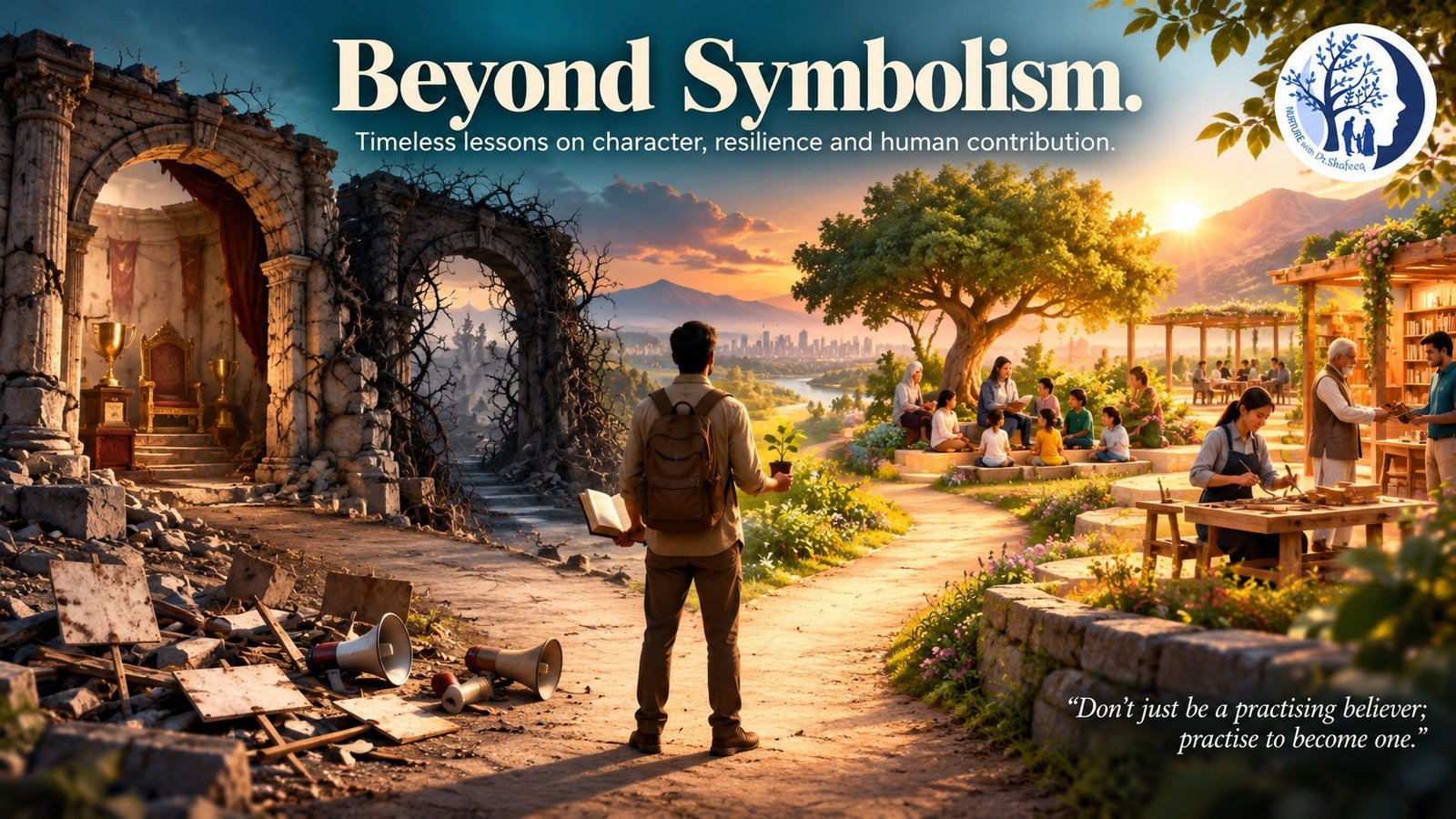
The lecture concludes with a memorable challenge: “Don't just be a practicing believer; practice to become one.”
Faith, philosophy, and ideals are not static labels to wear like badges of pride. They are dynamic, daily practices designed to refine human character, foster social harmony, and serve mankind. When we prioritize moral integrity, thoughtful action, and genuine contribution over noise and division, we fulfill our highest shared human purpose.
Dr. Shafeeq Ahmed S.M
Pediatrician, child psychologist, parenting coach, and career & life counsellor with over 20 years of experience. Read full bio →