Faith Is Not a Shortcut: The Real Reasons Communities Rise and Fall
Faith Is Not a Shortcut: The Real Reasons Communities Rise and Fall
Dr. Shafeeq Ahmed
A young student once asked a difficult question: "If faith brings real well-being, why do some societies that keep religion out of public life lead in science, industry and governance, while many Muslim communities are stuck behind?"
Slogans can't answer this, and neither can sorting the world into believers and non-believers. It needs honest reflection. It starts by separating two questions that are often confused: how God values a people morally and spiritually, and what laws govern material progress in this world. The two are related, but they are measured differently.
Change starts from within
The Qur'an sets out a principle that applies to every people: "God does not change the condition of a people until they change what is within themselves" (13:11). "What is within" does not just mean good intentions. It means a community's mindset, priorities, ethics and shared conscience.
Blessings are not only wealth. Peace, mutual trust, justice, a love of learning, strong institutions and stability are blessings too. When a community starts treating them as permanent rights instead of responsibilities that have to be earned, it begins to lose them.
We may recite these verses every day. But kissing a book and placing it on a high shelf is very different from making its principles the spirit of our homes, businesses, schools and community bodies. Reading a prescription aloud does not cure the patient.
Rise, comfort and decline
The fourteenth-century scholar Ibn Khaldun, often called the father of sociology, saw a cycle in history. A group bound by strong solidarity, simplicity and sacrifice rises even with few resources. Once it is comfortable, it slips into luxury and complacency, and the bonds weaken.
He compared it to a building. The first generation builds it with sweat, the second appreciates it, the third maintains it only for show, and the fourth assumes it will stand on its own. That is when it collapses.
The Qur'an makes the same point: "These are the days We alternate among people" (3:140). No decline is permanent, and no rise is guaranteed.
Justice keeps a society standing
The scholar Ibn Taymiyyah is widely quoted as saying that God sustains a just state even if it is not a believing one, but not an unjust state even if it is. The Qur'an says that God does not destroy communities "while their people are reformers" (11:117). The word used is not just "righteous" (salihun) but "reformers" (muslihun): people who actively stand against wrongdoing.
Personal piety alone is not enough. If our markets cheat, our community trusts are mismanaged, merit is pushed aside for family connections, and we stay silent, individual prayers will not protect the community. Ibn Khaldun wrote that "injustice signals the ruin of civilization." When people feel their effort will not be rewarded fairly, they stop building.
The Qur'an tells us to be just "even against yourselves, your parents and your relatives" (4:135). Too often we excuse corruption in our own circles and see only conspiracy in other people's success.
The law of effort applies to everyone
"A person gets only what they strive for" (53:39). This world runs on cause and effect. Fire burns a believer's hand and a non-believer's alike. Water carries anyone who knows how to swim.
The conditions for collective progress are universal: quality education, open research, equal rule of law, punctuality, transparency, strong institutions and respect for talent. Any society that follows them prospers, whatever it believes. Reciting a creed does not turn anyone into a surgeon or an engineer without years of study. Why would we expect it to work that way for a whole community?
Avoid both extremes
Two attitudes keep us stuck:
Blaming everything on others. Outside pressures and injustices do exist and should be addressed through lawful, constructive means. They cannot explain every failure.
Despair. Treating every hardship as divine punishment and giving up.
The Qur'an balances both views. Some hardships are trials (2:155), but "whatever misfortune befalls you is because of what your own hands have earned" (42:30). Generations of neglected education, weak institutions, nepotism and lack of research cannot be dismissed as trials alone.
Many areas are entirely within our control:
running schools and madrasas that teach critical thinking alongside values;
managing community endowments and charities honestly;
encouraging young people towards research, civil services, entrepreneurship and technical skills;
choosing leaders on merit, not family ties;
serving the wider society, whatever its faith, as good neighbors and citizens.
Nobody stops us from doing these things.
From lament to rebuilding
Faith gives a community direction, meaning and moral strength. It does not replace knowledge, hard work, discipline or justice. It should push us to pursue them. Every educator, student, trader and community leader can ask:
Is the devotion we show in places of worship also reflected in honesty in our businesses and fairness in our dealings?
Are our institutions only producing degrees, or are they encouraging curiosity and research?
Do we stand for merit, trust and the rule of law, even when it is uncomfortable for our own group?
The real question is not why others moved ahead. It is what we have done with our talents, resources and values.
Final thought
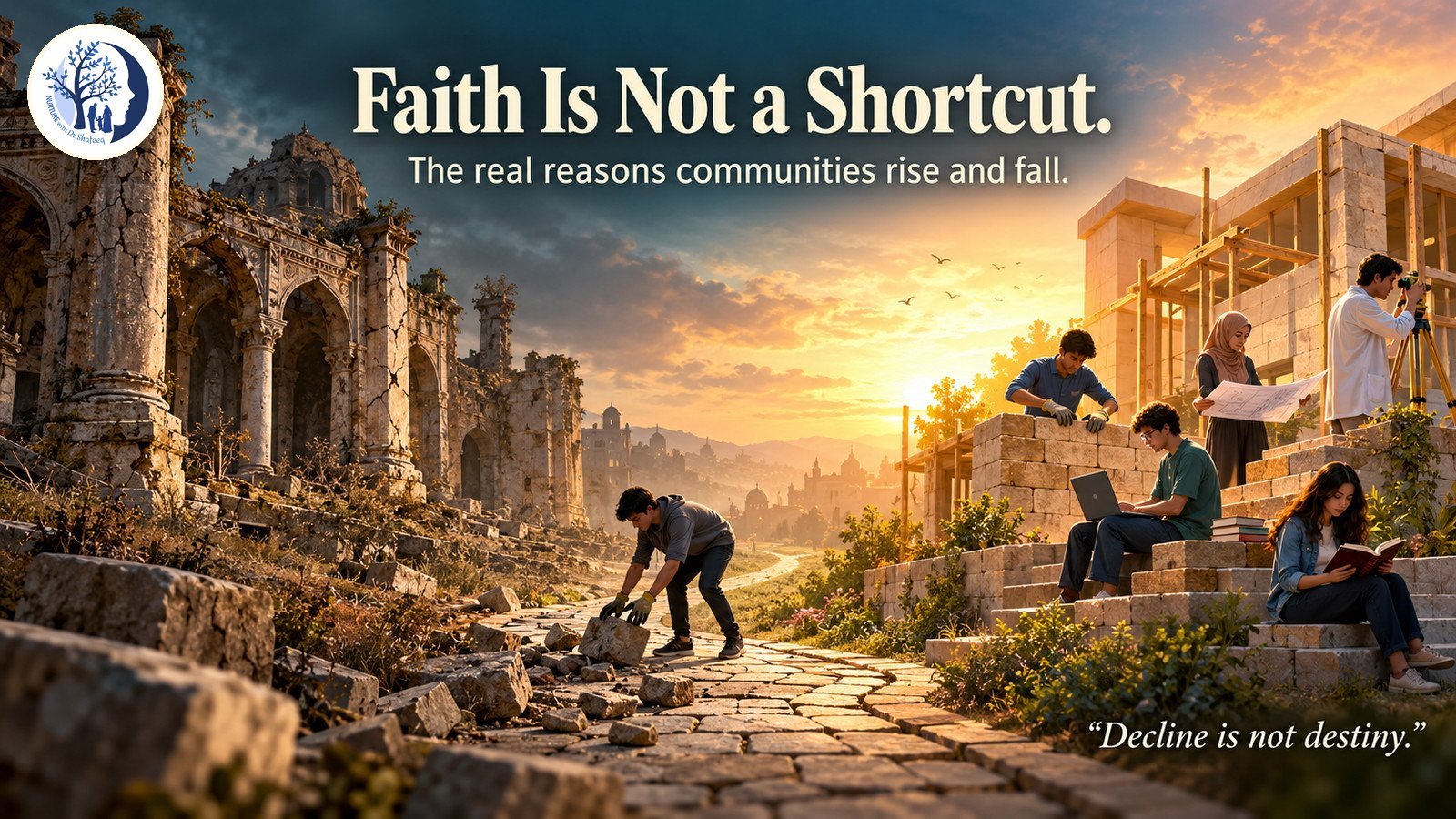
Decline is not destiny, and success belongs to no one by birthright. When we replace slogans with action, prejudice with justice, ignorance with learning and division with unity, the law of change will start working in our favor. Progress doesn't wait for people who complain about the stones on the road. It comes to those who pick up their tools and build a new one.
Dr. Shafeeq Ahmed S.M
Pediatrician, child psychologist, parenting coach, and career & life counsellor with over 20 years of experience. Read full bio →