She Checks on Our Newborns. Who Checks on Her Security?
She Checks on Our Newborns. Who Checks on Her Security?
Why the conversation about ASHA workers must go beyond praise—and beyond an unverified pay chart.
By Dr. Shafeeq Ahmed
Picture a mother at home with her newborn. Feeding is difficult, the baby seems unusually sleepy, and the family is unsure whether to seek help.
Now picture an ASHA worker arriving at the door—listening, asking questions and helping the family connect with healthcare.
This is an illustrative scene, but the responsibilities behind it are real. ASHAs are formally involved in newborn home visits, identifying and referring sick newborns, and helping mobilize families for immunization. Their work connects households with services that might otherwise feel distant or difficult to navigate.
But when we discuss the security of mothers and children, how often do we also ask about the security of the women supporting them?
A Chart That Raises Questions
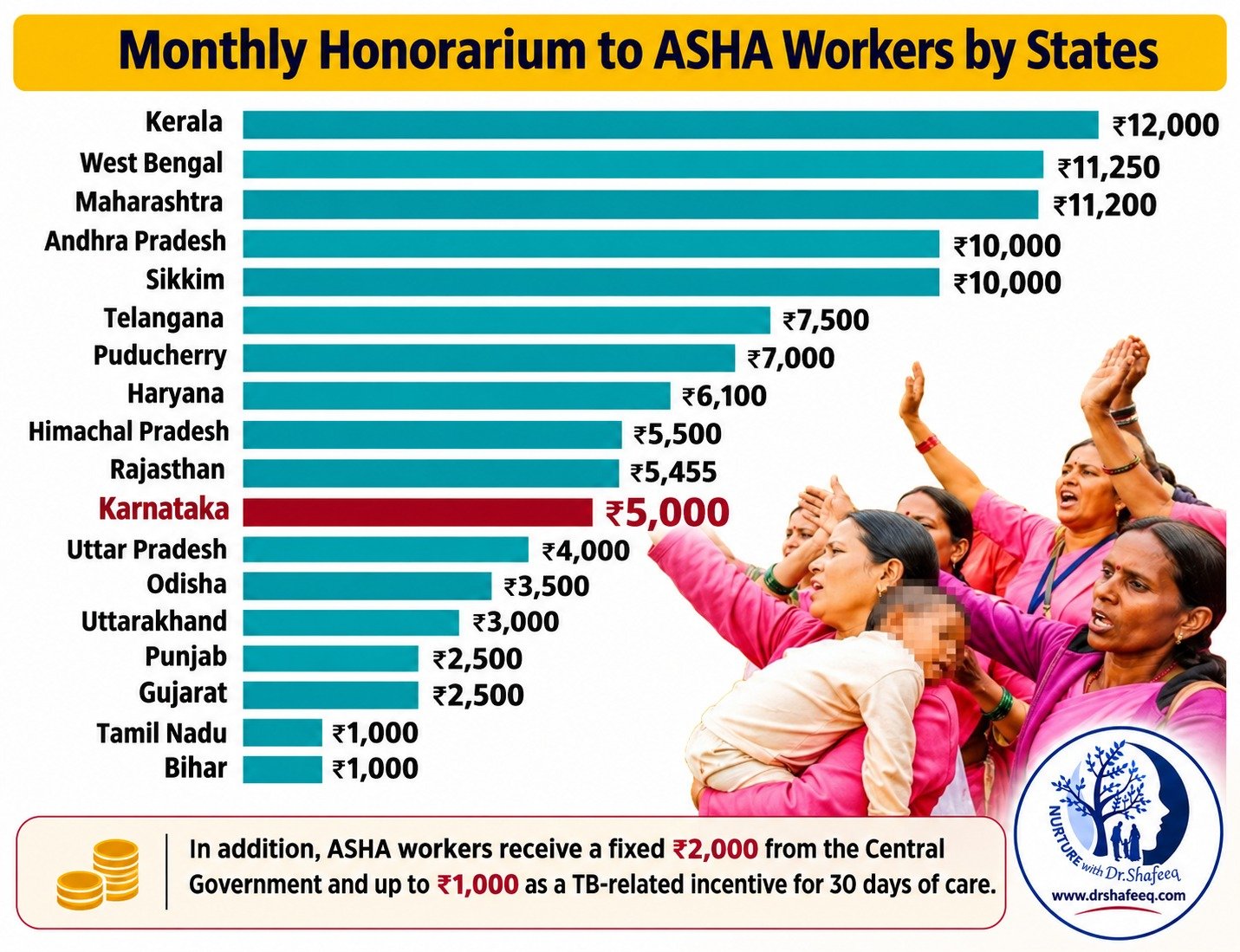
A Kannada graphic comparing ASHA workers’ monthly honoraria prompted this reflection. It shows substantial differences between states, with Karnataka highlighted at ₹5,000.
At first glance, the conclusion seems straightforward: similar responsibilities, very different financial recognition.
But a closer look requires caution.
The graphic has no visible publication date or original source. Some figures match available reports; others are outdated or insufficiently explained. Bihar’s ₹1,000 entry, for example, does not reflect a subsequently reported announcement increasing the state payment to ₹3,000. An announcement, however, is not by itself proof that every worker has received the revised amount.
We should neither dismiss the concerns the chart raises nor repeat every number as established fact.
Workers deserve accurate reporting as much as they deserve public attention.
What Does “Monthly Pay” Actually Include?
One difficulty is that ASHA remuneration is not necessarily a single, uniform salary.
Government information describes several components: payments for routine and recurring activities, incentives for particular tasks, additional state support and performance-linked team incentives. These categories should not be combined casually or compared as though they mean the same thing everywhere.
Even the central routine-incentive figure needs careful dating. A November 2024 government statement specifies ₹2,000 monthly, while July 2025 reporting quotes a parliamentary response announcing an increase to ₹3,500. The published NHM incentive schedule examined during verification still reflects the earlier arrangement, making the operative order and implementation date important.
This may sound like an administrative detail. For a household planning food, rent or school expenses, it is anything but.
There is a difference between money that is assured, money that depends on completed activities, and money that has been announced but whose payment status remains unclear.
A meaningful comparison must therefore ask: What is payable? Under what conditions? When does it reach the worker?
Behind Every Payment Is a Household
Imagine planning a family budget without knowing exactly which payments will arrive that month. Consider the difficulty of making commitments when part of the expected income depends on documentation, verification or performance conditions.
These are questions to investigate through workers’ experiences and payment records—not assumptions to make about every ASHA.
But they deserve investigation.
As a pediatrician, I see a particular reason to take this seriously: community healthcare does not begin and end at the clinic door. Newborn follow-up and immunization mobilization are recognized parts of ASHA work. The conditions supporting that work belong within our discussion of healthcare quality.
Appreciation Must Become Practical
Calling someone a “health hero” can express genuine gratitude. It should not replace a conversation about fair treatment.
A constructive policy discussion would ask:
Are payment components and eligibility conditions clearly explained?
Are completed activities verified and paid within a predictable timeframe?
Are work-related expenses recognized?
Are responsibilities realistic and clearly defined?
Can workers resolve payment discrepancies without an exhausting process?
Are protections adequate when illness, injury or family emergencies arise?
These questions need not become a contest between states or political parties. They are questions about how responsibly we organize essential community services.
National human-rights discussions have also raised the need to address remuneration disparities and improve dignity at work for ASHA and Anganwadi workers.
Better Evidence, Greater Respect
Before publishing a league table, we should check dated government orders, distinguish payment components and listen to workers about what they actually receive. A revised rate on paper and dependable income in practice are related—but different—questions.
The graphic may have started the conversation. It should not set its limits.
The deeper issue is whether our appreciation is matched by clear arrangements, fair expectations and reliable support.
We ask ASHA workers to help families recognize risks, seek care and protect their children’s health. In return, we should be willing to examine the conditions under which they serve.
An ASHA worker’s commitment deserves appreciation. Her livelihood deserves more than appreciation.
#NurtureWithDrShafeeq

Dr. Shafeeq Ahmed S.M
Pediatrician, child psychologist, parenting coach, and career & life counsellor with over 20 years of experience. Read full bio →