Step by Step: The Wisdom of Gradualism
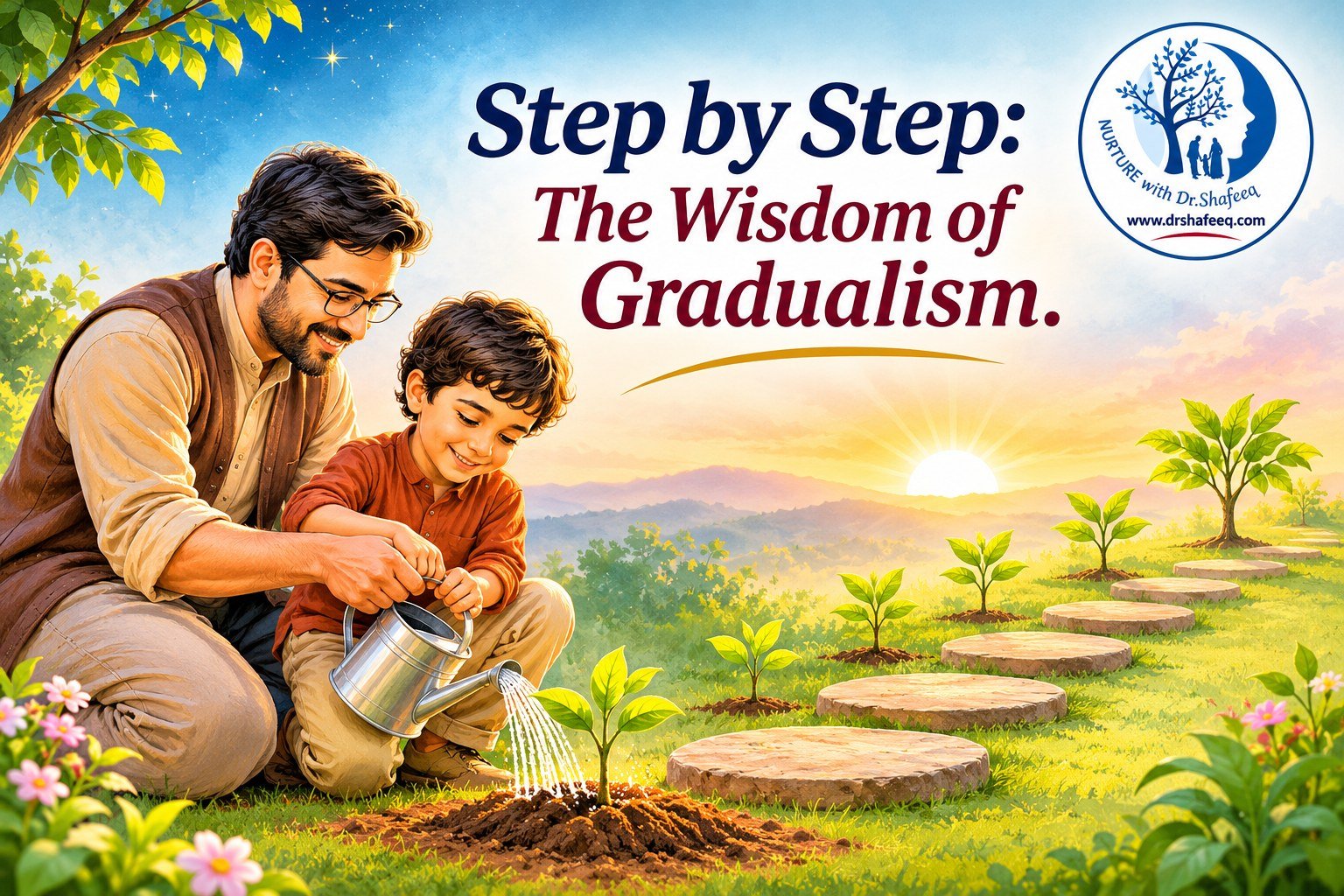
Step by Step: The Wisdom of Gradualism
Why children, like everything that truly grows, cannot be rushed
By Dr. Shafeeq Ahmed
No farmer plants a seed in the morning and expects fruit by evening. No one teaches a baby to walk by placing her at the start of a race. Yet in parenting we often forget this simple truth. We want our children to be responsible, confident, kind and disciplined, and we want it now.
We expect a toddler to share, a seven-year-old to manage big emotions, and a teenager to make wise decisions alone. We forget the long, patient steps that lead there. Real growth has always followed one quiet rule: step by step.
A lesson written into creation itself
Pause and consider how the universe came to be. Those who believe in God know that nothing is beyond His power. He needs only to say "Be," and it is. The Qur'an says so in more than one place.
Yet the same Qur'an tells us He created the heavens and the earth in six days. Classical scholars noticed this and asked why. Imam al-Qurtubi observed that God could have created everything in an instant but chose a measured course. One of the reasons he gave was to teach His servants calm deliberation in their affairs. Others reasoned that if the One who never errs creates in stages, then those of us who do make mistakes should act with even more care.
Scholars have offered several explanations for the six days, and only God knows the full wisdom. Still, this one speaks to every parent. The Creator could have hurried, and He did not.
Seen this way, the six days read as a gentle invitation. They ask us to trust the process and to stop demanding instant results from small, growing human beings.
Children are built in stages
Child development research tells a consistent story. Children grow through stages, and each stage lays the foundation for the next. The prefrontal cortex governs self-control, planning and judgement, and it keeps maturing into the mid-twenties. A child's ability to wait, to think before acting and to manage strong feelings does not switch on at a certain birthday. It is built slowly, through thousands of small experiences.
When we ask for skills a child's brain is not yet ready for, we set that child up to struggle. Worse, the child may begin to believe that he is the failure. Gradualism protects a child's sense of worth. We match our expectations to the stage the child has reached, then raise the bar gently as he grows.
The scaffold that comes down slowly
Psychologists describe good teaching as scaffolding. Builders put a scaffold around a new building to support it as it rises. They remove it piece by piece as the structure grows strong enough to stand alone. Parenting works the same way.
Think of a child learning to tie her shoelaces. First, we tie them while she watches. Then we tie them together, our hands guiding her small fingers. Then she tries while we encourage. Finally, one proud morning, she does it alone.
Remove the scaffold too early and the child gives up. Never remove it and the child never learns. The art lies in knowing which piece to take away next.
The psychologist Lev Vygotsky called the space between what a child can do alone and what she can do with help the "zone of proximal development." Real learning happens in this zone, where a task is neither too easy nor too hard.
Feelings grow step by step too
A screaming two-year-old is not being naughty. He does not yet have the inner tools to calm himself. Children first learn to regulate emotions by borrowing our calm. When we hold them, speak softly and name their feelings, we lend them a steady nervous system. Over years, through countless repetitions, they learn to do it for themselves.
This is why "Stop crying!" rarely works, while "I can see you are upset. I am here" eventually does. One demands an instant change. The other builds a skill.
Responsibility in small portions
Responsibility is best given in growing portions:
A three-year-old can put toys back in a basket.
A six-year-old can lay the table and pack her school bag.
A ten-year-old can manage pocket money and a small household chore.
A teenager can plan a week, cook a simple meal and take ownership of his studies.
Each small success tells the child, "You are capable," and prepares the ground for the next step. Freedom follows the same rule. Trust that is given gradually and earned gradually builds stronger young adults than freedom that arrives all at once at sixteen or never arrives at all.
A pattern older than parenting books
This wisdom is not new. It runs through the way guidance has reached humanity. The Qur'an was revealed over about twenty-three years. When the disbelievers asked why it was not sent down all at once, the answer was that it came in stages to strengthen the Prophet's heart and was spaced out so it could be recited and absorbed over time. Hearts were prepared first. Habits were then reformed gradually, in keeping with the people's readiness.
A well-known prophetic teaching advises that children be told to pray at the age of seven, with firmness coming only at ten. That is years of gentle practice before any insistence.
If the Creator of the universe chose measured steps, how much more should we, as parents, choose patience with our children?
Habits are not built overnight
The research here is often misquoted. A well-known UCL study found that building a new daily habit took 66 days on average. Individual cases ranged from 18 to 254 days, depending on the person and the behavior. So, there is no magic number, and complex habits can take many months.
Yet we try to fix five things at once: screen time, homework, manners, sleep and eating, all starting Monday. The child feels overwhelmed, the parent feels frustrated, and nothing lasts.
A wiser path is to choose one change at a time. Settle bedtime first. When it holds, move on to homework routines. Celebrate small progress rather than waiting for perfection. Quiet consistency over weeks achieves more than intensity that burns out in days.
The patience of a gardener
Gradualism does not mean lowering our standards. It is the most reliable way to reach them. It means holding a clear picture of who we hope our child will become, while walking beside them one realistic step at a time. It means forgiving setbacks, because growth is rarely a straight line. And it means remembering that comparison has no place in a garden where every plant blooms in its own season.
So tonight, choose one small step. Pick one habit to nurture, one skill to scaffold, or one feeling to help your child understand. Repeat it tomorrow, and the day after.
Years from now you will look at a confident, caring young person and realize that the most important things in their life were not built in a day. They were built step by step, with love.
#NurtureWithDrShafeeq

Dr. Shafeeq Ahmed S.M
Pediatrician, child psychologist, parenting coach, and career & life counsellor with over 20 years of experience. Read full bio →