Beyond Celebration: Building a Vibrant Future for Urdu
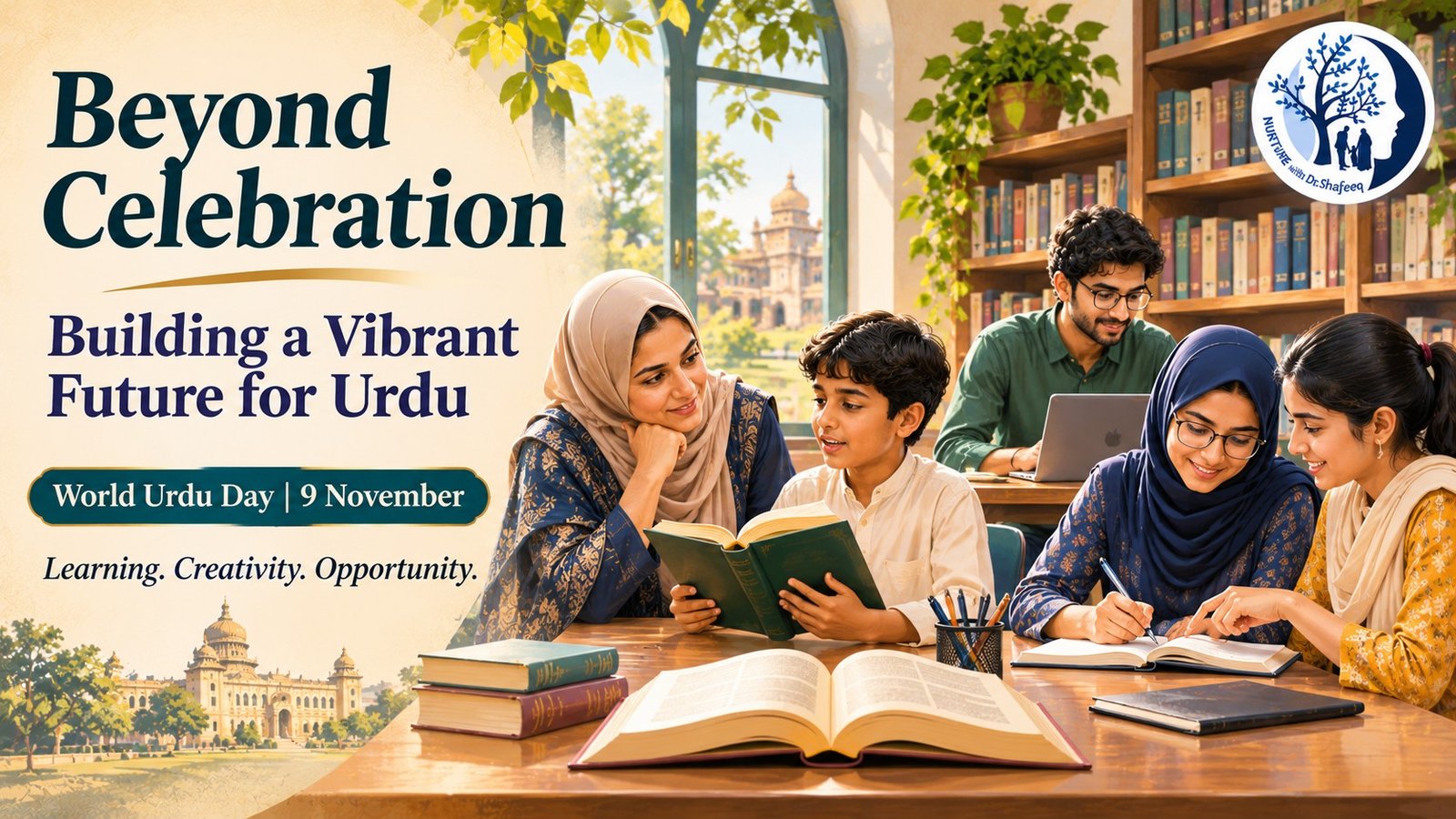
Beyond Celebration: Building a Vibrant Future for Urdu
This World Urdu Day, let us turn our love for the language into learning, creativity and opportunity.
By Dr. Shafeeq Ahmed
Every year, 9 November brings an opportunity to celebrate Urdu through poetry, literary gatherings and tributes to Allama Muhammad Iqbal, whose birth anniversary coincides with World Urdu Day.
These celebrations have value. They remind us of a language that carries memories, ideas, affection and a rich literary inheritance. But once the program ends and the applause fades, an important question remains:
What are we doing to make Urdu a living part of the next generation’s future?
Can a child find an engaging Urdu book? Can a teacher access meaningful support? Can a young person use Urdu to explore science, create digital content or develop a professional skill?
The challenge is not to choose between honoring Urdu’s heritage and preparing it for contemporary life. It is to do both.
A language’s future needs participation, not admiration alone.
Start with the Child, Not the Ceremony
A meaningful commitment to Urdu should begin with children’s ability to read, understand, speak and write it confidently.
That means looking beyond recitation and handwriting competitions. These activities can be enjoyable, but they should be accompanied by regular opportunities to explore stories, ask questions, express opinions and write in their own words.
Schools and community organizations could establish reading corners, lend books to families and organize small storytelling circles. Children who speak Urdu at home but cannot read its script should have welcoming opportunities to learn, without embarrassment or criticism.
The goal should not be to test their loyalty to the language. It should be to help them experience the pleasure and usefulness of knowing it.
Support the Teacher Behind the Language
Urdu cannot be strengthened by placing expectations on teachers without providing practical support.
Teachers need appropriate materials, time for preparation and opportunities to improve their practice. Professional development should move beyond occasional lectures and certificates towards demonstration, mentoring, classroom practice and constructive feedback.
A useful training program should help teachers address real questions: How can a hesitant reader be supported? How can writing become more meaningful? How can children with different levels of proficiency participate in the same lesson?
For Karnataka, a coordinated effort among the relevant education authorities, the Directorate of Minorities, Karnataka Urdu Academy and teacher-education institutions could help turn these needs into a sustained program rather than a series of disconnected activities.
Let Languages Strengthen One Another
Families should not be asked to choose between cultural connection and educational opportunity.
The practical objective should be strong Urdu alongside effective Kannada and English learning. Students need support to move confidently between languages, particularly when their medium of instruction changes.
Multilingual glossaries, bridging courses and clear explanations of subject terminology could help. Equally important is the message given to families: learning Kannada and English need not require abandoning Urdu, and valuing Urdu should not mean limiting a child’s wider opportunities.
This approach should also welcome children from any religious or linguistic background who wish to learn Urdu. A language grows through invitation, not exclusion.
Give Urdu a Place in Contemporary Knowledge
Urdu deserves space not only in poetry and remembrance, but also in discussions about science, technology, health, the environment and careers.
Schools, universities, publishers and community organizations could collaborate to produce accessible materials on these subjects. Young people could be encouraged to write explainers, conduct interviews, translate useful information and create educational audio or video content.
Digital publication should prioritize accuracy, readable Urdu script, mobile-friendly presentation and accessibility. New tools, including artificial intelligence, should support this work without replacing human judgment and careful review.
The objective is not simply to launch another website. It is to create resources people find useful enough to return to.
Connect Language with Skills and Opportunity
Affection for a language becomes easier to sustain when people can also use it meaningfully.
Practical programs could combine Urdu proficiency with translation, editing, journalism, subtitling, publishing, audio production and educational content development.
However, training should be grounded in actual demand. Before promising employment, program organizers should identify credible assignments, mentors, internships and potential clients.
A completed portfolio, a supervised translation or a useful publication can offer a stronger beginning than a certificate unsupported by practical experience.
Turn Libraries into Places People Use
A library should be more than a room where books are stored.
It can become a welcoming place for reading, discussion, homework support and intergenerational learning. Small grants could support updated collections, regular opening hours, children’s activities and accessible materials.
Families have a role too. Reading one short story together, discussing an article or helping a child select a book can make Urdu part of ordinary life rather than an occasional cultural obligation.
Young people should also be invited to shape these spaces. Let them recommend books, organize discussions and create publications. They should be contributors to Urdu’s future, not merely an audience for its past.
Replace General Concern with Clear Action
Concern about a language’s future should lead to specific questions and practical decisions.
For Karnataka, a district-wise assessment could identify where support is most needed: teacher availability, learning materials, reading proficiency, school transitions and demand for additional Urdu classes.
Funding should have clear criteria and transparent reporting. Program should be evaluated through learning and sustained participation—not only the number of events held or photographs published.
A manageable first-year initiative could bring together five priorities:
Foundational reading and writing support.
Continuing teacher mentoring.
Voluntary Urdu classes beyond Urdu-medium schools.
Active libraries and reviewed digital resources.
Youth-led creative and practical projects.
The purpose would be to learn what works, improve what does not and expand responsibly.
A More Meaningful World Urdu Day
Literary gatherings and anniversary tributes should continue. But each celebration can also leave something lasting behind: a reading group, a supported teacher, an accessible book collection or a young person’s first completed piece of writing.
Urdu should not be presented to the next generation as a fragile inheritance they must carry out of guilt. It should be offered as a language they can enjoy, question, create in and make their own.
This World Urdu Day, let the celebration open a door that remains open after 9 November.
The most meaningful tribute to Urdu may be a child who begins reading it with confidence—and a young person who discovers something worthwhile to do with it.
NurtureWithDrShafeeq
Nurturing relationships, learning and a fresh perspective.
Dr. Shafeeq Ahmed S.M
Pediatrician, child psychologist, parenting coach, and career & life counsellor with over 20 years of experience. Read full bio →