Iqbal and Azad: Beyond Portraits and Quotes
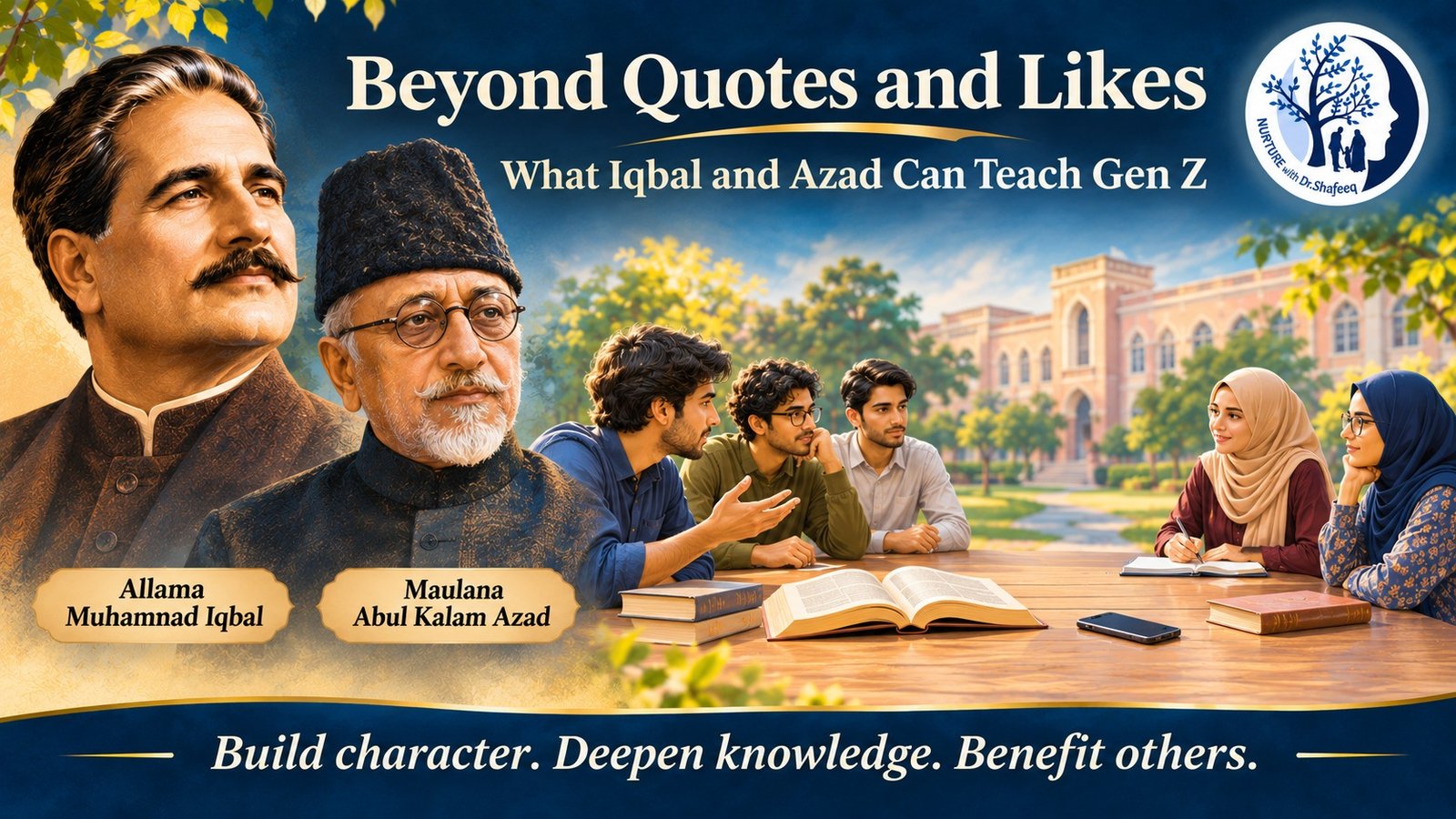
Iqbal and Azad: Beyond Portraits and Quotes
An invitation to Gen Z: discover your purpose, deepen your knowledge, and make your abilities useful.
By Dr. Shafeeq Ahmed
You open your phone for a moment. Someone has secured a scholarship. Someone has launched a business. Someone your age seems to have life completely figured out.
Suddenly, your own progress feels inadequate.
But there is a question worth asking before measuring yourself against another person’s highlight reel: What kind of person are you becoming—and who benefits from what you know?
November offers an opportunity to explore that question through two influential figures: Allama Muhammad Iqbal, born on 9 November 1877, and Maulana Abul Kalam Azad, born on 11 November 1888. Their anniversaries can become more than occasions for sharing portraits and quotations. They can invite a thoughtful conversation about identity, education and responsibility.
Iqbal: Build Yourself from Within
Iqbal was a poet and philosopher whose work gave particular importance to Khudi, often translated as selfhood. Rather than reducing this complex idea to a motivational slogan, we can approach it as an invitation to examine how a purposeful, responsible self develops.
For a young person today, a useful starting question is: Are your choices guided by considered values—or mainly by comparison and approval?
Recognizing your worth does not require believing you are better than others. It can mean taking responsibility for your abilities: developing them patiently, acknowledging mistakes and refusing to let one disappointment define your whole identity.
Consider the everyday choices:
Choosing honest preparation over cheating.
Learning a difficult skill instead of merely collecting tutorials.
Examining an argument rather than repeating the loudest opinion.
Trying a different approach after failure rather than declaring yourself incapable.
These are contemporary applications for reflection, not quotations attributed to Iqbal.
The invitation is not to become endlessly productive or appear permanently confident. It is to develop an inner direction strong enough to withstand distraction—and the humility to keep learning.
Azad: Let Education Widen Your World
Maulana Abul Kalam Azad was a scholar, journalist and independence leader who became independent India’s first education minister.
His life offers a starting point for another question: What should education enable us to do beyond earning a qualification?
A degree can open a door. But education should also help us examine evidence, understand unfamiliar perspectives and make responsible decisions when easy answers are tempting.
Learning a skill to support yourself and your family is worthwhile. Using that skill to help a small business, guide a younger student or make information accessible can extend its value.
Azad opposed the partition of India and advocated a united country that included different religious communities. Without overlooking that specific historical context, his position can prompt a relevant discussion today: can we remain rooted in our identities while working respectfully with people whose backgrounds and beliefs differ from ours?
That discussion becomes meaningful through ordinary conduct. Read before reacting. Check a claim before forwarding it. Listen before assigning a label. Disagree with an argument without humiliating the person making it.
A strong identity need not depend on making someone else feel smaller.
Respect the Differences, Study the Ideas
Iqbal and Azad should not be presented as interchangeable thinkers: their political visions differed significantly. Respecting them does not require hiding those differences or accepting every position without question.
A meaningful introduction to historical figures should leave room for context, complexity and thoughtful disagreement.
For Gen Z, the challenge is to move beyond the quotation card. A sentence on a beautiful background may attract attention, but understanding requires asking where it came from, what it meant and whether it has been accurately attributed.
Teachers, families and youth groups can make these anniversaries more useful through a few simple activities:
Read a short, verified passage from each thinker and discuss its context.
Explore the difference between confidence and arrogance, or disagreement and hostility.
Connect one idea to a real decision involving study, friendship or work.
Turn learning into a modest act of service, such as mentoring a student or organizing a reading circle.
The purpose is not to place the past beyond criticism. It is to let a serious encounter with the past improve the quality of our thinking today.
Perhaps the most meaningful tribute is not another polished anniversary post. It is a young person becoming more thoughtful about their identity, more disciplined in learning and more generous with their abilities.
Which small habit could you begin this week that would strengthen your character and make your knowledge useful to someone else?
NurtureWithDrShafeeq
Nurturing relationships, learning and a fresh perspective.
Dr. Shafeeq Ahmed S.M
Pediatrician, child psychologist, parenting coach, and career & life counsellor with over 20 years of experience. Read full bio →