Beyond Community, towards a Stronger Country: Let Education Unite Us
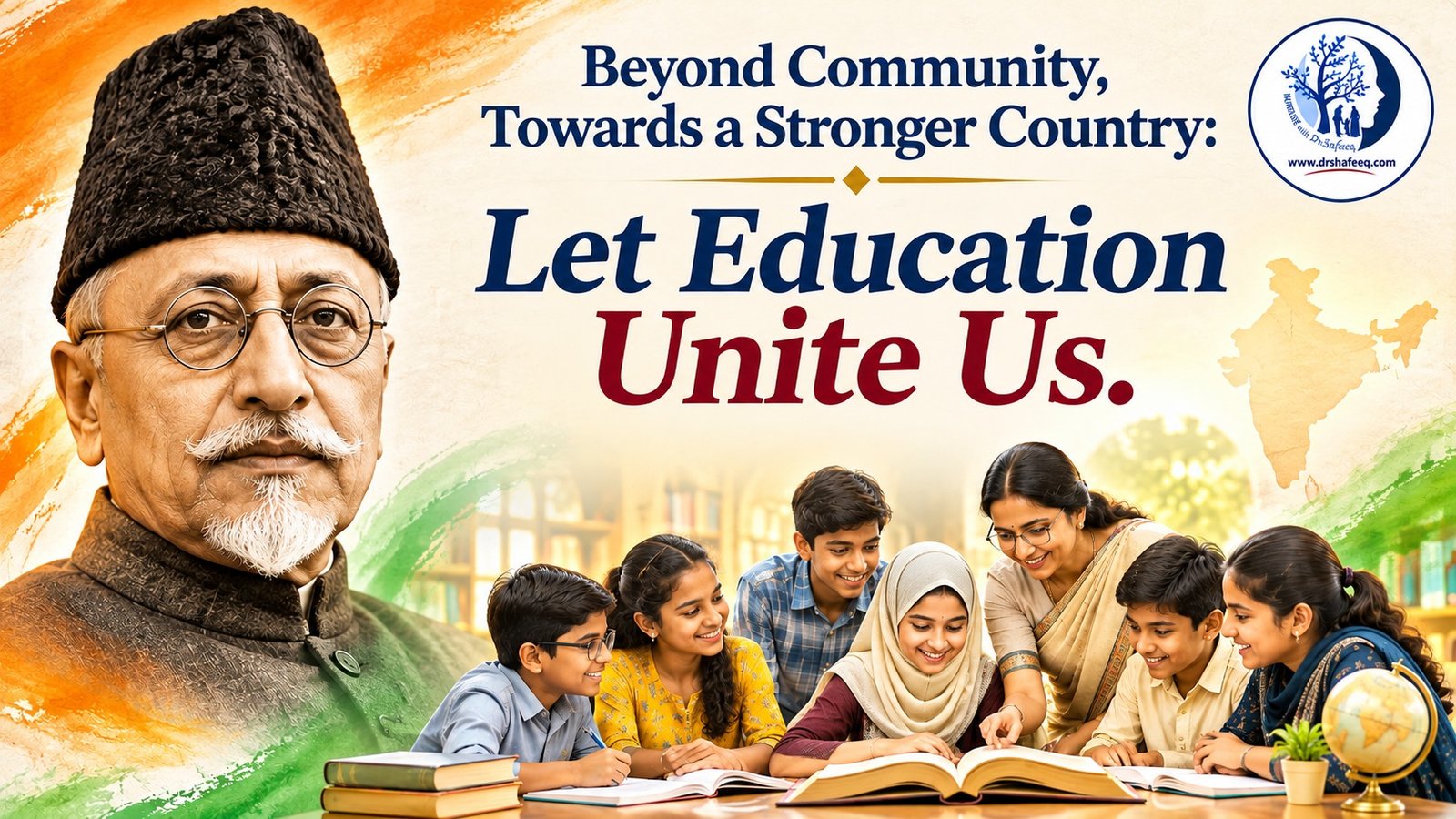
Beyond Community, Towards a Stronger Country: Let Education Unite Us
Maulana Abul Kalam Azad’s legacy—and our responsibility to turn respect for knowledge into opportunity for every child
Dr. Shafeeq Ahmed
We garland their portraits. We quote their words. We celebrate their anniversaries.
But do we carry their vision into our classrooms?
Maulana Abul Kalam Azad deserves more than ceremonial remembrance. He deserves to be understood as a builder of modern India: a scholar who brought intellectual depth to public life, a freedom fighter who understood that political independence required educational progress, and a minister who helped translate that conviction into enduring institutions.
As independent India’s first Minister of Education, serving from 1947 until 1958, Azad helped shape the foundations of the country’s educational and cultural development. His priorities embraced primary schools, universities, technical education, adult learning, the arts, and opportunities for girls. His responsibility was not confined to the community into which he was born. It extended to the nation he served.
That is where any meaningful reflection on his legacy must begin.
Freedom Needed Classrooms, Not Just a Flag
Independence brought India the right to determine its future. Education would help its people acquire the capacity to shape it.
Azad’s work addressed that relationship. He advocated free and compulsory education for children up to the age of fourteen, alongside adult education, girls’ education, vocational training, agricultural learning, and technical education. His vision recognized that national progress required opportunities at different ages and across different circumstances—not merely university places for a privileged minority.
This was education understood as nation-building.
A country could not fulfil its democratic promise if learning remained beyond the reach of large sections of its population. Nor could it develop its productive capabilities without investing in knowledge and skills.
Azad’s ambition was therefore larger than increasing the number of educated individuals. It was to help create an educated society.
The Institutions Behind the Vision
It is easy to describe a leader as visionary. The more useful question is: What did that vision help build?
Azad’s record provides a substantial answer.
Technical education for a developing nation
The first Indian Institute of Technology, at Kharagpur, opened in 1951 during his tenure. He also strengthened the All India Council for Technical Education, while the School of Planning and Architecture in Delhi emerged in 1955. These developments helped establish a foundation for advanced technical learning and professional capability.
They connected education with the practical requirements of a new nation: engineering, infrastructure, planning, and the development of expertise.
The larger lesson remains important: national aspirations need institutions capable of developing the people who can fulfil them.
A framework for university development
Azad played a central role in establishing the University Grants Commission, which received its statutory basis in 1956. Its responsibilities included supporting universities through grants and maintaining standards in higher education.
This was more than an administrative achievement. It helped create a durable framework for the expansion and quality of university education.
Azad also recognized universities as institutions with responsibilities to society—not merely organizations that conduct examinations and award degrees.
That principle still offers a demanding test: What does a university contribute beyond its own gates?
Culture as part of national development
Azad’s vision did not divide the nation’s future into useful science and dispensable culture.
He established the Indian Council for Cultural Relations in 1950 and helped establish the Sangeet Natak Akademi in 1953, followed by the Sahitya Akademi and Lalit Kala Akademi in 1954. These institutions supported cultural exchange, performing arts, literature, and visual arts.
Their place in his program reveals the breadth of his thinking.
A country needs engineers and scientists. It also needs writers, musicians, artists, historians, and people capable of understanding experiences beyond their own.
Technical competence helps build a nation’s infrastructure. Cultural understanding helps people inhabit that nation together.
Language in the service of learning
Azad supported primary education in the mother tongue while recognizing the educational and international usefulness of English.
This approach offers an alternative to treating languages as opposing camps.
The educational question should be: Which combination best helps a child understand, express ideas, and gain access to wider opportunities?
Language should become a bridge to knowledge, not another barrier placed before the learner.
The Uncomfortable Question Behind “Iqra”
For Muslim readers, Azad’s contribution carries an additional responsibility.
The opening revelation to Prophet Muhammad, whom Muslims regard as God’s final prophet, began with Iqra—commonly translated as “Read” or “Recite.” The opening verses of Surah Al-‘Alaq connect learning with the pen and with humanity being taught what it did not know.
The Prophet’s description of his own mission reinforces that connection. In a narration recorded in Sahih Muslim, he describes himself as having been sent to teach and make things easy. The expression mu‘alliman muyassiran brings together teaching and the facilitation of understanding.
Consider the moral force of these connections:
A religious tradition whose opening revelation calls to reading. A Prophet who describes his mission through teaching. A scholar from that community who becomes independent India’s first Education Minister.
These should be powerful reasons to place learning at the center of collective life.
Why, then, do educational disadvantages persist among significant sections of Indian Muslims?
The question must be asked honestly—but without turning concern into contempt.
Neither Collective Blame Nor Convenient Excuses
No community is a single, uniform educational story. It would be inaccurate to suggest that Muslims as a whole disregard learning, just as it would be wrong to dismiss the difficulties facing many Muslim students.
Academic discussion drawing on the Sachar Committee and subsequent research identifies interconnected barriers affecting educational access, including inadequate infrastructure, digital exclusion, social stigma, inequalities within the community, and gender-related restrictions.
These problems cannot be solved through moral exhortation alone.
A child needs a functioning school, not merely advice to work harder. A student needs affordable access, not simply reminders of a glorious intellectual past. A girl needs safety, encouragement, and opportunity—not praise for her potential followed by restrictions on pursuing it.
Government and public institutions have responsibilities that cannot be transferred to struggling families.
But recognizing structural barriers should not bring internal reflection to a halt.
Families, educators, religious institutions, and community organizations also need to examine their priorities. Are books, scholarships, mentoring, teacher development, and career guidance receiving sustained attention? Are young people encouraged to ask questions? Are daughters and sons offered comparable opportunities?
The useful question is not, “Who alone is to blame?”
It is, “What must each of us change?”
Pride Must Become Practice
There is nothing wrong with taking pride in Azad. The problem begins when pride becomes a substitute for participation.
“We gave India its first Education Minister” is a statement about history.
“What are we contributing to education today?” is a question about responsibility.
If we invoke Iqra, do we make room for reading in our homes?
If we praise scholarship, do we support students whose circumstances threaten to interrupt their studies?
If we celebrate Azad’s intellectual breadth, do we encourage young people to explore literature, science, history, ethics, and ideas beyond familiar boundaries?
These questions extend beyond Muslims. Every community can become skilled at celebrating its distinguished figures while avoiding the discipline their achievements demand.
The most meaningful inheritance is learning—not the possession of an illustrious name, but the cultivation of an active mind.
What Teachers and Students Can Learn From His Life
It would be unfair to say that no teachers or students learn from Azad. Many already embody dedication, curiosity, and public service.
Yet his life invites a more searching examination of what teaching and studying have become.
For teachers, the challenge is to remain learners.
Teaching should not become the mechanical repetition of a syllabus. It should help students understand, question, connect, and grow. The prophetic emphasis on teaching and making understanding easier offers Muslim educators a particularly meaningful standard—and a principle accessible to educators of every belief.
A good classroom should allow a student to say, “I do not understand,” without fear of humiliation.
For students, the challenge is to move beyond passive admiration.
Sharing a quotation is not the same as reading a book. Remembering an answer is not always the same as understanding it. Receiving a certificate does not end the responsibility to learn.
Azad’s breadth, so vividly recalled in Nayeem Javed Sb’s speech (One mind, Many Universes), invites a larger intellectual ambition: to become capable not only of passing examinations, but of interpreting the world and contributing to it.
No Educational Renewal Without Girls
Azad included girls’ education within his national educational priorities. It was part of his commitment to opportunity across differences of sex and creed.
That principle must remain explicit.
A girl deserves education not only because she may become a better mother, support a household, or contribute to the economy. She deserves it because she is a person with abilities, ambitions, and a future of her own.
Commitment must therefore extend beyond admission to school. It should include the support needed to continue: safe access, financial assistance where necessary, encouragement, and freedom to pursue suitable academic and professional pathways.
An educational vision that leaves daughters behind is incomplete from the beginning.
From Anniversary Speeches to Everyday Commitments
The practical tribute to Azad need not always be grand. It must, however, be real.
Families can protect reading time, discuss learning, and seek help when children struggle.
Schools can invest in teacher development, foundational skills, and understanding rather than memorization alone.
Community organizations can sustain scholarships, libraries, mentoring, and career guidance.
Universities can connect academic knowledge with public needs.
Governments must ensure that educational quality does not depend on a child’s religion, gender, disability, neighborhood, or family income.
These responsibilities reinforce one another. Family effort cannot replace a functioning education system, and public provision cannot replace every form of encouragement a learner needs.
The goal is partnership—not an endless transfer of blame.
A Shared National Inheritance
Azad’s Muslim identity belongs in his story. It helps explain the intellectual traditions from which he drew.
But his national contribution cannot be confined within that identity.
The institutions he helped build and the educational opportunities he advocated were intended to serve India. To remember him only as a source of communal pride would make his legacy smaller than his public purpose.
For Muslim readers, his life invites a renewed connection between reverence for knowledge and educational practice.
For readers of other faiths, or none, it offers an equally important lesson: a person can be deeply rooted in a tradition while working generously for a shared future.
Education is not a contest between communities. It is a matter of national interest.
The finest tribute to Maulana Abul Kalam Azad is not another garland around his portrait. It is a child who stays in school, a teacher who keeps learning, a library that opens its doors, and an institution that serves people beyond its walls.
We need not share the same beliefs to share that responsibility.
We should all agree that no child’s future ought to be limited by their capacity to learn.
#NurtureWithDrShafeeq
Dr. Shafeeq Ahmed S.M
Pediatrician, child psychologist, parenting coach, and career & life counsellor with over 20 years of experience. Read full bio →