DREAM BIG: Why Early Educational Goal Setting Can Transform Student Futures
DREAM BIG: Why Early Educational Goal Setting Can Transform Student Futures
Dr. Shafeeq Ahmed
Every great achievement begins with a clear direction. For school students, especially during Classes 8 to 10, this direction is often missing—not because they lack talent, ambition, or potential, but because they do not receive the right information, mentorship, and support early enough.
India has produced global leaders in science, technology, economics, public policy, business, and research. From Dr. M. S. Swaminathan’s contribution to India’s Green Revolution and Dr. V. Ramakrishnan’s Nobel Prize-winning scientific work, to the leadership of Sundar Pichai, Indra Nooyi, Amartya Sen, Abhijit Banerjee, and Dr. Raghuram Rajan, one common thread stands out: strong educational foundations can create extraordinary possibilities.
For today’s students, the question is not simply, “What marks will I score in Class 10 or 12?” It is: What future do I want to prepare for—and when should I begin?
The answer is clear: early educational goal setting matters.
The Problem: Talent Without Direction
Many capable students reach Class 10 without a clear understanding of the opportunities available to them. They may know broadly about engineering, medicine, commerce, or humanities but often remain unaware of the range of institutions, career pathways, entrance examinations, scholarships, and global undergraduate options open to them.
Premier institutions in India—including IITs, AIIMS, IISc, IISERs, National Law Universities, IIMs through Integrated Programme in Management pathways, Delhi University, and Jawaharlal Nehru University—do not merely offer degrees. They create environments where students learn to think critically, pursue research, solve complex problems, innovate, and lead.
Similarly, leading global universities evaluate applicants through a broader lens. Academic performance is important, but so are standardized tests where applicable, extracurricular engagement, leadership, intellectual curiosity, community contribution, and sustained achievements. These cannot be built overnight in Class 12. They require time, consistency, and planning.
Yet, many students begin thinking seriously about streams and careers only after Class 10. By then, they may have lost valuable years that could have been used for exploration, skill-building, academic strengthening, and confidence development.
Seven Gaps Holding Students Back
The challenge is not a lack of intelligence among students. It is the presence of several structural gaps that prevent talent from turning into achievement.
1. The awareness gap
Students and parents may not know which institutions align with a child’s interests and strengths. They may also be unfamiliar with admission routes, entrance examinations, eligibility criteria, scholarships, and alternative pathways.
A student interested in science, for example, may know about engineering and medicine but may not know about pure sciences, research programmes, liberal arts and sciences, economics, data science, design, law, public policy, or interdisciplinary education.
2. The decision-delay gap
Choosing a goal late often leads to rushed preparation. Competitive exams and holistic undergraduate applications reward sustained effort over several years.
A student who decides in Class 9 that they want to pursue a particular path has time to build strong conceptual foundations, improve study habits, explore interests, and develop a credible academic profile. A student who makes the same decision in Class 11 may have to compress years of preparation into a short and stressful period.
3. The confidence gap
Many students doubt their abilities, compare themselves with peers, or choose familiar paths simply because others are following them. This can result in indecision, unnecessary stream changes, or setting goals that are far below their actual potential.
Confidence does not mean assuming success is guaranteed. It means believing that disciplined effort, informed choices, and the right guidance can create meaningful opportunities.
4. The school-support gap
Schools rightly focus on academic performance and board examinations. However, board marks alone may not fully prepare students for competitive entrance examinations, application-based learning, research-oriented study, interviews, portfolios, or global admissions processes.
Students need structured exposure to career pathways, institutional opportunities, preparation strategies, and profile-building well before the pressure of senior secondary school begins.
5. The parental-support gap
Parents play a decisive role in a child’s educational journey. Emotional encouragement, practical planning, financial preparedness, and the ability to create a stable study environment can make a major difference.
At the same time, parental support should not become pressure. Students need the freedom to explore, make informed choices, learn from setbacks, and grow without fear of failure.
6. The mentorship gap
A talented student without access to mentors may struggle to understand how to convert ambition into action. Mentors can help students identify their strengths, set realistic milestones, discover resources, and remain motivated through setbacks.
Teachers, alumni, subject experts, counsellors, and senior students can all contribute to this support system.
7. The global-profile gap
For international undergraduate admissions, strong grades are necessary but may not be sufficient. Universities often look for evidence of initiative, sustained interest, leadership, creativity, intellectual engagement, and meaningful contribution beyond the classroom.
A student interested in environmental science, for instance, may strengthen their profile through science projects, local sustainability initiatives, reading and research, competitions, internships, writing, or leadership in school-based environmental activities. Such a profile must be built gradually, ideally beginning in Classes 8 or 9.
Why Classes 8 to 10 Matter
The middle-school years are often underestimated. They are treated as a period to “wait and see” rather than a period to discover and prepare. In reality, these years can shape a student’s long-term educational trajectory.
Early goal setting does not mean forcing a 13-year-old to permanently choose one career. Rather, it means helping students develop informed direction.
A student may initially identify broad interests such as:
Science, research, engineering, medicine, or technology
Commerce, entrepreneurship, economics, finance, or management
Humanities, law, public policy, psychology, or international relations
Design, architecture, media, communication, or the creative arts
Sports, social impact, sustainability, or emerging interdisciplinary fields
With exposure and mentorship, these broad interests can gradually become clearer goals. The objective is not rigidity; it is purposeful exploration.
The DREAM BIG Approach
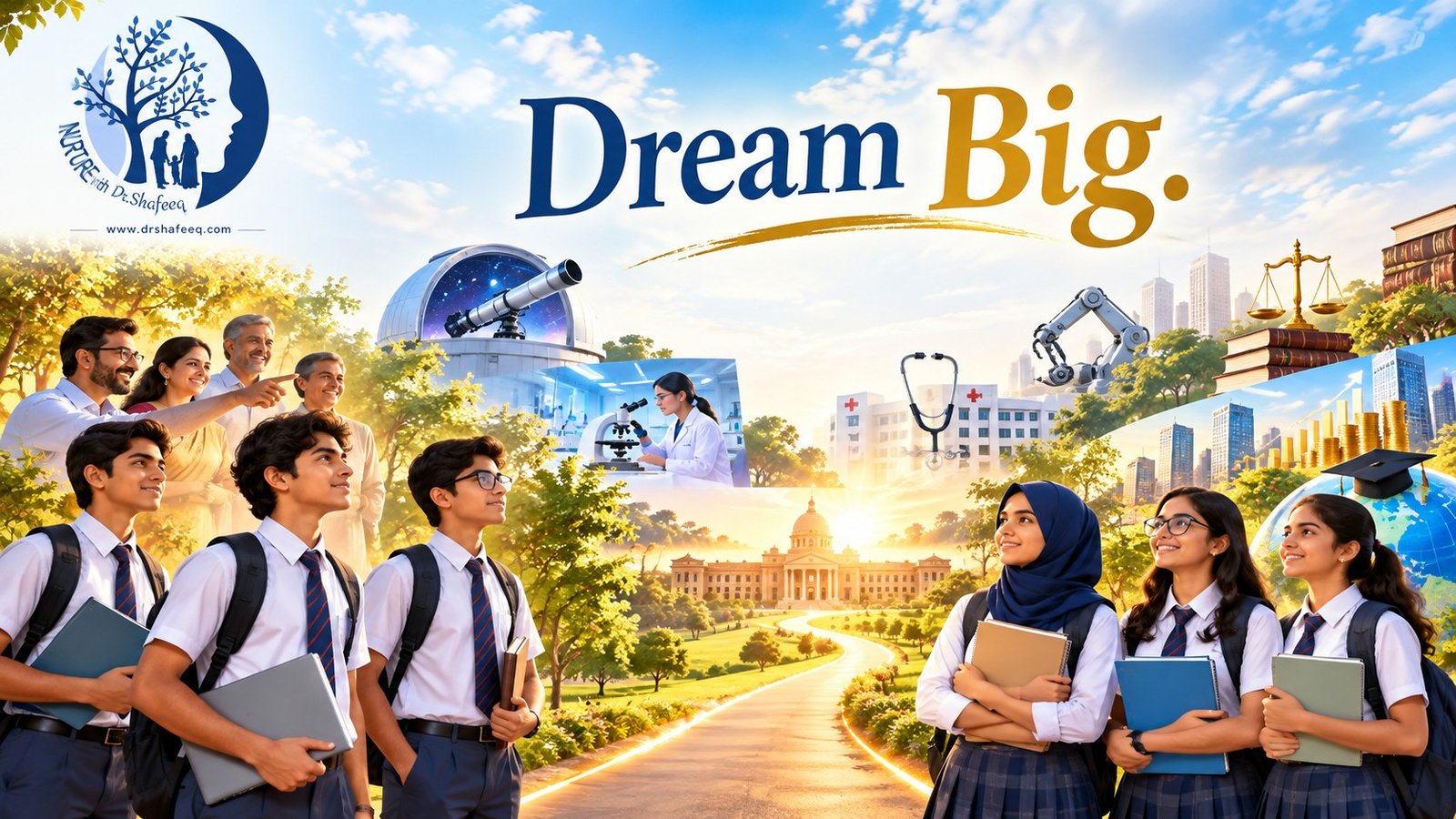
A school-wide culture of early educational goal setting can be built around one simple but powerful idea: DREAM BIG.
This approach encourages students to think beyond immediate examination results and begin planning for the institutions, careers, and contributions they aspire to make in the future.
A meaningful early-goal-setting framework can produce several important outcomes.
A clear goal by Class 8 or 9
Students should be encouraged to identify a preliminary academic stream, target pathway, preferred institutions, and relevant entrance examinations by the end of Class 8 or during Class 9.
This does not lock them into one path forever. Instead, it gives them a working direction that can be reviewed as their interests and abilities evolve.
A three- to four-year preparation plan
Once a student has direction, preparation becomes more structured. A long-term plan can balance school academics with competitive-exam readiness, reading habits, subject enrichment, extracurricular development, and personal growth.
For example, a student aspiring to study engineering may focus on strengthening mathematics and science concepts from Class 9 onward. A student considering law may develop reading, writing, debate, current-affairs awareness, and analytical reasoning. A student interested in global undergraduate admissions may build a well-rounded profile through sustained activities aligned with genuine interests.
Teacher-led academic tracks
Schools can designate enthusiastic teachers as Academic Track Coordinators for major pathways such as STEM, commerce and management, humanities and law, medicine and life sciences, design, and international admissions.
These coordinators can help students access relevant information, connect with mentors, monitor progress, and maintain motivation. Such support can make goal setting a normal part of school culture rather than an individual struggle.
Peer-learning and mentoring forums
Students learn effectively when they interact with peers who share similar aspirations. Stream-specific forums can bring together students, teachers, alumni, and external mentors to discuss courses, entrance exams, preparation methods, scholarships, projects, and career realities.
These forums also reduce isolation. A student preparing for a challenging goal should know that others are facing similar questions and working toward similar ambitions.
Stronger parent-school partnership
Parents should be part of the process from the beginning. When parents understand the nature of a student’s chosen pathway, they can provide more meaningful support—whether through encouragement, scheduling, financial planning, access to resources, or simply creating a positive environment at home.
The most effective support is not “You must succeed at any cost.” It is: “We believe in your potential, and we will support your sincere effort.”
A Culture, Not a One-Time Activity
Educational planning should not be a one-day career counselling session held after Class 10. It should become a continuing school culture.
Students need regular opportunities to reflect on questions such as:
What subjects genuinely interest me?
What problems do I want to solve in the world?
Which institutions and courses suit my aspirations?
What skills do I need to build over the next few years?
What daily habits will move me closer to my goals?
Who can guide me when I feel uncertain?
When schools, parents, teachers, alumni, and mentors work together, students are more likely to become self-aware, disciplined, resilient, and ambitious in a healthy way.
Beyond Admissions: Preparing Future Leaders
The purpose of early educational goal setting is not only to help students gain admission to prestigious colleges. That is an important outcome, but it is not the final objective.
The deeper goal is to help young people discover their strengths, develop intellectual curiosity, build resilience, and prepare to contribute meaningfully to society.
India’s future scientists, entrepreneurs, researchers, policymakers, educators, technologists, economists, and social leaders are sitting in today’s classrooms. Their potential should not depend on chance, late awareness, or access to limited information.
They deserve timely guidance, informed choices, supportive families, committed teachers, and the confidence to aim high.
Conclusion
A student’s future should not begin to take shape only after Class 10. By then, important opportunities may already have narrowed. The journey toward meaningful higher education and future leadership should begin earlier—with awareness, exploration, mentorship, planning, and belief.
Early Educational Goal Setting can help bridge the gaps of awareness, confidence, mentorship, school support, parental support, and long-term planning. It can create students who do not merely prepare for exams, but prepare for purpose.
The message for every student is simple: dream big, start early, stay disciplined, and seek the guidance needed to turn potential into achievement.

Dr. Shafeeq Ahmed S.M
Pediatrician, child psychologist, parenting coach, and career & life counsellor with over 20 years of experience. Read full bio →