Think Early, Decide Slowly
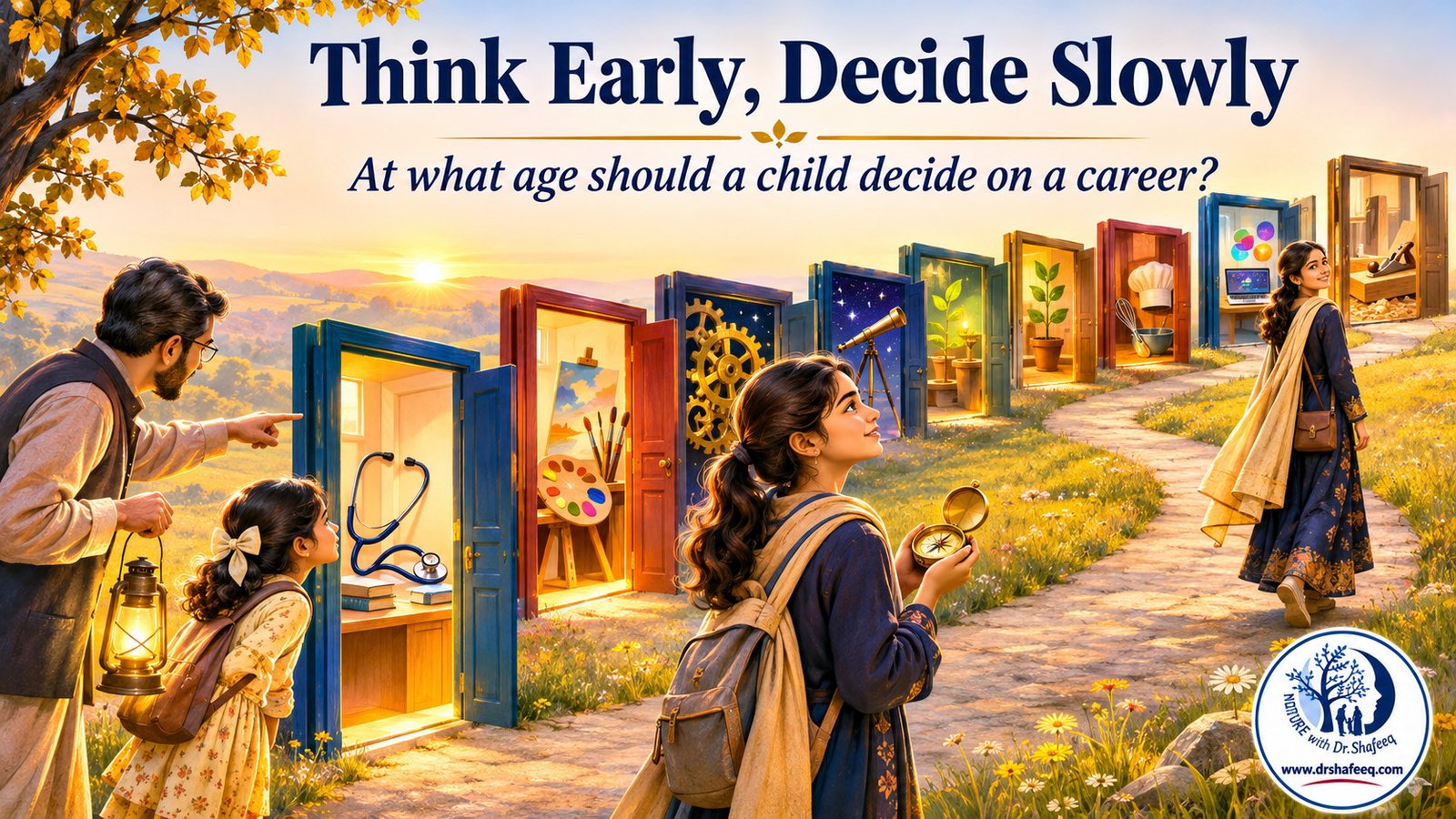
Think Early, Decide Slowly
At what age should a child decide on a career?
Not at five, not at fifteen, and never once and for all. What the science of career development tells parents and teenagers about timing.
By Dr. Shafeeq Ahmed
We start asking the question early. "What do you want to become when you grow up?" At five, the answer is a doctor, a pilot, a police officer or a superhero, and everyone smiles. At fifteen, the same question arrives with a form to fill in, a stream to choose and a deadline. At seventeen, it comes with an entrance exam. And somewhere in the early twenties, for many young people, it returns as a quiet crisis. Did I choose wrong? Is it too late?
In my counselling room, I hear both sides of this question often. Teenagers ask me whether they are already behind because they do not know what they want to be. Parents ask whether it is too early to push, or too late to change course. Underneath both questions is the same worry: that there is a right age to decide, and that we might miss it.
So let me offer the short answer first. There is no single right age. There is a right sequence. Career thinking should begin early, much earlier than most of us imagine. Career deciding should happen slowly, in stages, and should never be treated as final.
What the science of careers actually says
Career psychologists have studied this question for more than half a century, and their answer has been remarkably consistent. Donald Super, one of the most influential figures in the field, described the years from birth to about 14 as a period of growth, when children form a picture of themselves and of the world of work. He described the years from 15 to 24 as the exploration stage: a time for trying things out through classes, work and hobbies, making tentative choices and building skills. Notice the word tentative. Even the theory that shaped modern career guidance does not expect a 15-year-old to make a final decision. It also expects adults to cycle back through exploration whenever their careers change.
A second theory, from the psychologist Linda Gottfredson, carries a warning every parent should hear. Children begin narrowing their options much earlier than we think, and mostly without realizing it. Between the ages of six and eight, they absorb ideas about which jobs are "for boys" and which are "for girls". Between nine and thirteen, they learn which jobs carry status and quietly cross off those that seem beneath them or out of reach. Only from about fourteen do they begin matching jobs to their own interests and abilities. By then, Gottfredson observed, children already see the world of work much as the adults around them do, and many doors have closed before anyone has looked behind them.
The danger is not deciding too late. It is crossing off too early.
Large international studies tell the same story. When the OECD asked more than half a million 15-year-olds what job they expected to have at 30, nearly half of boys and more than half of girls across 41 countries named one of just ten popular jobs, a share that had grown since 2000. Outside the OECD's member countries, the figure often rose above 70 per cent, and the narrowing was strongest among young people from disadvantaged backgrounds. In other words, many teenagers are not choosing from the world of work. They are choosing from the small corner of it they can see.
The same research holds good news. Teenagers who explore, through career talks, workplace visits, job shadowing, volunteering, part-time work and conversations with adults about their interests, tend to do better in work as adults. The OECD found that these activities, mostly between the ages of 14 and 16, were linked with better employment outcomes 10 to 15 years later. Yet across OECD countries, only about half of 15-year-olds had ever spoken to a guidance adviser at school, and only four in ten had visited a workplace or shadowed someone at work.
The brain is still building, and the world keeps changing
There is a biological reason for patience too. The part of the brain behind the forehead, the prefrontal cortex, handles planning, prioritizing and decision-making, and it is one of the last regions to mature. According to the US National Institute of Mental Health, the brain finishes developing and maturing only in the mid-to-late twenties. We are asking a brain that is still under construction to make one of the biggest decisions of life. The same research has a hopeful side: the teenage brain is remarkably adaptable, and challenging classes, creative activities and new experiences help it grow stronger. That is exactly why the teenage years are perfect for exploring, and risky for locking in.
Then there is the world our children will work in. In the United States, people born between 1957 and 1964 held an average of 12.7 jobs between the ages of 18 and 56, nearly half of them before the age of 25. The pace of change is only increasing. The World Economic Forum's Future of Jobs Report 2025 expects 170 million new jobs to be created and 92 million to be displaced by 2030, and workers can expect about 39 per cent of their existing skills to be transformed or become outdated over the same period. A career today is not one decision made at 15. It is a series of decisions made across a lifetime.
An age-by-age guide for parents
Ages 3 to 8: Let them dream without labels
At this age, a career is a costume, and that is exactly as it should be. Let your child try on every dream. What matters most is what they see. If every doctor in their storybooks is a man and every nurse a woman, if they never meet a scientist, an architect or an electrician, their map of the world of work is already shrinking. Show them many kinds of work and many kinds of people doing it, and gently challenge "that's a boy's job" or "that's a girl's job" whenever you hear it.
Ages 9 to 13: Open as many windows as you can
This is the age when children start ranking jobs by status and quietly crossing some off. Counter it with exposure. Take them to your workplace. Let them watch a carpenter, a lab technician, a chef, a pharmacist, a farmer at work. Encourage hobbies that have nothing to do with marks. In India, NEP 2020 recommends a 10-day bagless period during Grades 6 to 8 in which students intern with local experts such as carpenters, gardeners, potters and artists, and the Ministry of Education released guidelines for it in July 2024. If your child's school offers it, treat it as a gift, not a holiday. Above all, notice what absorbs your child: the activity they lose track of time doing, the problem they keep returning to.
Ages 14 to 16: Explore with purpose, then choose a direction
Now exploration should become deliberate. Encourage career conversations with relatives, family friends and professionals. Look for job shadowing, volunteering, internships and short courses. Interest and aptitude assessments can help, as long as they start conversations rather than end them.
Then comes the first real choice: subjects for Class 11. Treat it as choosing a direction, not a destination. If your child is unsure, keep doors open. Mathematics, in some form, keeps many routes alive; the University of Delhi, for instance, requires it in CUET for its BA (Hons) Economics program. A narrow choice at 16 is not a life sentence, but a broad one is far easier to change.
Ages 17 to 19: Narrow to a field, then test it
This is the time to choose a course and a field, and to choose it for the right reasons: fit with your child's interests, abilities and values. Not marks alone, not prestige alone, and not because a cousin or a best friend chose it. Then test the choice early. A project, an internship or an honest conversation with someone a few years ahead will tell your child more than any brochure.
The twenties and beyond: Commit, learn, adapt
Commitment matters, because real skill is built through sustained effort. But changing direction in your twenties is not failure. It is the exploration stage doing its work. Remind your young adult that every skill they build travels with them, and that most people will change jobs many times across their working lives.
From director to guide: the parent's role
I want to speak directly to parents now, because in our families the career question is rarely the child's alone. Many of us carry our own unfinished dreams, our worries about money and security, and the weight of what relatives will say. Our children feel all of it, even when we say nothing.
Your role changes as your child grows. In the early years, you open windows. In the teenage years, you hold up a mirror, helping your child see their strengths, interests and values more clearly. In the late teens, you become a trusted adviser, not the decision-maker. Ask more than you tell. "What did you enjoy about that?" opens a door. "Why can't you be like your cousin?" closes one.
Watch for four common traps: choosing by marks alone, choosing for prestige, choosing to follow friends, and choosing out of fear, whether it is fear of uncertainty or fear of disappointing the family. Each feels safe at 16. Each can feel heavy at 26.
And if your child says, "I don't know yet," please do not panic. Across OECD countries, about a quarter of 15-year-olds cannot name the kind of job they expect to do. Not knowing at 15 is common, and it is far healthier than false certainty. Our task is not to force an answer but to help our children gather the experiences that will produce one.
Not what, but who
Perhaps we have been asking our children the wrong question all along. "What do you want to become?" invites a job title. A better question is "Who are you becoming?" because interests, abilities and values come first, and good career choices grow out of them. In my book Two Worlds, One Childhood, the question beneath every chapter is what kind of person we are helping a child become. Careers are one of the places where that question becomes wonderfully practical.
So, at what age should one decide on a career? Start thinking early, in childhood, with curiosity and without labels. Explore with purpose through the teenage years. Choose a direction at 15 or 16, and a field at 17 or 18. Commit through your twenties, and give yourself permission to change. Think early. Decide slowly. And never let a single decision at 15 define a life.
Tonight, ask your child one question that has nothing to do with marks: "What is something you could happily spend hours learning about?" Then listen. That answer may be the beginning of a career no one has yet thought to name.
#NurtureWithDrShafeeq

Dr. Shafeeq Ahmed S.M
Pediatrician, child psychologist, parenting coach, and career & life counsellor with over 20 years of experience. Read full bio →