Homeschooling: Questions, Doubts and Serious Reflection
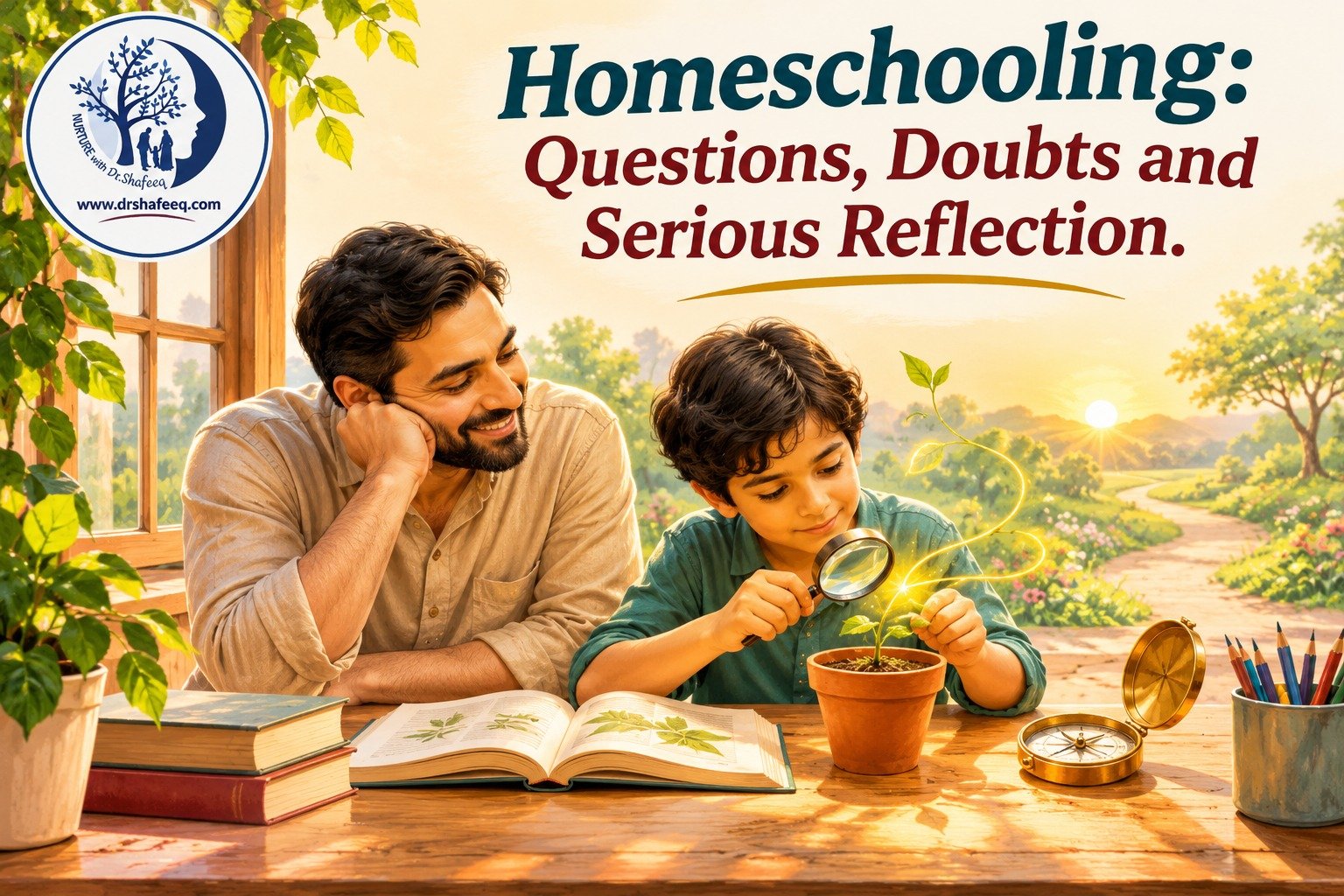
Homeschooling: Questions, Doubts and Serious Reflection
A calm look at Natural Learning
By Dr. Shafeeq Ahmed
Many of us spend ten, fifteen or twenty years of our lives in education. Few of us stop to ask why we are studying, or where education is meant to take us. Ask parents why they send their children to school and the common answers are "Everyone does," or "What will people say if we don't?" In this way, "going to school" and "being educated" have become one and the same thing in our minds.
This piece does not begin by advocating homeschooling. It begins with a more basic question. If the purpose is unclear, how can the path be right, whether it is school or home?
The four purposes of education
In many homes, a good education means the child gets into a good professional college and later earns well. That goal matters, but education is far broader than that. The talk described four purposes:
Discovering potential and building confidence: The Creator has placed immense possibilities within every human being. Our inner universe is as vast as the one outside us. Education should give a child a sense of their worth, self-respect and recognition of their strengths, so that they do not suffer from feelings of inferiority.
A vision of a meaningful life and creativity: These abilities were not given without purpose. Education should help a person understand why they exist and what it means to live as a conscious human being. Otherwise, life shrinks into earning, buying and consuming.
Character building: Education is not merely the gathering of information. It is also the nurturing of a person: someone who does not sell their principles to greed, who knows right from wrong and who stands by their word.
Meeting economic needs: Learning a skill and earning an honorable livelihood is also a purpose of education. But it should come after the other three, not in place of them.
A practical exercise for parents is to look at their child's daily routine and ask how closely it connects to these four purposes.
What a good learning environment looks like
Once the purpose is set, the next question is about method and environment.
A safe environment: The child should feel physically and psychologically safe. Fear, humiliation, fear of failure and constant pressure affect cognitive ability, self-worth, sleep and even health. Children should be treated with respect and trust, and their efforts should be acknowledged.
Freedom from comparison and uniformity: Every child grows at their own pace. One learns to walk early, another later. The Creator made each child different, so demanding identical performance from everyone is unfair. Exams should not keep a child in constant fear.
Protecting the capacity for self-learning: Children learn to talk and walk on their own. They already have a natural capacity to learn. A core principle of education should be to nurture this capacity, not crush it. Children should have chances to read, ask questions, observe and experiment, with help offered when they ask for it or need it.
Balancing self-learning and teaching: It is not necessary to tell a child everything at once. When a child faces a maths problem, first ask what they think and how they might solve it. Then guide them. Teaching and self-learning are partners, not rivals.
Connection to life, nature and family: Education confined to artificial examples misses a great deal. Good education connects a child to real life, the natural world and their family. They should help with household tasks, serve their elders and know their own language, traditions and family history.
Protection from harmful influences: In educational settings, children can pick up bad habits and inappropriate exposure along with knowledge. A good environment shields them from this too.
What homeschooling actually is
A common misconception is that parents set up a school at home, turn themselves into teachers and do everything a school does. That is not the idea. A more fitting term is Natural Learning: learning rooted in a person's innate ability, their experience, observation and connection to life. Humans have learned through life, family and society for thousands of years, while the modern school system is relatively recent in human history.
Several questions come up repeatedly:
How will the child study on their own? A child who has spent years being taught in a controlled, structured setting may struggle at first. The habit of self-learning has to be rebuilt over time. A parent's role is not to teach at every moment. It is to create a good environment, provide books and resources, hold discussions and step in when needed. Children can set their own learning targets and learn from various books.
What about college and university? Homeschooling does not close the doors to higher education. Students can sit for exams such as O Levels as private candidates under various boards and move on from there. It is wise to check the legal requirements and admission conditions in your own country and city beforehand.
How will they make friends? This question assumes that socialization happens only at school. If a family lives in isolation, with little hospitality and weak family ties, children will have few social opportunities wherever they study. Families that visit relatives, friends and neighbors, host guests and bring their children along give them natural opportunities to talk, play and build relationships.
Home environment and daily routine
Natural learning does not mean disorder. The routine can be flexible, but there should be structure. Staying up late, sleeping in the day, excessive TV and a disorganized life do not suit this approach. Parents should:
Keep healthy sleep and wake times.
Give priority to prayer times.
Build physical and outdoor activity into the routine.
Give children time for play and varied tasks.
Plan weekly and monthly activities.
Use screens with care. If the whole household becomes dependent on screens, children's lives start to revolve around them too. Interest in prayer, family conversation, play, reading and sitting with guests can fade. Parents must look at their own habits as well as their children's.
Step out of the age-based race. It is not essential for a child to have mastered particular skills by five, seven or ten. Cultivate a love of learning, offer opportunities and nurture abilities. Coercion and needless pressure do not work. Many parents keep worrying that their child will fall behind even while homeschooling. As long as the child's emotional wellbeing, confidence and peace of mind are cared for, constant comparison is unnecessary.
Nature, hands-on work and character
Some of the most powerful learning happens outside books:
Museums: If one is nearby, take your children. Observation and discussion there teach a great deal.
Gardening: Growing vegetables, fruit or plants at home teaches children about soil, compost, water and weather. It also builds reflection, observation, trust in God, gratitude, patience, calm and responsibility.
Keeping chickens: Where feasible, feeding, cleaning and caring for animals teaches responsibility and brings children close to nature.
Household chores: If a 14-year-old has never washed clothes, washed dishes, polished shoes or helped cook, important life experiences are missing from their education. Serving parents and caring for one's own belongings is part of upbringing.
Success versus a meaningful life
High marks, a good university and a good job may mark a successful professional life, but they do not guarantee a meaningful one. Fame and income do not ensure satisfaction or purpose. Parents should ask themselves whether they are preparing their children only for the job market, or also for good character, confidence, responsibility and human relationships.
We live in a consumer society where life's goal can become earning, buying and acquiring more. In that race, relationships, family and the inner self get left behind. Artificial intelligence will change economic systems further, so parents should think carefully about both the current education system and the future economy before deciding.
Good education frees a person from awe of status and mental servitude. Whether income is low or high, the home small or large, the car new or old, their confidence and trust in their Lord should not waver. A golden handcuff is still a handcuff. An educated person should not be dazzled by outward glitter. They should be able to recognize reality and stand by their values.
A final word for parents
Homeschooling may not be easy or suitable for every family. It demands time, attention, resources and a willingness to improve one's own life. Each family should decide in light of its circumstances, its children's temperaments, legal requirements and future plans. Parents of school-going children can take much from this conversation too, such as reducing pressure, dropping comparison, making room for self-learning and turning the home into a place of learning.
The real question is not which building a child studies in. It is who the child is becoming: a confident, principled, creative and responsible human being who knows their purpose, or merely a collection of degrees and marks.
(Source: ERDC webinar "Ifs and Buts of Homeschooling," speaker Salman Asif Siddiqui. This article is based on the key points of that talk.)
#NurtureWithDrShafeeq
Dr. Shafeeq Ahmed S.M
Pediatrician, child psychologist, parenting coach, and career & life counsellor with over 20 years of experience. Read full bio →